
Kayla L. Mayo, Embry-Riddle Aeronautical University, Daytona Beach, FL
Abstract
The Arctic is becoming a growing region of concern on the national security level, especially as it pertains to United States (U.S.) and the North Atlantic Treaty Organization (NATO) allies on local domestic levels. The aim of this report is to identify international and domestic concerns within this threat, as well as exploring international law as it applies to this region. In doing so, we will examine the background of this threat, the shift in U.S. security policy as this region grew and the resolution of this threat through NATO mediation. With this being a recent risk, it plays a key factor in the new Arctic Sentry Mission which NATO announced in February 2026 as negotiations had settled. Now the goal of the stakeholders within this risk is to maintain this peaceful arrangement while also balancing the burden of Arctic Sentry in addition to outside conflict factors.
Keywords: Arctic, Greenland, NATO, U.S. Security Policy, International Law
Introduction
In looking at active but unexpected threats, the Arctic is becoming an area at the top of several security threat lists. This area is facing security threats all the way around, most immediately from China and Russia, which is in turn causing the United States (U.S.) to become involved as it could immediately become a threat to their national security if the Arctic is overtaken. The threat stems from historically aggressive states staking claims to the constantly expanding Arctic Sea regions, in addition to risking escalation into military action. Building on this concern, is Russia potentially gearing up to become an aggressor towards the U.S. by moving in near Alaska, with nuclear-armed submarines? If so, the U.S. is looking at the potential of customary international law aiding the nuclear defense argument to establish more presence in the region without impeding NATO concerns or severing ties with other states in the region to gain ground. Both sides of this scope show that the security threat can be all encompassing from the threat itself to the response and outcome of this situation.
This report argues that although this is a large power competition between three key players deepens Arctic security risks, NATO-mediated diplomacy through the Arctic Sentry Mission establishes a framework to balance sovereignty, deterrence, and burden-sharing. To visually see geographic concerns, Figure 1 shows a regional map of the Arctic as well as the military bases and sea travel routes which exist as of 2024. Establishing the geography of the area demonstrates the need for NATO to have mediated a peaceful and diplomatic resolution due to the risks these power players would impose on other states shown in Figure 1 if violence were to have been the alternative. This was seen during the Cold War as many of the current sea routes were utilized to move forces through, as were numerous bases shown on Figure 1.
Figure 1
Map of the Arctic, sea travel routes, and its bases.
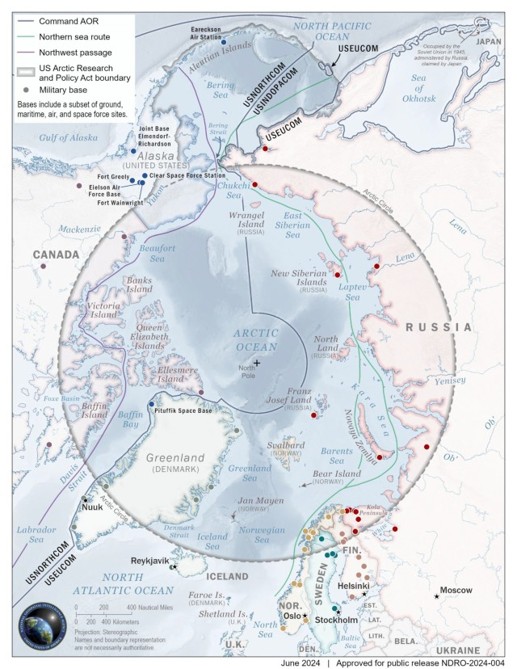
Note. Adapted from the U.S. Department of Defense. (2024). 2024 Arctic Strategy. In U.S. Department of Defense. https://media.defense.gov/2024/Jul/22/2003507411/-1/-1/0/DOD-ARCTIC-STRATEGY-2024.PDF. In the public domain.
Scope of Study
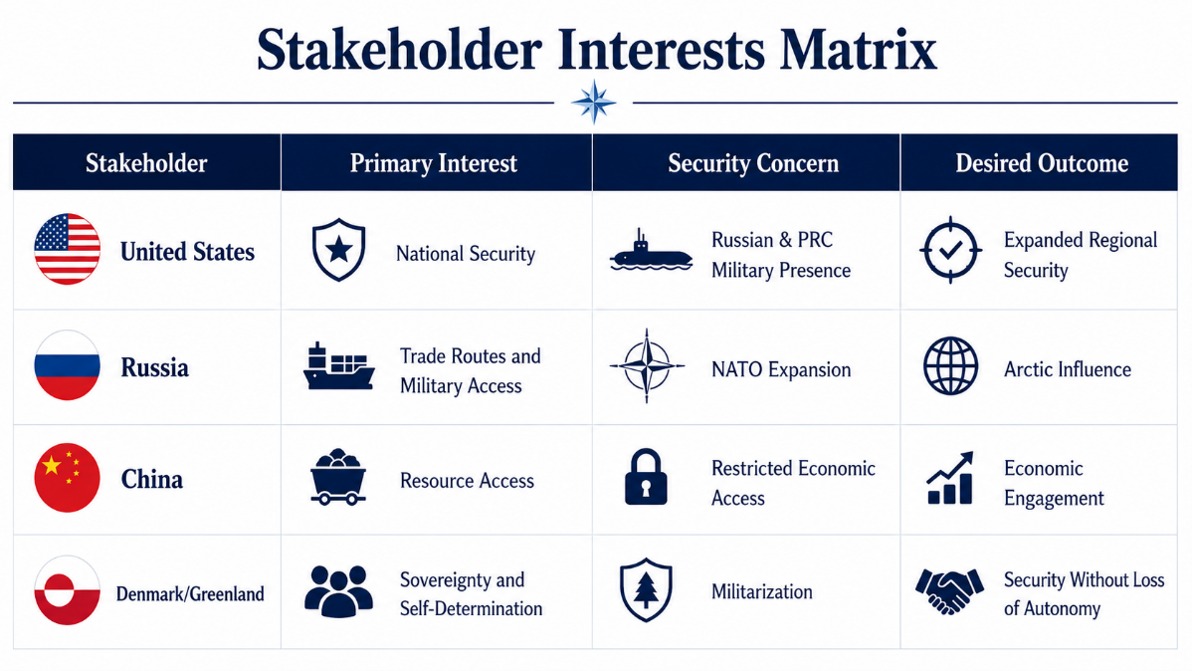
Greenland has remained on the national security radar for years, yet the climate changes occurring within the environment have altered its presence globally. Russia has made a clear point, as they currently control a sizeable portion of the Arctic coast, to utilize these new sea routes forming for nuclear armed submarines and the maritime trade boom that will occur within the region (U.S. Office of the Director of National Intelligence, 2025). China at the same time, is pushing to utilize these newly opened natural resources along Russia’s coast, pushing to expand trade routes here and shift the natural energy dependence (U.S. Office of the Director of National Intelligence, 2025). The U.S. becoming involved has created distrust among numerous allies. The North Atlantic Treaty Organization (NATO) being one, due to the U.S. pulling away from NATO goals to focus on state interests within the region ahead of Russia and China’s potential involvement (Danish Defence Intelligence Service, 2025). This is the overall reason for the involvement of the U.S. as the Arctic borders up against one of their states as well as military bases in the region, in addition to this region being deemed a new “battleground” (De Arimatéia da Cruz, 2025). People’s Republic of China (PRC) is not the true aggressor to be examined here, as they have clarified their role in the Arctic being purely focused on the resources available, and it has been established their presence in the region is due to Russian ties (U.S. Department of Defense, 2024). The overall complexities of the stakeholders within this security concern can be seen in Figure 2, even looking at each state’s interest and end goals.
Figure 2
Visual of the stakeholders within this threat and their concerns.
Note. Visual was created with the aid of OpenAI ChatGPT based on the analysis within this report.
Although these tensions are not new, it has shifted and such requires the U.S. Department of Defense to do the same in the strategy implemented within the region. The current strategy within the region looks at balancing the challenge of the People’s Republic of China (PRC) and Russia with engaging allies within the region and maintaining presence there (U.S. Department of Defense, 2024). This specific region requires policy adaptations as two of the states within the regions joined NATO after the Russia-Ukraine war, due to the ever-growing presence of the Russian military in the region over the last several years (U.S. Department of Defense, 2024). Due to this concern, this will be where the scope of our study begins, as this is when the U.S. first truly identified the potential threat this region by then President Trump in 2019 (Curtis & Fella, 2026). When examining this security threat, we must consider stipulations within international law, more so the International Court of Justice, concerning the threat of use of force as the U.S. and Russia both have done so within the last year. Other areas here will be examining NATO as well as the UN Charter they abide by within conflict. Later, we will be reviewing the overall international institutions involved as well as determining the role of domestic versus international law within this security threat.
Background
Greenland and the Arctic have been a region well targeted for years due to the vast and prosperous minerals found there (Curtis & Fella, 2026). Climate change has opened new areas of unanticipated sea travel, becoming accessible for expanded ship and submarine travel within the region. This has created a new region for other states, Russia specifically, to move in with more of a presence via sea on the United States. It also brings into consideration a new area of territory to control who and what may travel through, especially with previous years of sea travel within set lanes and territories. However, this security threat seeks to consider the concerns with Russia reactivating Soviet-era bases to provide more of a military presence in the region towards Denmark and Greenland (Butler, 2026). This point further shows the concern with Russia moving in on the territory and backs up the issue of Russia being a threat to Greenland, and by extension Denmark (Curtis & Fella, 2026).
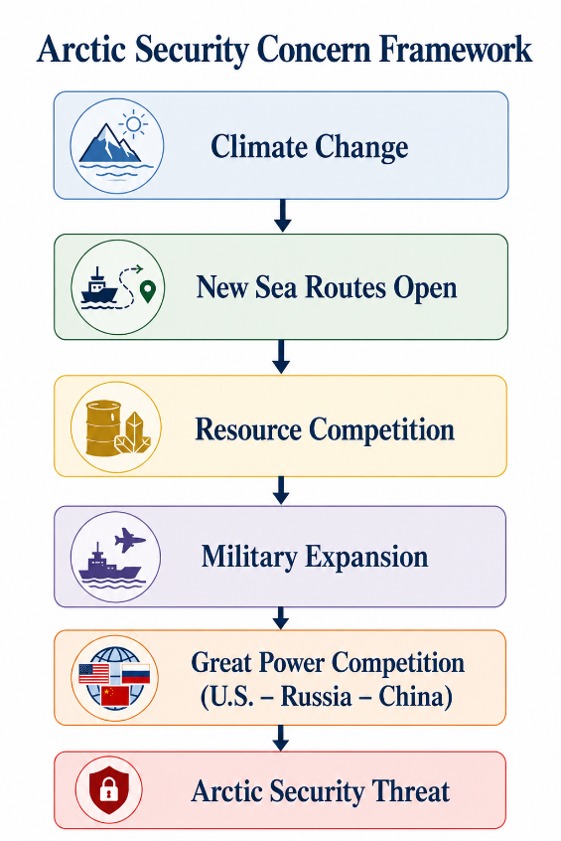
Now, to fully understand the impact this security threat has with Russia moving in, first it must be understood that Greenland falls within the control of the Kingdom of Denmark. Greenland has control over portions, but the scope of the defence policies, and foreign affairs fall within Denmark’s control due to Greenland being a Danish territory since 1953 (Fella, 2026). This means that Denmark has the final say in what may or may not be interpreted as a threat for Greenland, which is part of the reason for the U.S. becoming involved and identifying Russia as a potential aggressor within this region (Curtis & Fella, 2026). Another portion of this security threat ties into the long-standing power struggle between the U.S., Russia, and China in recent years, but most specifically between the U.S. and Russia (Pincus, 2020). This region has long been an ideal area for the rivalry to fully grow, especially with Russia and the U.S. sharing borders to this sea-based territory as well as the potential for transportation route control via military force (Pincus, 2020). These growing tensions push the need for legal frameworks and foreign policy intervention to manage the growing Arctic security concerns as seen in Figure 3.
Figure 3
Framework of the Arctic Security Threat.
Note. Visual was created with the aid of OpenAI ChatGPT based on the analysis within this report.
International Law and U.S. Foreign Policy
International Law
When it comes to security threats, legalities are the next steps to be considered and within the Arctic the first world of law is international law. International law has several layers that could aid in this threat, especially with the considering of Greenland falling within the scope of Denmark’s control and the alliances or memberships gained from that. From this, the United Nations as well as NATO come into play, with both having treaties or charters that pertain to what is expected of member states as well as use of force. The U.S. is signatory to the NATO Treaty, deeply mentioned within most articles specifically and with Denmark being the member extending membership to Greenland by default. The same can be said for the UN Charter, as Denmark extends membership to Greenland and the U.S. maintains member status as well. A final consideration looks at the European Union, which the U.S. is not a member of, and the Council of Europe, in which the U.S. does observe some agreements made. This shifts the focus to specifics; Article 2 Section 4 of the UN Charter which covers use of force or threat against territorial integrity or political independence of any state, manners inconsistent with the purpose of the UN (United Nations, n.d.). NATO Article 1 reiterates the same statement but adds in the factor of not endangering international peace and security, looking to solve disputes by peaceful means (The North Atlantic Treaty, 1949). The threat of force itself is considered customary international law, making it applicable to all states regardless of member status. In looking at how this impacts the U.S. regarding enforcing these treaties, the U.S. has ratified them by making itself a signatory member to oblige by their verbiage. Thus, this opens the door to the International Court of Justice (ICJ) to become involved if the threats of force on Denmark and Greenland had continued, allowing international law to step in upon violations of treaties.
So where does that leave other legal concerns within this threat? The large international law factor here goes back to the legalities of Greenland’s sovereignty through Denmark. This is where the push from the UN factors in to force the U.S. to acknowledge the right to self-determination here, as well as international human rights (United Nations Human Rights Office of the High Commissioner, 2026). Self-determination is discussed within Article 1 of the International Covenant on Civil and Political Rights, in addition to being noted several times throughout the UN Charter (United Nations Human Rights Office of the High Commissioner, 2026). This does not mean that the U.S. is not obligated to abide by this as well, as the U.S. is also signatory to this convention in addition to the UN Declaration on the rights of Indigenous Peoples, which many reside within Greenland (United Nations Human Rights Office of the High Commissioner, 2026). This also applies to the concerns on military involvement from outside states or governments, even with our current existing agreements with Denmark and by default Greenland. Here there are a few precedent scenarios similar regarding acquiring another state’s territory as the U.S. is attempting to do with Denmark for Greenland. Two examples as Schmit and Bridgeman (2026) point out are the U.S. acquiring Louisiana from France and Alaska from Russia. Additional limitations to this expansion are from the Declaration on Friendly Relations which also addressed state acquisition. This is done through use of force; which the ICJ also set precedents for in the 1986 Frontier Dispute Judgement where it was ruled states can have effective control over a territory but do not acquire the title if it was done so unlawfully” (Schmit & Bridgeman, 2026). This also pulls into play the Montevideo Convention on the Rights and Duties of States which directly addresses the current concerns the UN and EU have against the U.S. regarding military occupation in Greenland lawful or unlawful (Schmit & Bridgeman, 2026). Leaving this threat unmitigated opens the door for states to take territory by force or even show of force, by overwhelming military presence as show of force per the UN Charter, which should not be left unchecked. In the past states have responded to such force, yet it is not being managed that route this time which leaves the impression of weak governance and opens the opportunity for other states to step in on their behalf to protect the human security in the region. Throughout the rest of this report, we will examine the domestic side of law and how specific foreign policies as well as other international institutions play a role within this threat.
U.S. Foreign Policy
Now that we know the scope of international law within this threat, the next legal scope is U.S. policy on foreign affairs. Historically there has been a great relationship between the U.S. and Denmark, especially with the convention which allowed the purchase of the U.S. Virgin Islands, previously the Danish West Indies (Curtis & Fella, 2026). However, the U.S. making the threats of use of force to acquire Greenland has stressed this relationship, not just with Greenland but Denmark and even NATO members. The current administration for the U.S., President Donald Trump, first served in office previously starting in 2017. Later in his first term, around 2019, President Trump proposes the concept of acquiring Greenland to help foster U.S. security but does not move further than proposition of the idea. The overall large concern during his first term of office is the concern of Russia and our European allies as the Russia-Ukraine aggression slowly kicks off. This set the tone for the shift that occurred within U.S. policy after the term, as it became clear on the global level of security that Russia was amping up to become a larger security concern than anticipated. Part of this new shift is due to the 1823 Monroe Doctrine, which identifies Western Hemisphere problems as part of the U.S. responsibility to manage and mitigate, where previously the Arctic was not deemed within our sphere to oversee (Jacobsen & Olsvig, 2024). President Trump as well as Secretary of State Mike Pompeo warned the Arctic Council in 2019 of the growing threats to their security, pushing to making the region safer as well as urging them to pushback against outside threats not exclusive to the mineral interest in the region but territorial control (Jacobsen & Olsvig, 2024). The perceived goal was to examine the upcoming global threats that Russia as well as China posed, if they managed to get a foothold in the region, but especially for the U.S. due to Russia destabilizing other state governments (Jacobsen & Olsvig, 2024). This led to aligning security goals with the Arctic, Greenland, and Thule Air Base, but the prioritization lacked due to concerns with Iran (Jacobsen & Olsvig, 2024).
Between President Trump’s first and current administration, President Joe Biden, takes a deeper look at the Arctic within his National Security Strategy of 2022. This administration goes into a bit more detail between the combination of National Security Strategy and the National Defense Strategy issued by the DOD during Biden’s time in office. The administration also addressed the common concern of climate change and impacts it poses in the Arctic region as that is the cause for the region opening with more accessible areas via sea travel than previously known (Biden, 2022). However, President Biden’s strategy identifies the growing Russian occupation within the Arctic and the concern of growing military presence in the region which can be seen in the timeline in Figure 4. The solution posed here was the increase in maritime security, but leaving the larger security control up to the Arctic nations as per self-determination and their right to defend their territory (Biden, 2022). The DOD showed that the U.S. would be partnering closer with allies in the region, and Canada to further these goals of securing the region through maritime domain awareness (U.S. Department of Defense, 2022). Yet this was not a priority task for the U.S. administration as the Russia-Ukraine war had broken out as had other regions overseas, although the Arctic was heavily monitored.
Figure 4
Timeline of the security threat leading to resolution plans.
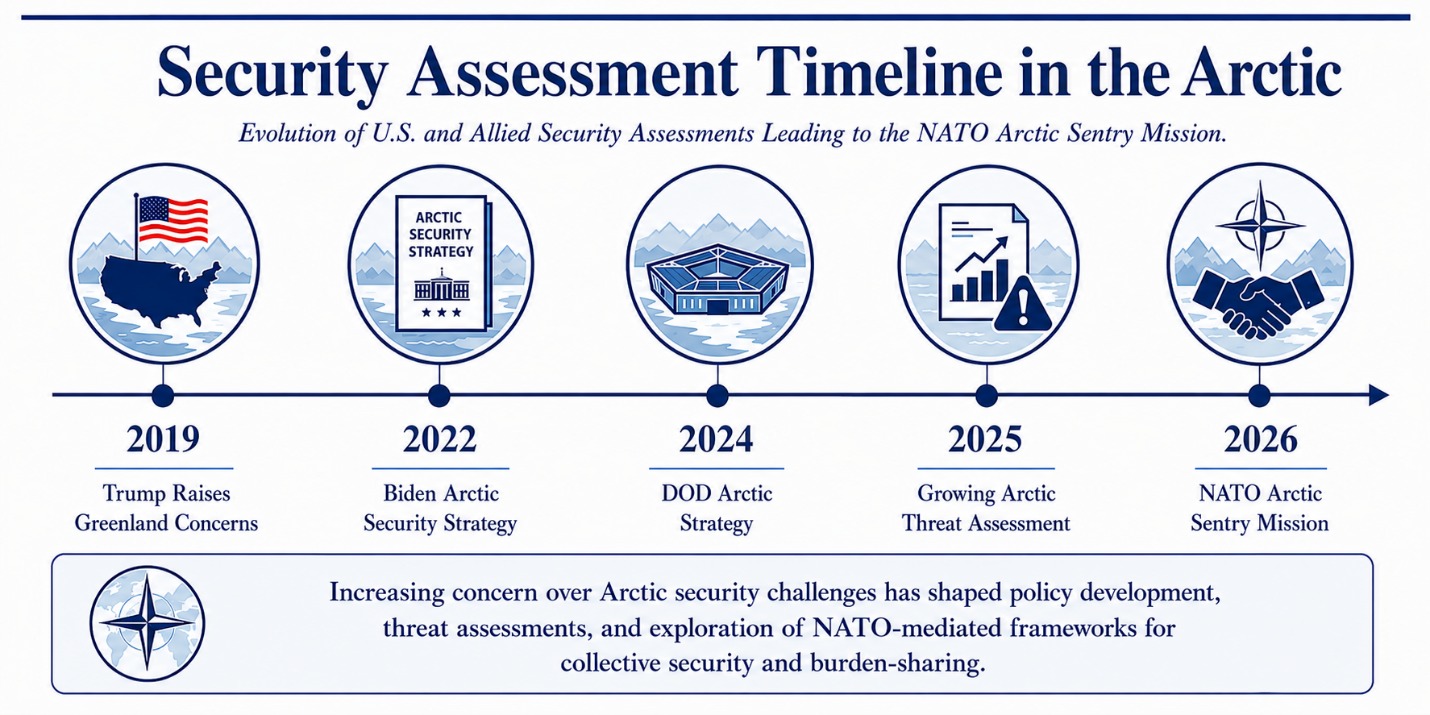
Note. Visual was created with the aid of OpenAI ChatGPT based on the analysis within this report.
Presently, security goals are pushing the usage of the Monroe Doctrine in the aspect it was first set out to do, helping to use the U.S. as the large-scale power player to keep assets secure in the Western Hemisphere. However, concerns lie with the period between 2019 to now, as Greenland rejected Denmark’s wants to increase military presence to secure the region (Jacobsen & Olsvig, 2024). This is also true due to the current administration instilling tariffs against NATO states who disapprove of the acquisition of Greenland, specifically eight of them (Fella, 2026). These specific countries backed Denmark in the reconnaissance exercise earlier this year, which was intended to be a form of show of force (Fella, 2026). Though, later in January 2026 President Trump recalled the extra tariffs due to the potential of a deal to increase military presence within Greenland without acquisition of the territory, with Denmark being open to the idea and further talks to settle the terms (Fella, 2026). Now we will shift to look at the overall international institutions involved, and how these have or have not worked in addition to domestic law to mitigate this threat. While international law and foreign policy set up the framework, international institutions play a critical role with enforcing these norms, aiding diplomacy and further mediating the security risk in the Arctic.
International Institutions and Resolution
International Institutions
Since this threat is on an international level, with several states involved, there are several international institutions also at play due to the membership of these institutions as active or signatory members. This threat has seen large involvement from NATO, as this international organization has been the force the U.S. has been working with, and at times against trying to nullify the threat. NATO has set guidelines through the North Atlantic Treaty which active members acknowledge upon gaining membership status, and these standards then apply for all actors and parties involved. This treaty also works to establish a sense of responsibility within the scope of warfare, negating peace is the answer in lieu of violence or the threat of violence (The North Atlantic Treaty, 1949). NATO then goes as far as to prescribe peace, in lieu of war for its members in addition to proscribing use of force against its members as well. NATO is known for its collective defence, under Article 5, which notes that an attack on one state is an attack and all and they will acknowledge it as such (NATO, 2025). NATO’s treaty ties into the United Nations (UN) Charter as well, bringing in a second international organization to monitor and intervene in conflict as well. NATO and the UN work alongside each other, as acknowledging the NATO Treaty also acknowledges the commonality of maintaining peace among everyone within any position in life or political standing (The North Atlantic Treaty, 1949). Bringing in the UN also brings in the United Nations Security Council regarding this threat, allowing for further interventions and decisions to be made. These three institutions play the larger role, especially with the U.S. being a large NATO backer, with much of the treaty referencing the U.S. specifically. These treaties and charters as well as the council prescribe how states are meant to manage conflict in numerous ways, the ultimate focus being peaceful methods. All three organizations have strict guidelines on the threat or use of force, as it constitutes what can be done in retaliation for response to force, specifically all three proscribe the use of force. Exclusively, Article 2 section 4 of the UN Charter addresses the force concerns, through the International Court of Justice (United Nations, n.d.; Handel-Mazzetti & Zwanenburg, 2026). However, the last international organization, the International Court of Justice (ICJ) stands to aid in the final legalities of what constitutes force or threat of force (Butler, 2026). This is where customary international law comes into factor as well, as all these institutions are signatory to customary law. In addition to the UN, with Denmark having oversight of Greenland, this brings another institution into play, the European Union (Fella, 2026). This institution shares similar end goals with the UN, NATO, and ICJ, all to maintain peace and resolve conflict with the absence of violence.
To provide some clarity on the Arctic’s internal attempts at mediating, the Arctic Council has tried to manage the concerns between Russia and NATO previously (Butler, 2026). Yet the problem for them is that they do not exclusively address military concerns, and this threat is deeply tied into military forces moving into the region. This could partially be linked to how NATO has oversight of the Greenland-Iceland-United Kingdom (GIUK) gap which allows some control over Russian forces moving in (Butler, 2026). This allows for some oversight with the forces, even with the Russians reactivating soviet era bases to try to establish themselves deeper in the region (Butler, 2026). Looking at international institutions, the largest factor may lie with the Arctic Council, an informal alliance, especially considering Denmark, the U.S. and Russia all share seats within the council unlike with NATO and the UN (Arctic Council, n.d.). Although they cannot make enforce guidelines and they exclude military security, the largest sway may be held within the working groups and member states associated. These work to maintain environmental safety and health as well as response to emergencies if needed, which could aid protecting the territorial security especially if Russia does have plans of moving in with nuclear submarines which could further endanger the marine environment there. All the international institutions mentioned rely on each other to cohesively make decisions as well as not to undermine one another on said decisions. The Arctic Council specifically is reliant on international organizations which can enforce guidelines and recommendations, as the UN and NATO are as well, leaving the ICJ and UN Security Council as the higher powers here to make the call on when enforcement needs to be followed up with to be sure the threat is not spreading. Lastly, we will shift to examine how international and domestic law intermingled to mitigate the threat as well as other areas of overlap or lack of overlap between the two.
International law and U.S. domestic law have both worked to be sure that the Arctic remains secure yet there is only so much that can be done by either legal scope. Both have tried to mitigate the threat, however neither have been able to fully determine or deter the immediate Russian military presence in the region. A large scope of the studies completed in the Arctic center around climate change concerns, as Briggs (2020) points out, this opens the door for the usage of proxies in hybrid warfare areas where climate change is prominent. Proxies do not necessarily have to be another actor, it can also be “masking of identity and goal…not admitting attribution even in cases where actions are linked to the government” (Briggs, 2020, pp. 46). This is part of the concern with Russia’s presence within the Arctic which international and domestic law are lacking in mitigating. Russia was identified to be a threat within the Arctic, even with the visible goal being tied to the Arctic oil and gas reserves, yet the more unexamined portion by the legal scopes ties to the ability to push nuclear-armed submarines into important naval routes connecting to the Atlantic (U.S. Office of the Director of National Intelligence, 2025). Yet if this is left unchecked, then Russia could grow to become a larger threat globally with its military presence now having access to Atlantic and Pacific naval routes which, contributed to why Finland and Sweden joined NATO in 2024 due to the looming risk (Cotta, 2024). On the opposite side, from Russia’s perspective this increased military presence is to be sure that shipping lanes maintain security in addition to their own economic interest affiliated with these. This same method allows Russia to balance the relationship with local NATO allies which border these shipping lanes and makes their movements more defensive than aggressive from their view.
This shifts to looking at the Arctic overall, this region being highly competitive when it comes to resources all the way back to the Cold War, specifically tied to oil and gas (Cotta, 2024). This trade-off of resources drives the need for added militarization and trade routes, yet on the same note they damage the fragile ecosystem of the Arctic itself. Which adds to the push from many to keep the extra sea traffic and added members at bay, as policy can only do so much to preserve the fragile underwater ecosystems which foster these resources. The combination of concerns for the resources to be gained and territory control, adds to the fact that Russia as well as China both pose a concern with moving into the region bordering up to the U.S. However, this also branches into other obstacles faced in the region, such as the concept of self-determination in which Greenland encompasses, and the growing hostility in the region since the start of the Russia-Ukraine war (Cotta, 2024). In this aspect, U.S. policy has not aided in addressing these concerns but merely opened the door to add to the militarization concerns many natives are facing in Greenland, much to their own dismay even though Denmark agrees with the increased presence (Cotta, 2024). This attribute alone is the largest concern for the sizeable Indigenous community as well as many Greenlandic leaders. Even with Denmark pushing for the expansion of military cooperation, this does not mean that Greenland agrees due to the concerns of infringing on the self-determination they have always known. Although the largest changes did not occur until the last year, with President Trump really pushing to get a foothold on the problem, albeit the policy was rocky in the beginning with tariffs and vocalized threats of force. This did put a spotlight onto the security concern, which was not there in previous administrations, purely seeming to be placed at a lower risk on the global scale, due to larger problems such as Iran and the Russia-Ukraine war. Part of the reasoning behind this current administration could also be tied to the fact that on the scale of state power, the U.S. has always been one of the top contenders but as of late appeared to be weakening with others moving in on neighboring territory (Fakhoury, 2025). This is seen in the aspect of how U.S. policy treated the Arctic and Antarctic as one within policy, even combining Alaska in, until finally the Arctic Council formed, splitting the two within U.S. policy (Fakhoury, 2025). This paradigm was the shift in which the U.S. finally looked at the region as a prime area for maintaining security even with low threats at the time of the council forming (Fakhoury, 2025). Now the concern, even with the Arctic Council working groups able to monitor the concerns on the ground of the people within Greenland as well as climate change programs, how do the combat the imposing Russian military threat? Part of that is to continue with the current agreement allowing more NATO member states access to fall within Article 5 as the Russian and PRC militaries move in, and be the military backing needed to maintain their self-determination. Another part is to allow a wave of new agreements, with consideration to Denmark, allowing the alliance via military forces to continue and potential for expansion of current U.S. bases so that forces may be better prepared to provide aid if needed. Keeping the legal frameworks in mind as well as the international institutions, NATO has played a large role in maintaining diplomacy and pushing this security concern towards a peaceful resolution.
Resolution Tactics
Attention now turns to the resolution framework which came about earlier this year through the help of NATO as well as many other key actors. Greenland, Denmark, the U.S., and NATO have all come to a framework for an agreement within this security concern at the behest of working together in lieu of against each other (Hadley & Kramer, 2026). Specifically, NATO pushing for the urge to remain within the treaty guidelines of non-violence. We can see this in the new military mission NATO has labeled “Arctic Sentry” aiming towards shared labor between all of NATO’s partners (Hadley & Kramer, 2026). This is fully in response to the framework of negotiations being brokered between Denmark, Greenland and the U.S. by NATO which works to maintain Greenland’s sovereignty (Hadley & Kramer, 2026). To elaborate, the new framework is intended to build upon the existing military agreement between the U.S. and Denmark, the 1951 Defence Agreement, which will allow more of a military presence without infringing on sovereignty issues (Hadley & Kramer, 2026). The intention behind this is to breakdown the burden of Arctic security among all NATO members from the U.S. to Canada rather than place it all on one state or alliance specifically. With this said, the intention from NATO also seems to be to establish more of a defense within itself, to build upon what has been pointed out to be lacking and appropriate funding towards it (Hadley & Kramer, 2026). This change satisfies President Trump’s demands for NATO to step up in defense of its members, as well as providing further protections which Denmark and Greenland benefit from as well. NATO emerged the primary diplomatic mediator, distributing the burden equally among all who stand to be impacted should Greenland go to war with Russia or even China over territory. Although it is not fully what the U.S. wanted out of this, it satisfies the needs of the many involved by appropriating funding and military resources as well as allowing NATO to share the military burden with allies as seen in Figure 5.
Figure 5
Burden distribution with the Arctic Sentry Mission.
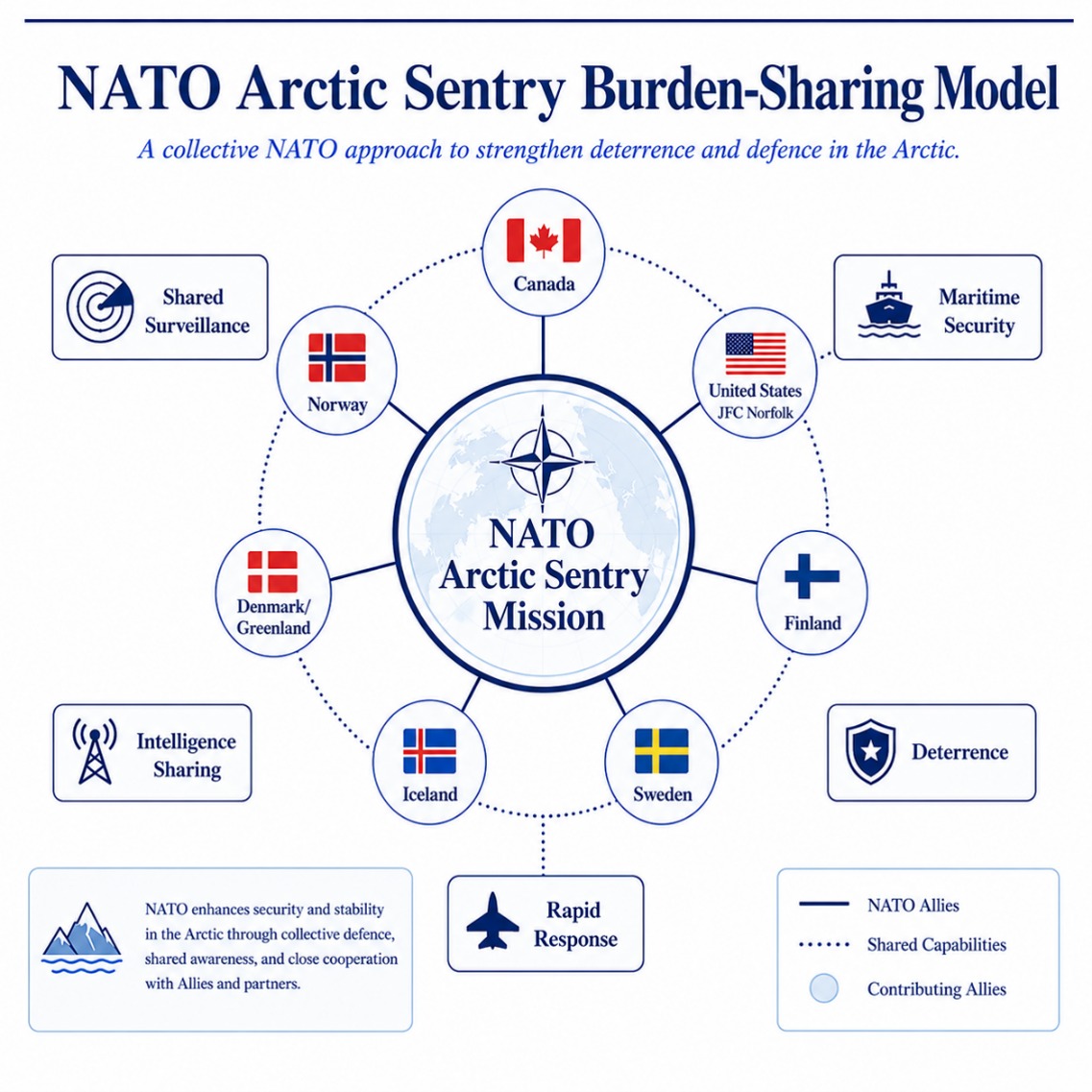
Note. Visual was created with the aid of OpenAI ChatGPT based on the analysis within this report.
Having established the resolution reached, the newer information on where this intends to go is still emerging due to the shift within the Middle East as the U.S.-Iran concerns have taken the forefront. This does not go to say that the Arctic is at the bottom of the agenda, but now that NATOs Arctic Sentry Mission in action allowing multiple militaries to work in unison and maintain the region’s security the focus has shifted on the U.S.’s agenda. NATO remains fully focused on the Arctic as the mission at hand allows full operational control and the ability to increase their own presence there as a deterrent against Russian or PRC forces (NATO, 2026). Part of the reasoning for this is due to NATO’s maintained interest and previous concerns with Russia regarding portions of the Arctic, which did not have significant impacts on the U.S. Perhaps it can also be tied to the concept of strategic competition; NATO racing to maintain the advantage they have geographically within the Arctic compared to Russia and even the U.S. which demands they defend it against those who would seek to take it causing the reconstruction of older defense mechanisms (Duffy et al., 2025). Nevertheless, this has been a security risk which bordered into the potential to become violent but settled through traditional methods of negotiations with NATO mediating to maintain the goal of peace. Now the focus can return to maintaining the peace and sense of order within NATO and its allies as they move forward with the laid framework to protect the regions of its members.
Conclusion
The Arctic is a region that is environmentally changing, thus leading to security concerns as the region is shifting to become a battleground among several states. While it is still a newly examined security threat due to the recent uptick in U.S. and Russian movements, it is a region that has been on the radar for several years with previous strategic reports outline for security concerns. NATO allies remain within the common goal of backing each other without the use of force as per the UN Charter and obligations they face. However, this does not suffice to fix the growing concern of looking at a region at risk of territory being overtaken via force, whether it be voiced ahead of time or done so silently. This could be further explored with how the U.S. has made impacts within Venezuela as well as Iran over the last several months, potentially allowing for more exploration of the legalities of the Monroe Doctrine as well as human rights law updates.
References
Arctic Council. (n.d.). About the Arctic Council. https://arctic-council.org/about/
Biden, J. (2022). National security strategy. In Office of the Secretary of War Historical Office. The White House. https://bidenwhitehouse.archives.gov/wp-content/uploads/2022/10/Biden-Harris-Administrations-National-Security-Strategy-10.2022.pdf
Briggs, C. (2020). Climate change and hybrid warfare strategies. Journal of Strategic Security, 13(4), 45–57. https://www.jstor.org/stable/26965517
Butler, R. (2026, February 10). Atlantic chokepoint, cognitive front: Russian influence operations and the GIUK gap. The Arctic Institute – Center for Circumpolar Security Studies. https://www.thearcticinstitute.org/atlantic-chokepoint-cognitive-front-russian-influence-operations-giuk-gap/
Cotta, F. A. (2024). Navigating Arctic realities: Geopolitics, security, and climate change. IL Politico, 89(1), 260. https://www.jstor.org/stable/48795094
Curtis, J., & Fella, S. (2026). President Trump and Greenland: Frequently asked questions. In House of Commons Library. UK Parliament. https://commonslibrary.parliament.uk/research-briefings/cbp-10472/#:~:text=It%20adds%20%E2%80%9CGreenland%20is%20the,UK%20(GIUK)%20Gap%E2%80%9D.
Danish Defence Intelligence Service. (2025). INTELLIGENCE OUTLOOK 2025. https://www.fe-ddis.dk/globalassets/fe/dokumenter/2025/-fe-intelligenceoutlook-25-.pdf
De Arimatéia da Cruz, J. (2025). The Arctic in the new geopolitical context of the twenty-first century. Journal of Advanced Military Studies, 16(1), 137–154. https://www.usmcu.edu/Portals/218/JAMS_Spring%202025_16_1_daCruz.pdf
Duffy, R., Matisek, J., McKenzie, J., & Pillai, C. (2025). NATO’s long cold front: Why NATO must reorganize its approach to defending the European high north. Journal of Advanced Military Studies, Special Issue 2025, 78–98. https://muse.jhu.edu/article/967385
Fakhoury, R. (2025). What is the Arctic to the United States? Status anxiety, ontological security, and the evolution of U.S. Arctic policy. Polar Record, 61. https://doi.org/10.1017/s0032247425100168
Fella, S. (2026). Greenland: Home rule, new international relations and U.S. interest. In UK Parliament House of Commons Library. https://commonslibrary.parliament.uk/research-briefings/cbp-10234/
Hadley, S., & Kramer, F. (2026, January 26). Resolving the Greenland challenge through shared responsibility – Atlantic Council. Atlantic Council. https://www.atlanticcouncil.org/dispatches/resolving-the-greenland-challenge-through-shared-responsibility/
Handel-Mazzetti, L., & Zwanenburg, M. (2026, January 26). The prohibitions of threat of force revisited: Greenland, credibility and international law. EJIL: Talk! https://www.ejiltalk.org/the-prohibitions-of-threat-of-force-revisited-greenland-credibility-and-international-law//
Jacobsen, M., & Olsvig, S. (2024). From Peary to Pompeo: The history of United States’ Securitizations of Greenland [eBook]. In Greenland in Arctic Security:(De)securitization Dynamics under Climatic Thaw and Geopolitical Freeze (pp. 107–148). University of Michigan Press. https://doi.org/10.3998/mpub.12676130
NATO. (2026, February 16). Arctic security. https://www.nato.int/en/what-we-do/deterrence-and-defence/arctic-security
NATO. (2025, November 12). Collective defence and Article 5. https://www.nato.int/en/what-we-do/introduction-to-nato/collective-defence-and-article-5
Pincus, R. (2020). Three-way power dynamics in the Arctic. Strategic Studies Quarterly, 14(1), 40–63. https://www.jstor.org/stable/26891883
Schmitt, M., & Bridgeman, T. (2026, January 22). The insurmountable legal obstacles to U.S. acquisition of Greenland. Just Security. https://www.justsecurity.org/129374/legal-obstacles-us-greenland/
The North Atlantic Treaty. (1949, April 4). NATO. https://www.nato.int/en/about-us/official-texts-and-resources/official-texts/1949/04/04/the-north-atlantic-treaty
United Nations. (n.d.). United Nations Charter (full text) | United Nations. https://www.un.org/en/about-us/un-charter/full-text
United Nations Human Rights Office of the High Commissioner. (2026, January 14). Greenland: UN experts urge United States to respect international law and right to self-determination [Press release]. https://www.ohchr.org/en/press-releases/2026/01/greenland-un-experts-urge-united-states-respect-international-law-and-right
U.S. Department of Defense. (2022). 2022 National Defense Strategy of the United States of America. In U.S. Department of Defense. https://media.defense.gov/2022/Oct/27/2003103845/-1/-1/1/2022-NATIONAL-DEFENSE-STRATEGY-NPR-MDR.PDF
U.S. Department of Defense. (2024). 2024 Arctic Strategy. In U.S. Department of Defense. https://media.defense.gov/2024/Jul/22/2003507411/-1/-1/0/DOD-ARCTIC-STRATEGY-2024.PDF
U.S. Office of the Director of National Intelligence. (2025). Annual Threat Assessment of the U.S. Intelligence Community. In U.S. Office of The Director of National Intelligence. https://www.dni.gov/files/ODNI/documents/assessments/ATA-2025-Unclassified-Report.pdf

Kayla Mayo is an operations and training professional with experience in law enforcement, legal administration and public service. Her background includes operational support, training coordination, compliance management, and organizational development. She is currently pursuing a Master of Science in Security and Intelligence Studies at Embry-Riddle Aeronautical University.
Outside of her professional and academic pursuits, Kayla enjoys reading, exploring new craft projects, hiking, and spending time with family. Through her involvement with the NATO Veterans Initiative (NAVI), she hopes to build on her legal and public service experience while expanding her knowledge of international organizations and emerging global security challenges.