
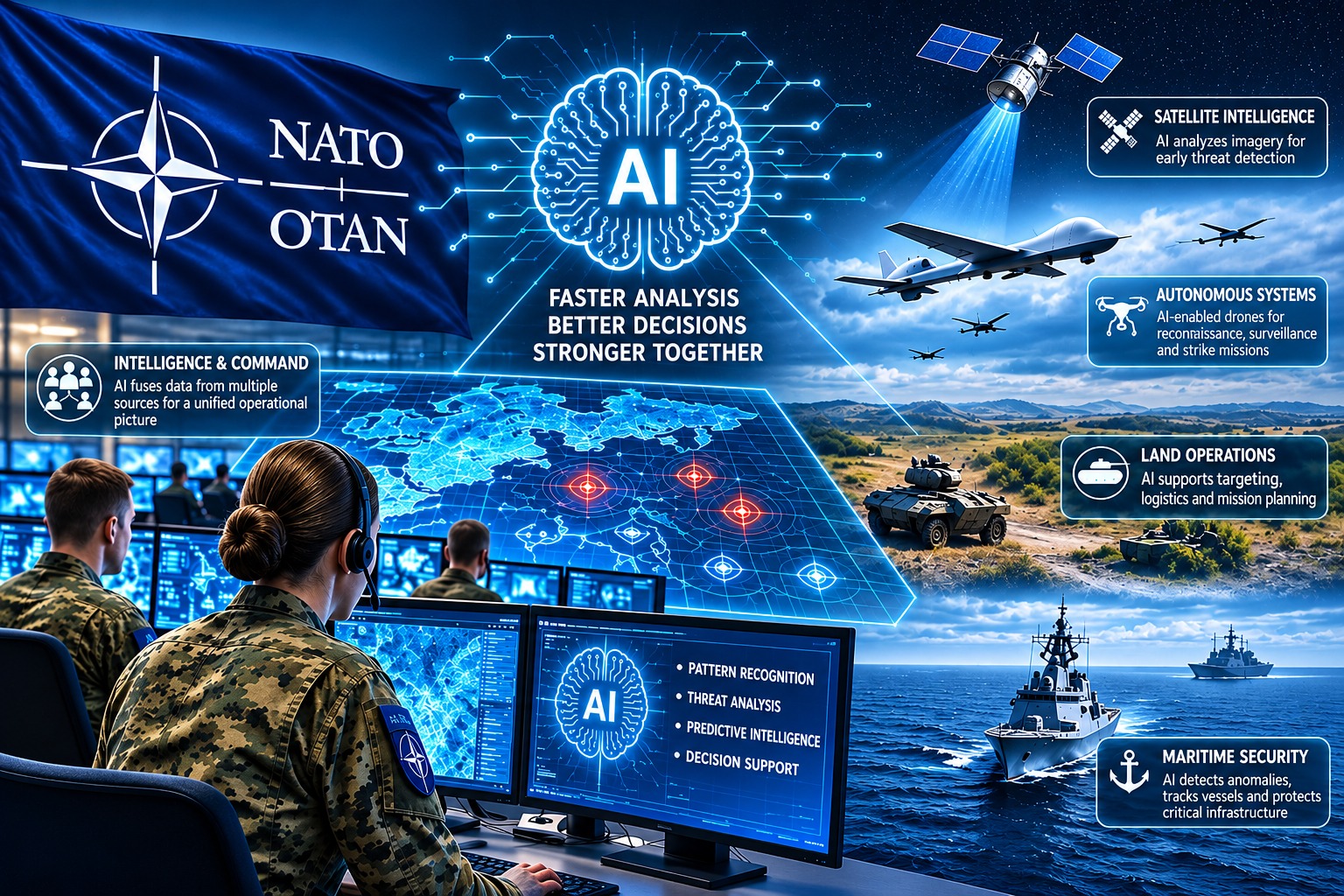
In 2020, I wrote a book titled Humans, Machines, and Data: Future Trends in Warfare,[1] published in 2021. It offered a comprehensive analysis of the technologies and strategies shaping how future conflicts are waged. It examined drones, artificial intelligence, quantum computing, cybersecurity, biotechnology, cyborgs, robotics, and other technologies and scenarios. I made a number of predictions in the book – many that came true and some that didn’t.
I thought it would be an interesting exercise to share my predictions to see what happened five years later, in 2026. Let’s take a walk through the book to see how prescient I was in 2021.
Drones and Unmanned Vehicles
Prediction in 2021: War will become gamified, with regular targeted assassinations by drones that will be much easier in the future. Leaders can say a few words, followers can press a button, and drone strikes will become like a video game. Page 23.
Outcome in 2026: Just in the first year of President Donald Trump’s second term of office, the United States has conducted hundreds of drone strikes around the world. In May 2026, “U.S. 4th Fleet and U.S. Naval Southern Command recently tested the use of drones and artificial intelligence to track and target suspected narco-boats and counter transnational organized crime.[2] Vladimir Putin, Volodymyr Zelensky, and Benjamin Netanyahu regularly order drone strikes against humans.
However, this may not mean that the process of assassination by drone has been gamified, but it does show that drone use to eliminate human targets has become widespread and easier for heads of state. Usage does not necessarily create a surprise, but it does have an asymmetric effect.
Development Assessment: Partially Realized
Prediction: Drone-on-drone warfare with “hard kill drones” will be a common occurrence. Page 161.
Outcome: First-Person View (FPV) drones used by Ukraine are physically destroying Russian drones with “hard kill” kinetic ramming in the air. Specialized interceptor drones are prevalent. As of this year, the United States is using the low-cost remote-controlled combat attack systems (LUCAS) in the Middle East against Iranian drone targets. LUCAS is based on “reverse engineering Iranian Shahed-136 technology.”[3]
Development Assessment: Realized.
Prediction: The human mind will control drones in the future. Page 160.
Yes, China has been working on this since 2024. A paper by Pe Shin Lu and Li Wei Ko,[4] “A Brain-Computer Interface Drone Control System Based on Human Cognitive Assessment,” outlines a system that “receives and analyzes electroencephalography (EEG) signals to determine drone-control commands,” using an 8-channel wearable EEG headset.
In 2025, Divya Darsi et al. presented[5] a “Deep Learning for Brain Computer Instrumentation” system that uses EEG signals to generate drone control commands. However, the mind-control of drones remains mostly in the research and development phase.
Development Assessment: Emerging
Prediction: “Shape-shifting” drones will morph into other objects in flight. Page 165.
Yes, in 2026, writing in Nature Communications,[6] Liming Chen and colleagues have devised the “squirrel drone” – a “bio-inspired drone that can continuously modify its shape via limb and tail actuation.” This is coupled with its “skin-like membrane.” During flight, the drone reconstitutes itself into the shape of a flying squirrel. The system is still in the research and development phase.
Development Assessment: Emerging
Prediction: Swarming drones will proliferate on the battlefield and deliver nuclear, biological, or chemical (NBC) strikes from North Korea to South Korea. Page 163.
Swarming drones are already being used in battle in Ukraine, but thankfully North Korea has not yet conducted an NBC strike using an unmanned craft.
Development Assessment: Partially Realized
Prediction: Undersea Unmanned Drones are coming soon. Page 164.
Uncrewed underwater vehicles (UUVs) are becoming more widespread, and some are fully autonomous. They can map and survey the ocean plus remove sea mines. They also operate as research vehicles for oceanographers and other scientists. UUVs can serve as intelligence, surveillance, and reconnaissance craft for better situational awareness in war. Many sea drone programs are still experimental for long-range attacks, combat swarms, or armaments, but combat sea drones are being developed.
Development Assessment: Realized
Prediction: Iran will have kamikaze drones. Page 172.
Yes, the Shahed-131/136 kamikaze/ loitering munitions are in service. Russia has built its own one-way attack drones based on the Shahed-Iranian design and used them extensively in Ukraine. “The Shahed 136’s simplicity, combined with its almost uncanny accuracy, long range, and low cost, makes it unique among strategic standoff weapons,” according to RUSI[7].
Development Assessment: Realized
Prediction: Russia’s Poseidon undersea, nuclear-powered drone is autonomous and equipped with a nuclear weapon that could reach the United States. Page 170.
Considered one of Putin’s “super weapons,” Russian television commentators have called for the navy to use the Poseidon against the United Kingdom. The Poseidon is not fully operational and may be experimental. Russia has at least one submarine that could launch it, but Poseidon is still under development as of 2026.
Development Assessment: Partially Realized
Artificial Intelligence
Prediction: “Artificial intelligence can be scary, and from a sociological perspective, it is becoming a threat to humans.” Page 240.
In a U.S. poll conducted September 17–21, 2026, Quinnipiac asked[8]:
“How concerned are you that future AI systems could potentially threaten human survival?”
Results among U.S. adults:
38% — very concerned
35% — somewhat concerned
14% — not so concerned
11% — not concerned at all
So, 73% expressed at least some worry that AI might threaten humans. The survey asked 1,202 American adults and had a ±3.5 percentage-point margin of error.
This poll admittedly gives an indication of perceived risk, but perhaps not the demonstrated threat in and of itself.
Development Assessment: Partially Realized
Prediction: “At the strategic level, AI could help decision-making in deciding and planning for how large an effort a hypothetical war could be.” Page 240.
Numerous media reports[9] in the fall of 2026 claimed that President Trump used the Grok chatbot for its opinions on how the Venezuelan people would react if the United States snatched narco-terrorist President Nicolas Maduro. Trump spent hours talking to the AI model for strategic-level advice.
This raises the question of whether AI chatbots are simply a tool to support decision-making or whether the large language model is close to a “co-actor” in the decision-making process.
Development Assessment: Partially Realized
Prediction: “Policy makers may favor a way to limit the arms race of AI because of ethical constraints.” Page 245.
Dozens of U.S. Members of Congress expressed concern about AI development and its associated hazards in 2026. However, some European policymakers have articulated a more nuanced approach to AI. In spring 2026, the President of the European Parliament, Roberta Metsola, said,[10] “On Artificial Intelligence, Europe should be open-eyed, not afraid,” and “what is needed is the self-confidence to meet this moment, because the potential is colossal and the foundations are there.”
There is a fine line between addressing these risks and avoiding constraints on its development. The balance between these two distinctions should always be considered.
Development Assessment: Realized
Prediction: “Conflict will transform into what I call ‘Speed War.’ Fighting by months, weeks, days, and hours could be reduced to seconds and even nanoseconds with AI decision-making.” Page 246.
Not yet, although AI has sped up some decision-making processes. War has become long and open-ended. The Russians and Ukrainians have been fighting for years. The U.S. war against Iran has taken much longer to execute. Some countries also endure “frozen conflicts,” for example, between China and Taiwan and North Korea and South Korea.
There are also other considerations about warfare such as planning, mobilization, and stabilization that lengthen the process. Plus, there can be the original regime change victory followed by a longer period of insurgency and terrorism as in the Second Gulf War.
AI has accelerated processes across many domains, yet when it comes to warfare, technological developments do not necessarily translate into war becoming faster in the same way. Warfare also involves diplomacy, political judgement, and decision-making, where AI may not necessarily be given the same level of control considering the consequences of such decisions. Perhaps the question is therefore not only how much AI can accelerate warfare, but how much decision-making states (and eventually non-state actors) would be willing to delegate and entrust to AI in such consequential contexts, if such a role is even considered.
Development Assessment: Not Realized
Prediction: “China sees the development of AI fitting into its ‘Assassin’s Mace’ concept in which the PLA strikes in an asymmetric fashion against the enemy – think a missile strike against an aircraft carrier.” Page 265.
China has numerous “ship-killing” and “carrier-killing” missiles, but it is not entirely clear that the PLA is using AI for missile targeting. The Center for Security and Emerging Technology in a 2026 report[11] found that China “is pursuing AI-enabled capabilities across all domains. The applications include decision support systems, sensor enhancement tools, data fusion algorithms, and much more.”
Development Assessment: Partially Realized
Prediction: AI will be used extensively to create deepfakes. Page 232.
“An estimated 8 million deepfakes were shared in 2025, up from 500,000 in 2023, according to government figures,” Reuters cited.[12]
Development Assessment: Realized
Prediction: Neural Networks, Deep Learning, and Extremely Big Data will be bigger than ever. Page 256.
Yes. These facets of superintelligence development are critical to the AI you are seeing in 2026 and are the basic building blocks. AI has scaled up to dominate the scene, and these three aspects have converged to power many of its capabilities.
Development Assessment: Realized
Super Soldiers and Improving Individual Human Performance in Warfare
Prediction: China will create “Super Soldiers” with CRISPR gene editing. Page 86, 87.
I predicted this first in 2017 in an article for the Atlantic Council.[13] CIA Director John Ratcliffe has said[14] that China was indeed using CRISPR to make super soldiers. It is difficult to ascertain how far China has developed this concept. China’s military has invested in gene-editing research, but it is unclear whether it uses this procedure on People’s Liberation Army personnel.
Development Assessment: Indeterminate
Prediction: The U.S. Army will regularly use exoskeletons for its soldiers to enhance performance on the battlefield. Page 84.
In 2026, the U.S. Army Medical Research and Development Command is developing the Intrepid Battlefield Exoskeleton (IBEX) system to “stabilize lower-leg injuries such as tibia fractures while bearing a service member’s body weight, allowing the injured individual to stand and walk independently when evacuation is delayed or unavailable.”[15] But front-line combat troops do not widely use exoskeletons.
Development Assessment: Emerging
Prediction: Cyborg soldiers will be connected to computers. Page 92,93.
DARPA’s Next-Generation Nonsurgical Neurotechnology program is exploring this[16], but it is not fully developed. With this program, DARPA “aims to develop high-performance, bi-directional brain-machine interfaces for able-bodied service members. Such interfaces would be enabling technology for diverse national security applications such as control of unmanned aerial vehicles and active cyber defense systems or teaming with computer systems to successfully multitask during complex military missions.”
It should be noted that most aspects of cyborg warfare are in the research and development stage.
Development Assessment: Emerging
Prediction: The U.S. Army will use augmented reality and virtual reality night vision goggles and “smart contact lenses” to gain battlefield advantages. Page 99.
Yes, in 2026, the U.S. Department of Defense is working on the Army’s Integrated Visual Augmentation System (IVAS) program. This is a “ruggedized [i.e., strengthened] extended reality [XR] heads-up display [HUD] for night vision goggles,” according to the Congressional Research Service[17]. Night vision goggles now have digital sensors. The Army has also sponsored research into contact lenses with embedded features that measure eye movement and gaze direction, pupil size, and the number of eye blinks. This helps control an augmented reality headset.
Development Assessment: Emerging
Prediction: Nanotechnology will improve soldier survivability. Page 103.
In 2026, extensive research is underway on nanotech materials to create better body armor. DARPA’s BioElectronics to Sense and Treat (BEST) program[18] is developing “smart bandages” that use nanotechnology to improve wound treatment. DARPA’s Bioelectronics for Tissue Regeneration program[19] aims to create more tissue healing with nanotech.
Development Assessment: Emerging
Prediction: 3D printing will be used to make body parts for wounded soldiers. Page 129.
Yes, the U.S. military and the VA medical system have produced prosthetics with 3D printing. In 2026, the FDA approved 3D-printed titanium cranial plates[20] at Walter Reed National Military Medical Center. The VA Puget Sound Health Care System X_Labs expanded its 3D bioprinting center.[21] “It is designed to print patient-matched grafts and organs that can be delivered directly to the operating room.”
Development Assessment: Realized
Prediction: 4D printing is coming to a defense contractor soon. 4D printing adds a fourth dimension: time. Fabricated objects can change shape over time when introduced to a stimulus. Page 129.
4D printing remains a popular space for research, and it has many potential applications for defense, particularly in aerospace, logistical buildings that could be constructed, and in experimental space structures. But it is not widespread yet.
Development Assessment: Not realized
Cyber Security
Prediction: Artificial Intelligence will be used to predict and protect against cyber-attacks. Page 199-201.
Yes, AI can predict cyber-attacks. It can analyze historical attack data and identify vulnerabilities. The technology can detect suspicious behavior, such as unusual data transfers, that signal risk. AI can also look for phishing and malware, plus AI can model incoming threats to improve forecasting.
AI can be developed as an assistant to human analysts, helping them identify patterns, vulnerabilities, and potential threats more quickly, and someday anticipate certain forms of attack based on previous incidents. At the same time, in an increasingly inter- and hyper-connected world, malicious threats are also evolving and becoming more complex, with cyberattacks potentially producing increasingly significant material, logistical, and potentially human consequences (depending on the target and nature of the attack). This makes the role of AI in supporting human analysis and anticipation increasingly relevant, while also raising questions about the limits of what AI can predict.
Development Assessment: Realized
Prediction: AI can be used to launch offensive cyberattacks. Page 201.
AI can simulate the best way to social engineer an attack and then create automated phishing tools. AI can quickly construct malicious software code. Then targets can be found automatically. It will easily adapt to security defenses. Deepfakes to fool users can be constructed easily by AI. These are malicious actions.
Development Assessment: Realized
The “Internet of Military Things” can be hacked. Page 202-3.
I predicted the future of the Internet of Military Things, which could be easily attacked using AI and modern threat actors. The Internet of Military Things never came about, but if it did, it could plausibly be exploited.
Development Assessment: Not Realized
Threat actors will score large ransomware attacks against major defense contractors. Page 203.
Yes, ransomware attacks have hit major defense contractors like RTX (Raytheon), negatively affecting its Multi-User System Environment (MUSE), software used by airports in 2025. Boeing Distribution Inc. suffered a Lockware ransomware attack in 2023. U.S. Navy shipbuilder Austal USA was the target of a ransomware attack in 2023, though the damage was minor.
Development Assessment: Realized
Cybersecurity analysts will use virtual reality headsets to better protect systems from attacks. Page 199.
It is not widespread. Most cyber defense personnel still use monitors and keyboards. The European Union has funded a cyber/ virtual reality project called CyberSecDome. According to the corporate website[22], CyberSecDome is “a visionary European project that combines AI technology and virtual reality to revolutionize cybersecurity. The project’s mission is to predict and efficiently respond to cybersecurity threats, safeguarding digital infrastructure.”
Development Assessment: Emerging
Robotics
Prediction: The British Army will have a robot tank. Page 185.
No robot tank yet. The Challenger 3 main battle tank is crewed. But the British Army has tested two tracked robot vehicles that can perform various functions, including reconnaissance, electronic warfare, counter-drone support, casualty evacuation, and logistics.
Development Assessment: Emerging
Prediction: China will have a fleet of killer robots known as the Sharp Claw One. Page 185.
They are not truly autonomous killer robots, but in 2026 China deployed the Sharp Claw One: a group of tracked robots with a 7.62mm machine gun, mainly used for reconnaissance rather than swarming attacks. They are carried by another robotic vehicle called Sharp Claw Two that deploys Sharp Claw One.
Development Assessment: Partially Realized
Prediction: The U.S. Army will use robots to transport 155mm howitzer shells for artillery systems. Page 182.
The Army tested a robotic arm to lift and load shells called the Robotic Arm Artillery Resupply (RAAR), although it did not receive full funding for widespread development. Robots as I envisioned, vehicles that would automatically carry and resupply howitzers on a mobile platform, have not entered service.
Development Assessment: Not Realized
Prediction: A Cheetah robot will run 28 miles per hour and hop over fences. Page 183.
DARPA evaluated a fast-moving robot called the Cheetah, but the Department of Defense did not put it into operational service.
Development Assessment: Not Realized
Lasers
Prediction: Lasers will be used for counter-drone operations. Page 122.
Yes, Israel is using the high-powered laser Iron Beam system to shoot down drones. The U.S. Army has its LOCUST laser apparatus for directed-energy bursts against unmanned craft. The U.S. Navy’s shipboard HELIOS laser system has been tested aboard the USS Preble.
Development Assessment: Realized
Prediction: Lasers will be used on tanks. Page 123.
Not really on tanks in 2026. There is a laser weapon on some U.S. Army Stryker combat vehicles. The directed energy system is used to counter drones.
Development Assessment: Partially Realized
Quantum Computing
Prediction: Fighter jet pilots will use quantum computing to control drones. Page 155.
No, quantum computing is not being used in fighter jet cockpits. But countries are developing what are called Loyal Wingman drones that are controlled by manned airplanes. The United States calls this concept the Collaborative Combat Aircraft, and it is advancing quickly.
Development Assessment: Partially Realized
Prediction: Quantum computing will be used in cyber defense. Page 158.
Somewhat. Some research exists in this field for quantum-assisted cybersecurity. The White House has identified this as a priority. A presidential executive order in June 2026, declared[23] that the “National Institute of Standards and Technology [NIST]-approved Federal Information Processing Standards (FIPS) for Post-Quantum Cryptography [PQC], and to assist critical infrastructure owners and operators with their transitions.”
Development Assessment: Emerging
Space
Prediction: The U.S. Space Force will protect GPS in space from hacking by Russia and China. Page 193.
Yes, the Space Force uses a system called M-code to protect against jamming and spoofing. It detects and tracks interference. If satellites are attacked, contingencies can mitigate intrusions and keep GPS operating during an exploit. GPS is not invulnerable, though.
Development Assessment: Realized
Prediction: Iran will block GPS satellite signals. Page 191.
That hasn’t happened yet. While plausible, it is unlikely, but Iran could still try to do this through jamming, spoofing, and cyberattacks.
Development Assessment: Not Realized
Telecommunications
Prediction: China will develop 6G wireless technology networks. Page 137.
China is progressing in this area in 2026. The government is funding research and prototypes. The Chinese are field testing, but 6G is not yet an operational network.
Development Assessment: Emerging
Prediction: Terrorists will regularly use WhatsApp, Signal, and Telegram. Page 153.
Yes. “Terrorist organizations and individuals are reported to increasingly use instant and encrypted messaging applications such as WhatsApp, Telegram, Viber, and Signal,” according to a July 2025 report from the Financial Action Task Force[24].
Development Assessment: Realized
Blockchain
Prediction: Blockchain technology will be used to mitigate the flow of the illegal arms trade. Page 49.
The United Nations Institute for Disarmament Research and the Flemish Peace Institute are considering using blockchain to track illegal weapons. Chain Analysis and TRM Labs use blockchain-based intelligence platforms to trace and disrupt illegal arms deals.
Blockchain technology is a distributed encryption system, and it can be used anywhere requiring confidentiality. However, cracking a blockchain system requires a bit more social engineering than a solely technical approach. But the usage of quantum computing may change the case radically.
Development Assessment: Partially Realized
Major End Items
Prediction: The U.S. Air Force next-generation B-21 Raider Stealth Bomber is coming soon. Page 134.
Yes. The B-21 program is on schedule and under budget. The bomber is conducting test flights regularly and is planned to be delivered in 2027. Northrop Grumman is building a new B-21 manufacturing center.
Development Assessment: Realized
Prediction: Israel’s fifth-generation stealth fighter, the F-35I Adir, will be awesome. Page 156.
The F-35I Adir may be one of the best fighter jets in the world. It had a successful operation against Iran with no aircraft being shot down. It even destroyed an Iranian fighter, which made it the first air-to-air kill of an F-35 in history. It is highly stealthy and easily fooled Iranian air defenses. Israel wants to buy 100 F-35s and convert them to the Adir standard with better missiles, and its mission data files, which collect sensor data, are more quickly updatable than the base-model F-35.
Development Assessment: Realized
Prediction: Russia’s T-14 Armata Main Battle Tank will be a game changer. Page 144.
No. The T-14 has performed terribly against Ukraine. It was never deployed in large numbers and made little difference on the battlefield. The Russians removed most, if not all, of them from active service in 2023.
Development Assessment: Not Realized
Prediction: North Korea will have an ICBM with a mateable nuclear warhead by the end of the decade. Page 148.
North Korea is trying to accomplish this, and they reportedly have an ICBM that can target the United States, but the nuclear warhead is not ready to be miniaturized and deployed on the missile. The Hwasong-18 and Hwasong-19 are advancing to this stage, but it is not known how far the North Koreans have progressed with a usable nuclear warhead on an ICBM. This could be possible by 2030.
Development Assessment: Indeterminate
Prediction: Near-peer competitors will regularly use MACH 5+ hypersonic weapons. Page 114.
Yes, Russia has deployed the Avangard strategic hypersonic glide vehicle. It has also deployed and used the Tsirkon naval hypersonic cruise missile in combat against Ukraine. China has the DF-17 medium-range hypersonic glide vehicle system (operational), the YJ-20 naval hypersonic anti-ship missile (almost fully deployed), and the DF-27 longer-range missile with a possible glide payload (development status unknown).
Development Assessment: Realized
Scenarios
Prediction: Climate change in the Arctic will make the region more important for militaries worldwide. Page 57.
According to the NAVI Research Institute’s report on the Arctic security threat,[25] “Climate change has opened new areas of unanticipated sea travel, becoming accessible for expanded ship and submarine travel within the region.”
Development Assessment: Realized
Prediction: Iran can close the Strait of Hormuz with sea mines and swarming patrol boats. Page 152.
This happened in 2026 with dire consequences for global oil prices and shipping in the strategic waterway.
Development Assessment: Realized
Five of the Most Accurate Future Warfare Predictions
Assessment based on “Humans, Machines, and Data: Revisiting the Book Five Years Later”
Selection method. These five predictions were selected because the analysis describes concrete evidence of the predicted capability being used, deployed, or widely adopted by 2026.
| Prediction | Reported outcome by 2026 | Assessment |
| 1. Iran would have kamikaze drones | The article reports that Iran’s Shahed-131/136 one-way attack or loitering munitions are in service. It also says Russia developed and extensively used Shahed-derived one-way attack drones in Ukraine. | Very strong prediction — the predicted weapon type is in service and has seen extensive combat use. |
| 2. Lasers would be used for counter-drone operations | The article reports Israel using the Iron Beam high-powered laser against drones, the U.S. Army using its LOCUST laser system against unmanned craft, and the U.S. Navy testing HELIOS aboard USS Preble. | Strong prediction — multiple military services and countries are reported to be fielding or testing laser systems for this role. |
| 3. Near-peer competitors would regularly use Mach 5+ hypersonic weapons | The article identifies Russia’s Avangard hypersonic glide vehicle and Tsirkon hypersonic cruise missile, and several Chinese systems, including the operational DF-17. | Strong prediction — the article describes deployed Russian systems and operational or near-deployment Chinese capabilities. |
| 4. AI would be used extensively to create deepfakes | Citing government figures reported by Reuters, the article says an estimated 8 million deepfakes were shared in 2025, compared with 500,000 in 2023. | Very strong prediction — the reported increase in deepfake volume directly supports the prediction of extensive use. |
| 5. Terrorists would regularly use WhatsApp, Signal, and Telegram | The article cites a July 2025 Financial Action Task Force report saying terrorist organizations and individuals increasingly use encrypted messaging applications, including WhatsApp, Telegram, Viber, and Signal. | Strong prediction — the cited report supports the predicted use of encrypted messaging platforms. |
Source: Brent M. Eastwood, “Humans, Machines, and Data: Revisiting the Book Five Years Later,” attached PDF, focusing on pp. 2, 7–9. Table made by ChatGPT.
Discussion
The success of my predictions on drones was enhanced by obvious trends. The inherent low cost of unmanned platforms, their diversity, and their ability to use existing off-the-shelf commercial technologies are easy to understand and observe. An army or non-state actor can purchase or manufacture large numbers of inexpensive unmanned systems, modify them quickly, and use operational experience to improve new versions after conducting post-combat reviews. We are seeing these practices during the war in Ukraine. This has created a high level of innovation that is difficult for conventional defense procurement programs to match in countries that are not engaged in active combat.
Militaries must increasingly plan for non-stop surveillance, attacks from different vectors, rapid replenishment of aerial supplies, and the survivability of forces against ubiquitous drone threats. Soldiers also need to integrate unmanned craft into already designed formations of tanks and other armored ground vehicles rather than treat them as specialized equipment unattached to regiments in the existing order of battle. The result is a war zone where tactical advantage may depend on the ability to engage in drone warfare that requires decisions made in a matter of seconds.
AI can reduce the time needed to ascertain intelligence, find and identify targets, analyze sensor information, and coordinate the next move on the battlefield. AI can also increase the volume of information commanders need to evaluate and hatch plans to mitigate new vulnerabilities or for achieving complete victory. Ethical AI designers are required to create this end state and to limit the collateral damage from air strikes. Armies will need tactics, techniques, and procedures for assessing AI information and creating ethical human accountability to limit civilian casualties. Determining which decisions can safely be sent to automated systems for execution of modern warfare will be a challenge for armies that are not trained for the advent of attacks that can harm non-combatants.
Improving human performance is a more difficult problem than creating a narrowly defined singular robotic task. Human enhancement must account for basic sciences like biology and physics. Safety is important. Fatigue is possible. Mental cognition, physical mobility, and the consequences of prolonged use could make a difference on the battlefield. However, technology may demonstrate an impressive effect in a laboratory but fail to provide a sufficient advantage under combat conditions due to time consuming and expensive requirements for research and development before wide adoption is possible.
Cybersecurity is becoming a ceaseless amalgam of operational requirements instead of just an individual technical function. Command networks can make or break a system. Logistics are a large factor in success or failure. Weapons systems, intelligence databases, and acquisition requirements all contribute to cyber offense and defense. A successful cyberattack can disrupt operations without destroying a physical platform, while AI-assisted defenses may help restore awareness and respond more quickly by predicting cyber-enabled exploits. There is also the psychological factor of cyber warfare in which a successful attack can create fear and loathing in the victim.
China’s Sharp Claw One and British tracked robotic vehicles are progressing toward real unmanned ground operations. However, the British Army does not yet have a robot tank, and the U.S. Army’s robotic artillery-resupply concept with a working autonomous vehicle did not enter widespread service. DARPA’s Cheetah robot was not adopted as an operational military system.
My predictions on quantum technologies were not comprehensive, and this was a shortcoming in my analysis. Quantum computing is not being used in fighter jet cockpits as predicted. While quantum systems could be deployed in cyber defense, their use in this example is not fully developed or widespread.
Implications for NATO
NATO must be prepared for conflicts in which large numbers of cheap unmanned systems are deployed alongside traditional fighter jets, missiles, tanks, artillery, and infantry. This must be accomplished at an affordable cost for defense acquisition programs with economies of scale to integrate across multiple domains. That is difficult in a time of budgetary austerity that limits the amount of military spending.
The alliance can also work on soldier survivability, information dominance, and human-machine hybrid effects. For cyber defense, NATO must have operational resilience. The security of data and the ability to protect against AI-enabled exploits is also paramount. There must also be coordination across governmental and civilian computer architecture.
NATO’s challenge must go beyond identifying emerging technologies. It must invest funds to adopt new weapons. Various components require integration. Manufacturing needs to be run efficiently. Sustaining the development of new and better combat systems is thus challenging. NATO should also create working prototypes for rapid procurement efforts. Advancements are also needed across multiple fields, and interoperability must be sustained among alliance members. Conducting realistic testing and evaluation is also imperative. This can achieve the deployment of technologies that are effective in combat, and these systems can be replicated across multiple battlefield domains.
Conclusion
My predictions in 2021 on drones, AI, lasers, and cybersecurity were strong and consistent. My foresight about robotics, the Internet of Military Things, and quantum computing was weaker. I should have spent more time and page length on quantum technologies in the book. Overall, there were many correct predictions from 2021 to 2026. Admittedly, there were also swings and misses. It might be worth writing a follow-up book based on Humans, Machines, and Data. I am currently writing a new book proposal on predicted geopolitical scenarios and strategic foresight, with a chapter on future warfare for the 2030s.
Unmanned systems and AI have advanced rapidly because they can often be built on existing commercial technologies, integrated into current military operations, and improved through software updates. Military robotics, powered exoskeletons, and quantum technologies face demanding physical, scientific, and engineering challenges. Existing infrastructure and operational systems must be perfected. There is often more monetary investment in drones and AI. Plus, these technologies are based on big data models and software that can be more easily developed at this stage. Meanwhile, quantum systems are difficult to create as the technology is still somewhat immature.
Another aspect of this analysis is that some of the predicted technologies are not operational and integrated into the battlefield – they are still in research and development mode, but time will tell if they can be used by personnel in combat and integrated into NATO militaries.
Note: For purchase: https://www.amazon.com/dp/B091F5SK19
[1] Brent M. Eastwood, Humans, Machines, and Data: Future Trends in Warfare (Independently Published, 2021).
[2]Mahadzir, D. (2026, May 5). U.S. tests using drones to track, target suspected narco boats. USNI News. https://news.usni.org/2026/05/05/u-s-tests-using-drones-to-track-target-suspected-narco-boats
[3] FORUM Staff, “Counterattack: Allies and Partners Integrate Defensive Systems to Combat Drones,” Indo-Pacific Defense FORUM, September 14, 2026, https://ipdefenseforum.com/2026/09/counterattack/
[4] Pei Shin Lu and Li Wei Ko, “A Brain-Computer Interface Drone Control System Based on Human Cognitive Assessment,” in 2024 International Conference on System Science and Engineering (ICSSE 2024) (IEEE, 2024), https://doi.org/10.1109/ICSSE61472.2024.10608858
[5] Darsi, D., Babu, A. S., Cavalcanti, A., & Al-Azzam, O. (2025). Deep learning for brain computer instrumentation. IEEE Xplore. https://ieeexplore.ieee.org/document/11103600
[6] Liming Zheng, Alexander van Zuijlen, and Salua Hamaza, “A Squirrel-Inspired Drone with Enhanced Stability, Agility and Maneuverability via Whole-Body Morphing,” Nature Communications (2026), https://doi.org/10.1038/s41467-026-72822-w
[7] Uzi Rubin, “Russia’s Iranian-Made UAVs: A Technical Profile,” Royal United Services Institute, January 13, 2023, https://www.rusi.org/explore-our-research/publications/commentary/russias-iranian-made-uavs-technical-profile
[8] Quinnipiac University Poll, “The Age of Artificial Intelligence: 73% Concerned About Potential Threat to Human Survival, Quinnipiac University Poll on AI Finds; 86% Support Independent Safety Standards for AI Companies,” September 30, 2026, https://poll.qu.edu/poll-release?releaseid=3969
[9] Dominic-Madori Davis, “Musk’s AI Chatbot Grok Reportedly Encouraged Trump to Capture Venezuela’s President,” TechCrunch, October 1, 2026, https://techcrunch.com/2026/10/01/musks-ai-chatbot-grok-reportedly-encouraged-trump-to-capture-venezuelas-president/
[10] Roberta Metsola, “On Artificial Intelligence, Europe Should Be Open-Eyed, Not Afraid,” European Parliament, March 24, 2026, https://the-president.europarl.europa.eu/home/ep-newsroom/pagecontent/actualites/on-artificial-intelligence-europe-should-be-open-eyed-not-afraid-president-metsola.html
[11] Emelia Probasco, Sam Bresnick, and Cole McFaul, China’s Military AI Wish List: Command, Control, Communications, Computers, Cyber, Intelligence, Surveillance, Reconnaissance, and Targeting (C5ISRT) (Center for Security and Emerging Technology, Georgetown University, February 2026), https://cset.georgetown.edu/publication/chinas-military-ai-wish-list/
[12] Muvija Muvija and Joe Bavier, “Britain to Work with Microsoft to Build Deepfake Detection System,” Reuters, February 5, 2026, https://www.reuters.com/world/uk/britain-work-with-microsoft-build-deepfake-detection-system-2026-02-05/
[13] Brent M. Eastwood, “Gene-Editing in China: Beneficial Science or Emerging Military Threat?” Atlantic Council, July 13, 2017, https://www.atlanticcouncil.org/blogs/futuresource/gene-editing-in-china-beneficial-science-or-emerging-military-threat/
[14] Courtney Kube and Carol E. Lee, “China Has Done Human Testing to Create Biologically Enhanced Super Soldiers, U.S. Officials Say,” NBC News, December 10, 2020, https://www.nbcnews.com/politics/national-security/china-has-done-human-testing-create-biologically-enhanced-super-soldiers-n1249914
[15] DHA R&D–MRDC Public Affairs Office, “New Exoskeleton Designed to Facilitate the Self-Evacuation of Wounded Soldiers,” Defense Health Agency, May 27, 2026, https://mrdc.health.mil/index.cfm/media/articles/2026/new_exoskeleton_designed_to_facilitate_the_self-evacuation_of_wounded_soldiers
[16] Defense Advanced Research Projects Agency, “N3: Next-Generation Nonsurgical Neurotechnology,” U.S. Department of Defense, accessed October 23, 2026, https://www.darpa.mil/research/programs/next-generation-nonsurgical-neurotechnology
[17] Kelley M. Sayler, Army’s Integrated Visual Augmentation System (IVAS): Background and Issues for Congress, CRS In Focus No. IF13022 (Congressional Research Service, 2025), https://www.congress.gov/crs-product/IF13022
[18] Defense Advanced Research Projects Agency, “BEST: BioElectronics to Sense and Treat,” U.S. Department of Defense, https://www.darpa.mil/research/programs/best-bioelectronics
[19] Defense Advanced Research Projects Agency, “Bioelectronics for Tissue Regeneration (BETR),” U.S. Department of Defense, https://www.darpa.mil/research/programs/bioelectronics-for-tissue-regeneration
[20] Paloma Duran, “Walter Reed’s 3D-Printed Titanium Cranial Plate Becomes First Implant Cleared by the FDA for a Point-of-Care Institution,” 3D Printing Industry, August 7, 2026, https://3dprintingindustry.com/news/walter-reeds-3d-printed-titanium-cranial-plate-becomes-first-implant-cleared-by-the-fda-for-a-point-of-care-institution-253587/
[21] VA Puget Sound Health Care System, “VA Puget Sound Unveils Nation-Leading 3D Bioprinting Facility to Transform Veteran Care,” U.S. Department of Veterans Affairs, June 26, 2025, https://www.va.gov/puget-sound-health-care/stories/va-puget-sound-unveils-nation-leading-3d-bioprinting-facility-to-transform-veteran-care/
[22] CyberSecDome, “CyberSecDome: An Innovative Virtual Reality-Based Intrusion Detection, Incident Investigation and Response Project,” accessed October 23, 2026, https://cybersecdome.eu/
[23] The White House, “Securing the Nation Against Advanced Cryptographic Attacks,” Executive Order 14412, June 22, 2026, https://www.whitehouse.gov/presidential-actions/2026/06/securing-the-nation-against-advanced-cryptographic-attacks/
[24] Financial Action Task Force (FATF), Comprehensive Update on Terrorist Financing Risks (July 2025), https://www.fatf-gafi.org/content/dam/fatf-gafi/publications/Comprehensive-Update-on-Terrorist-Financing-Risks-2025.pdf.coredownload.inline.pdf
[25] Kayla L. Mayo, “The Arctic Security Threat,” NATO Veterans Initiative (NAVI), June 16, 2026, https://nato-veterans.org/the-arctic-security-threat/

Brent M. Eastwood, PhD, is a Geostrategist and Global Thinker. He previously served as a Senior Defense Editor and Columnist for the foreign policy web magazines National Security Journal and 19FortyFive. Before that, Brent was a Fellow in Technology and Innovation at R Street Institute, a think tank in Washington, DC. He has served as a Legislative Fellow for U.S. Senator Tim Scott and advised the senator on defense and foreign policy issues. Brent has taught at George Washington University, American University, and George Mason University. He has founded and led technology startups in artificial intelligence event prediction, intelligence analysis, and biometrics. Brent has written five books on global alliances, foreign policy, future warfare, streaming video, and economic policy. He has also written for the RAND Corporation, the American Enterprise Institute, the Atlantic Council, the Jamestown Foundation, and the Foreign Policy Research Institute. He is a former U.S. Army Infantry officer and represented the United States as a Young Leader at the 2006 NATO Summit in Riga, Latvia.