

Opening
As NATO prepares for NATO Edge 2026 in İzmir, Türkiye, the Alliance faces a consequential challenge: turning rapid technological advancement into measurable improvements in operational readiness.
Artificial intelligence, autonomous systems, cloud computing, cyberspace technologies, and space-enabled services offer substantial opportunities to strengthen defense capabilities. Yet, their value ultimately depends on the Alliance’s ability to integrate them across national systems, ensure security and reliability, develop the necessary workforce, and transition successful innovations into sustainable operational use. NATO’s Alliance Digital Strategy identifies the rapid integration of secure, resilient, and interoperable digital capabilities as central to this transformation (NATO, 2026a).
NATO Edge 2026 brings together defense leaders, government representatives, industry partners, and researchers to examine emerging requirements and practical technology solutions. With the conference emphasizing collaboration, innovation, and capability delivery, discussion could extend beyond what new technologies can do to consider the institutional and operational conditions that shape their effective adoption.
NATO Edge 2026 therefore offers an opportunity to shift discussion from technological promises and innovation demonstrations toward evidence of how advanced technologies can be integrated, governed, scaled, and sustained in operational environments. Ahead of the conference, the Emerging Technologies & Data Studies Program of the NAVI Research Institute identifies five questions that could help frame constructive dialogue and assess meaningful progress.
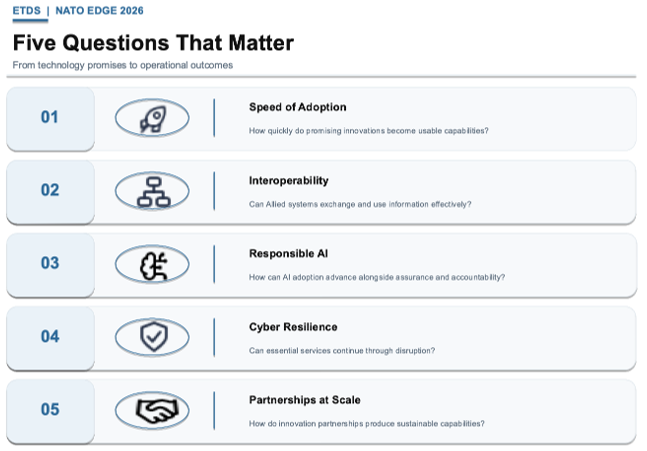
1. How can NATO move emerging technologies from experimentation to operational deployment faster?
NATO has made accelerated adoption of emerging technologies an important objective. Its digital transformation agenda emphasizes faster integration of capabilities, while its Strategy for Industry-NATO Cooperation recognizes the importance of connecting innovation, testing, experimentation, acquisition, and capability delivery across the capability lifecycle (NATO, 2026b, 2026c).
One question for discussion could therefore be how promising demonstrations might move beyond experimentation toward fielded capabilities. This could involve considering the barriers between testing, operational validation, acquisition, and transition, as well as how progress might be measured. Identifying and addressing these barriers more proactively may help establish clearer transition pathways, implementation responsibilities, and measurable milestones for moving successful innovations toward operational use.
2. Can NATO achieve meaningful digital interoperability across Allied systems?
Digital transformation increasingly depends on the ability of different national and organizational systems to exchange and use information securely and reliably. NATO’s Alliance Digital Strategy identifies interoperability as a core requirement of digital transformation, while its implementation strategy establishes interoperability, security, innovation, and operational as central elements of the Alliance’s digital approach (NATO, 2026a, 2026b).
The discussion could therefore extend beyond technical connectivity to consider how different standards, architectures, national requirements, security considerations, and organizational practices may affect whether systems work effectively together in realistic multinational operations. Relevant questions could include which standards and architectures may facilitate meaningful interoperability, how national requirements and information-security considerations could be reconciled with collaborative data use, and how interoperability might be tested under realistic operational conditions. Progress in this area could be reflected in clearer technical, governance, and evaluation requirements for effective multinational integration.
3. How can NATO accelerate AI adoption while preserving security, reliability, and human accountability?
NATO’s revised AI Strategy seeks to accelerate AI adoption while emphasizing responsible use, interoperability, risk management, testing and evaluation, workforce development, and measurable steps toward AI integration (NATO, 2024). It also could identify the development of standards, assessment tools, review processes, and an Alliance-wide testing, evaluation, verification, and validation landscape as important elements of responsible AI adoption.
As AI systems become more capable and increasingly integrated into operational processes, discussion could consider not simply how quickly NATO can adopt them, but under what conditions their use could remain reliable, accountable, and appropriately controlled. This could include questions concerning appropriate applications of controlled autonomy, testing under realistic technological and operational conditions, and safeguards for traceability, responsible use, and meaningful human oversight. Ethical considerations should also inform the adoption and deployment of AI-enabled capabilities, including how responsibilities are assigned, how human judgement is preserved in consequential decisions, and how their use remains consistent with applicable legal obligations and ethical principles. A more proactive consideration of assurance and governance alongside technological adoption may also help anticipate such questions before systems move further into operational use.
4. How resilient are NATO’s growing digital dependencies under conditions of disruption?
Digital transformation can strengthen operational effectiveness while also increasing interdependence among systems, services, infrastructure, and organizations. NATO’s 2026 Resilience Baseline Requirements emphasize increasing interconnectedness, interdependencies, cascading effects, continuity, and the need for tested and exercised resilience arrangements (NATO, 2026d).
Discussion could therefore consider not only the security of individual systems, but whether essential functions can continue when interconnected capabilities or supporting services are disrupted. This could include how critical dependencies and potential cascading effects might be identified proactively, whether resilience assessments sufficiently reflect operational missions and dependencies, and how multinational exercises could test disruption across interconnected systems and organizations. Progress could be reflected in stronger mission-oriented resilience arrangements, clearer contingency planning, and practical measures for maintaining continuity under disruption. Moreover, a further discussion could involve whether we have a comprehensive approach to resilience that includes anticipation, preparation, response to, and recovery from disruptions.
5. How can NATO, industry, academia, and research institutions build partnerships that deliver scalable capabilities?
Partnerships are central to NATO’s innovation ecosystem, but collaboration should ultimately be assessed by more than participation, announcements, or technology demonstrations. NATO’s Strategy for Industry-NATO Cooperation identifies advancing innovation and interoperability, as well as strengthening, scaling, and sustaining defense production, as key objectives (NATO, 2026c).
Discussion could therefore consider how partnerships might better connect research and experimentation with procurement, deployment, production, and long-term support. However, translating these partnerships into operational capabilities also would require predictable and sustainable defense budgets. Adequate and sustained funding would be essential to support procurement decisions, provide industry with greater certainty for investment and production, and ensure that promising capabilities could be acquired and maintained over time. This could include what incentives may encourage sustained industry participation, how universities and research institutions might contribute beyond early-stage research, and what mechanisms could help promising prototypes move toward procurement and deployment. Progress could ultimately be reflected in clearer transition pathways, sustained collaboration, and measurable capability outcomes.
Closing
The success of NATO’s digital transformation will depend not only on technological innovation, but on the Alliance’s ability to translate innovation into capabilities that are operationally useful, secure, interoperable, resilient, governable, scalable, and sustainable. NATO’s recent strategies indicate that many of the necessary objectives and mechanisms are already being established; the continuing challenge is demonstrating how effectively they translate strategic ambition into operational outcomes (NATO, 2026a, 2026b, 2026c, 2026d).
The five questions presented here are intended to encourage evidence-based discussion at NATO Edge 2026 and to focus attention on the conditions required for successful technology adoption. For NAVI ETDS, they also provide a basis for assessing publicly documented conference outcomes and identifying areas that may warrant further research.
References
NATO. (2024, July 10). Summary of NATO’s revised Artificial Intelligence (AI) strategy. NATO. https://www.nato.int/en/about-us/official-texts-and-resources/official-texts/2024/07/10/summary-of-natos-revised-artificial-intelligence-ai-strategy.
NATO. (2026a, January 13). Alliance Digital Strategy. NATO. https://www.nato.int/en/about-us/official-texts-and-resources/official-texts/2026/01/13/alliance-digital-strategy.
NATO. (2026b, May 26). NATO’s Digital Transformation Implementation Strategy 2.0. NATO. https://www.nato.int/en/about-us/official-texts-and-resources/official-texts/2026/05/26/natos-digital-transformation-implementation-strategy.
NATO. (2026c, July 8). Strategy for Industry-NATO Cooperation. NATO. https://www.nato.int/en/about-us/official-texts-and-resources/official-texts/2026/07/08/strategy-for-industry-nato-cooperation.
NATO. (2026d, September 15). 2026 Resilience Baseline Requirements. NATO. https://www.nato.int/en/about-us/official-texts-and-resources/official-texts/2026/09/15/2026-resilience-baseline-requirements.

Dr. Amel Attatfa is a cyber diplomacy expert with an interdisciplinary background spanning international political science, law, and geopolitics. Her research sits at the intersection of cybersecurity, international relations, and public policy, with a focus on cyber diplomacy, global cyber governance, emerging technologies, and the sociotechnical dimensions of cyber threats. She holds a PhD in Cybersecurity from Abertay University, where her doctoral research examined cyber diplomacy, multistakeholder cooperation, and international norms for cyberspace. She is a Research Fellow with the NATO Veterans Initiative Research Institute, contributing to the Emerging Technologies & Data Studies Program.