

Abstract
For more than a century, the relationship between China, Japan, and South Korea has been rooted in political disagreement, fueled by mutual distrust and historical grievances. Today, this relationship represents one of the Indo-Pacific’s most intricate trilateral security dynamics. Japan’s rise as an empirical power in the 19th and 20th century, to its temporary colonization of South Korea and aggression towards China fuels the current tension between these nations, thus constraining trilateral cooperation even in areas of shared strategic interest.
This fragile relationship has significant implications for NATO decision-makers, whose interests are closely tied to the region’s stability. To address these challenges, NATO can strengthen regional stability by indirectly supporting joint cooperation frameworks such as the Quadrilateral Security Dialogue (QUAD), AUKUS, and the Indo-Pacific Economic Framework (IPEF); as well as collaborating with regional institutions such as the Association of Southeast Asian Nations (ASEAN) to highlight the importance of cooperation. By adopting this partnership-centered approach, NATO can help sustain the rules-based international order amid the tensions between China, Japan, and South Korea.
Keywords: NATO, trilateral security, China, Japan, South Korea
The Strategic Relevance of China-Japan-ROK for NATO
The security dynamics among China, Japan, and the Republic of Korea (ROK) represents one of the most complex trilateral relationships within the Indo-Pacific. At the heart of the China–Japan–ROK security triangle is deep-rooted mistrust and asymmetrical relationships. China’s increasing assertiveness with Japan, particularly in the East China Sea has raised security concerns throughout the Indo-Pacific. Disputes over exclusive economic zones (EEZs), sovereignty, and military activity in the area has heightened Sino-Japanese tensions. Japan and its allies view this dispute as aggressive Chinese expansionism, while China uses historical claims to assert their power over the uninhabited islands to achieve their economic, political, and military goals. Overall, these tensions are affecting the rule-based order established by NATO, thus threatening global and economic security.
South Korea, on the other hand, is closely allied with the U.S. primarily due to vulnerability to North Korean provocations, yet the ROK also has economic interdependence with China which creates a delicate balancing act. Seoul relies on Washington and Tokyo for security cooperation, yet fears the consequences of antagonizing Beijing as displayed by China’s reaction following South Korea’s decision to deploy the THAAD missile defense system in 2016.
For Japan, closer defense ties with South Korea is critical for regional stability, but political disputes over history and territory derail cooperation. The legacy of Japanese colonial rule over the ROK from 1910 to 1945 has remained a crucial point of resentment for South Korea, especially in regard to the use of “comfort women” and wartime issues such as forced labor. These tensions along with nationalists sentiment have contributed to the repeated failure to build a sustainable diplomatic and security relationship with one another.
Overall, China-Japan-ROK trilateral cooperation is weak with progress only ranging from disaster relief and economic dialogue. As a result, no comprehensive security agreement has been made between the states, thus limiting the effectiveness in addressing regional security issues. Without a deeper sense of trust and alignment with one another, this trilateral dynamic will remain constrained to disaster relief and economic dialogue, ultimately failing to properly address the rising tensions within the Indo-Pacific.
For NATO decision makers, these dynamics matter not only because they involve two of NATO’s formal partners, Japan and South Korea, but also because instability in this region can directly affect global trade, maritime security, and strategic competition with China. Although NATO members are not directly involved in the instability within the Indo-Pacific primarily due to its geographic location, NATO must support Japan and South Korea in managing their tensions with China through joint cooperation frameworks to reinforce alliance cohesion and global stability. all in efforts to support cooperation and avoid escalation.
The Role of Joint Cooperation Frameworks in Shaping NATO’s Indo-Pacific Strategy
For NATO, protecting the liberal international order is essential to its purpose. To protect this mission, NATO has turned to joint cooperation frameworks to ensure stability within the Indo-Pacific, and to encourage cooperation among China, Japan, and South Korea. The Quadrilateral Security Dialogue, also known as QUAD, involves the U.S., Japan, India, and Australia. This diplomatic forum emphasizes freedom of navigation, maritime security, and emphasizes the importance of a rule-based order. QUAD allows for Japan and South Korea to reinforce deterrence against China’s assertiveness especially within the South China Sea. Although South Korea is not an official member of QUAD, it participates in conversation and shows interest in cooperation. For NATO, QUAD indirectly helps reinforce regional stability while also creating an opportunity for democratic nations to form partnerships. Since NATO is not a direct participant in QUAD, this allows for NATO to advance its goals of security and resilience without being directly involved.
Similarly, AUKUS is an informal alliance between Australia, the U.K., and the U.S. that focuses on defense technology sharing and surveillance. Although Japan and ROK are not AUKUS members, both nations benefit indirectly from enhanced regional deterrence through AUKUS. Particularly, Japan and ROK are considered optimal partners for Pillar Two, a trilateral defense cooperation framework to jointly develop advanced military capabilities, concentrating on delivering a range of high-tech defense technolog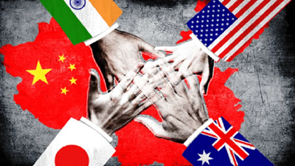 ies more quickly (Brooke-Holland, 2024). For NATO, AUKUS, is significant because it demonstrates how members extend their security commitments to Asia, specifically the Indo-Pacific. Moreover, AUKUS high-tech defense technology, such as cyber defense, undersea warfare, and advanced surveillance, directly aligns with NATO’s interests in intelligence sharing among democratic partners. Through supporting AUKUS-led activities in the Indo-Pacific, NATO can strengthen regional stability without the need of direct military involvement.
Meanwhile, economic partnerships such as the U.S.-led Indo-Pacific Economic Framework (IPEF) work as a platform that allows Japan and ROK to decrease their dependence on China and align themselves more closely with democracies. For Japan, this means deepening cooperation with the U.S. and ASEAN economies. For ROK, this is crucial to their economy given China’s economic retaliation during THAAD in 2016. IPEF also offers Japan and ROK the opportunity to collaborate without being entangled in their disputes and historical tensions, ultimately softening tensions within their relationship. China is intentionally not a member of IPEF for many reasons. Although not a direct competitor, the IPEF can be referred to as an alternative to China’s Belt and Road Initiative (BRI). The BRI offers strong dependency on China compared to the IPEF, which allows countries the choice to work with a U.S. or democratic-led framework based on democratic values and norms. For smaller countries, the IPEF offers economic engagement without the political strings (Goodman and Reinsch, 2022). China also prioritizes state-owned enterprises, loans with political conditions, and less stringent governance standards compared to that of the IPEF which emphasizes fair trade and supply chain resilience.
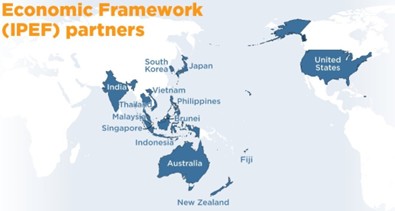 Although China’s exclusion from the IPEF may be concerning in regard to the China-Japan-ROK trilateral relationship, this framework is non-security and non-defense focused, instead prioritizing economic collaboration which has the potential for conversation between China, Japan, and ROK. Although these nations have a difficult relationship, they are deeply interconnected economically. Although China is not a member of the IPEF, there remains room for its engagement through regional institutions that overlap with IPEF members, such as ASEAN+3, on topics ranging from infrastructure to trilateral dialogues. For NATO, the IPEF allows for economic resilience for their Indo-Pacific partners. This includes reduces vulnerabilities that could be exploited in regional crisis or with a partnership with China, thus preserving the liberal international order.
Regional Balancers: ASEAN and the Shanghai Cooperation Organization (SCO)
Regional institutions such as the Association of Southeast Asian Nations (ASEAN) and the Shanghai Cooperation Organization (SCO) are also key factors in shaping regional balance in the Indo-Pacific. ASEAN serves as a diplomatic hub in the Indo-Pacific to promote regional stability, economic integration, and peaceful dispute resolution (ASEAN, 2025). It has hosted several multilateral dialogues such as the East Asia Summit (EAS) and the ASEAN Regional Forum (ARF) where China, Japan, and ROK were all participants. Through these platforms, ASEAN has eased tensions and supported trust-building between the three states, especially when bilateral or trilateral dialogues have stalled. While ASEAN itself provides a diplomatic environment, ASEAN+3 demonstrates concrete action that continues even when trilateral dialogues have stopped. ASEAN+3 is a regional economic cooperation framework that works as one of the main platforms that directly links China, Japan, and ROK since the 1997 Asian financial crisis. At the 27th ASEAN+3 summit, the restoration of China-Japan-ROK trilateral cooperation was noted as being “strengthened under the ASEAN+3 framework” after years of no dialogue. This framework represents how ASEAN facilitates trust building and regional stability, both of which aligns closely with NATO’s interests.
ASEAN is a vital player when it comes to regional stability and multilateralism in the Indo-Pacific. Through platforms such as ARF, EAS, and ASEAN+3, ASEAN brings together major powers, preventing escalation and reducing the risk of severe regional conflict. ASEAN also acts as a gateway for NATO’s broader engagement in the region, thus enabling cooperation on non-traditional security issues such as humanitarian aid (NATO, 2025 “Relations with Partners in the Indo-Pacific Region”). ASEAN is also concerned with preventing a single power, such as China, to dominate regional security frameworks, which allows for NATO partners such as Japan and ROK to engage more assertively without the direct provocation of China. Overall, NATO views ASAN as a regional norm-setter that will promote stability and a rules based order.
On the other hand, the Shanghai Cooperation Organization (SCO), led by China and Russia, represents an alternative approach to regional security that is relevant to NATO. The SCO serves as a platform for China to counterbalance U.S.-led frameworks such as NATO, the QUAD, and AUKUS. The organization emphasizes cooperation among its member states, neither which are Japan nor ROK as they align themselves more with western ideology and frameworks, further widening the divide between the trilateral dynamic as well as other East Asian states. 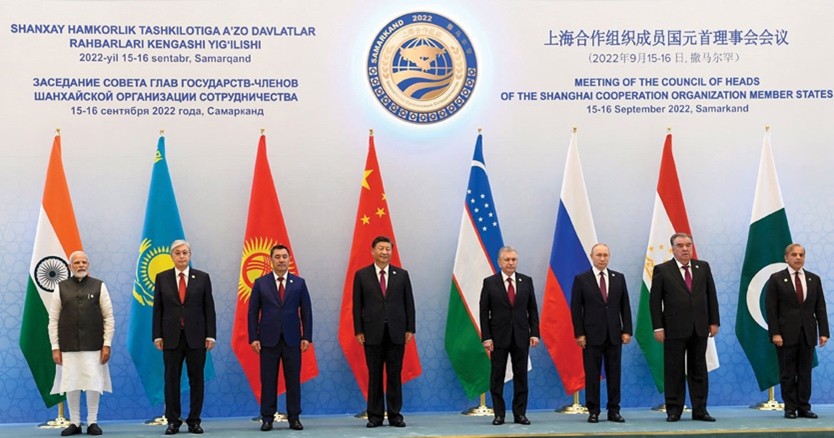 For NATO and its partners, the SCO can be referred to as a rival as it offers a model of authoritarian cooperation rather than democratic governance, thus increasing security fragmentation in the Indo-Pacific (Yun, 2024). Ultimately, the SCO, particularly through the lens of security and economic cooperation, represents a strategic challenge to NATO.
Indirect Strategies for NATO in China–Japan–ROK Security Dynamics
In a region marked by historical tensions and strategic competition, NATO’s most effective role lies in indirect engagement through joint cooperation frameworks, which includes promoting trilateral cooperation, facilitating trust building, and supporting regional resilience without the provocation of escalation. With this in mind, the trilateral dynamic of China-Japan-ROK also directly affects the global commons particularly in maritime trade. Any crisis, whether triggered by a China-Japan confrontation or the collapse of the trilateral coordination, would disrupt the global supply chain and impose significant costs, especially on NATO economies. China, Japan, and ROK are major producers of electronics, automotive parts, and industrial machinery which NATO economies depend on these imports. This region also has important sea lanes, such as the East and South China Sea, that carry a huge portion of global maritime trade. Any disruption would delay shipments and create a global supply chain issue.
China can be a “systemic challenge” (North Atlantic Treaty Organization, 2022) to Euro-Atlantic security, so leaders have to pay close attention to the activity in the Indo-Pacific as it can affect both the alliance’s economy and security. NATO has consistently emphasized the defense of a rules-based international order. If tensions between China, Japan, and ROK weaken respect for maritime rules or make it difficult to respond to threats, it will challenge the values that NATO stands for.
To address these concerns, this trilateral relationship between China-Japan-ROK must adopt a pragmatic, partnership-centered approach. Direct military involvement from NATO would be perceived as threatening by China and unnecessarily raise tensions. Instead, NATO can contribute by indirectly promoting dialogue and trust-building in ways that do not provoke or escalate the already high tensions. This includes supporting and contributing to joint cooperation frameworks, but a key step is to strengthen the bilateral relationships between these states which are already hindered by historical grievances and centuries of mistrust. Enhancing the relationship between Japan and ROK, for instance, can improve intelligence sharing and defense coordination. Not only could this potentially create space for deeper trilateral engagement, but also allow for NATO aligned partners to respond more effectively to regional security challenges. Overall, NATO can indirectly support bilateral cooperation which is necessary for effective trilateral cooperation
In addition to bilateral partnerships, NATO can also leverage existing joint cooperation frameworks to indirectly encourage a more constructive engagement between China-Japan-ROK. For instance, NATO’s growing ties with the Indo-Pacific Four (IP4) which includes Japan, ROK, Australia, and New Zealand, can allow for increased regional security efforts. These democratic nations have a shared commitment to the rule-based international order and can act as regional stabilizers in security dynamics. Since Australia and New Zealand are less entangled in the historical disputes between China, Japan, and ROK, they can act as neutral facilitators to encourage dialogue and cooperation. Other frameworks such as the IPEF and ASEAN provides neutral platforms for China, Japan, and ROK to engage diplomatically, ultimately fostering regional integration. Indirectly investing in joint cooperation frameworks allows NATO to not only reinforce collaboration efforts between China-Japan-ROK, but also encourage stronger alignment between its partner states and upholding their mission of a rules based order.
Conclusion
The China–Japan–ROK trilateral dynamic represents a critical security issue for NATO decision makers, even though NATO’s primary focus remains in the Euro-Atlantic. While direct military involvement is not advised, NATO cannot afford strategic neglect in this region. Through joint cooperation frameworks, encouraging bilateral dialogues, and leveraging them, NATO can play a meaningful role in both strengthening the China-Japan-ROK dynamic and deepening their partnerships with Japan and the ROK. This approach allows NATO to safeguard its security interests, promoting a rules-based order and indirectly maintaining regional stability.
References
ASEAN Staff. (2025). What We Do. Association of Southeast Asian Nations, https://asean.org/what-we-do/
Brooke-Holland, Louisa. (2024). AUKUS Pillar 2: Advanced Capabilities. House of Commons Library, https://commonslibrary.parliament.uk/research-briefings/cbp-9842/#:~:text=Pillar%202%20focuses%20on%20developing,bases%2C%20and%20supply%20chains
Chubb, Andrew. (2024). The East China Sea Dispute: China’s and Japan’s Assertiveness from Mao to Xi. Asia Society Policy Institute. https://asiasociety.org/policy-institute/east-china-sea-dispute-chinas-and-japans-assertiveness-mao-xi
Congress. (2024). Indo-Pacific Economic Framework for Prosperity. Congress.gov, https://www.congress.gov/crs_external_products/IF/HTML/IF12373.web.html
Council on Foreign Relations Staff. (n.d.) Excerpt: The US–South Korea Alliance. Council on Foreign Relations. https://www.cfr.org/excerpt-us-south-korea-alliance#chapter-title-0-5
Curtis, Lisa et. al. (2024). Forging a New Era of U.S.-Japan-South Korea Trilateral Cooperation. CNAS. https://www.cnas.org/publications/reports/forging-a-new-era-of-u-s-japan-south-korea-trilateral-cooperation
Department of Foreign Affairs and Trade Staff. (2025). The Quad. Australian Government Department of Foreign Affairs and Trade, https://www.dfat.gov.au/international-relations/regional-architecture/quad
Dominguez, Gabriel. (2023). Japan and NATO agree to deepen partnership, saying rules-based order ‘at stake’. The Japan Times. https://www.japantimes.co.jp/news/2023/01/31/national/politics-diplomacy/nato-jens-stoltenberg-fumio-kishida
Fact Sheets on the European Union. (n.d.). European Parliament. https://www.europarl.europa.eu/factsheets/en/sheet/182/east-asia
Goddard, Lee. (2025). AUKUS Pillar II: Speed, Innovation, and Expansion Interview with Lee Goddard. The National Bureau of Asian Research, https://www.nbr.org/publication/aukus-pillar-ii-speed-innovation-and-expansion/
Goodman, Matthew P. and Reinsch, William Alan. (2022). Filling In the Indo-Pacific Economic Framework. Center For Strategic and International Studies, https://www.csis.org/analysis/filling-indo-pacific-economic-framework
Manyin, Mark E. (2015). Managing Japan-South Korea Tensions. Council on Foreign Relations, https://www.cfr.org/report/managing-japan-south-korea-tensions
Ministry of Foreign Affairs. (2012). China-Japan-ROK Cooperation (1999-2012). Ministry of Foreign Affairs People’s Republic of China, https://www.mfa.gov.cn/eng/zy/gb/202405/t20240531_11367260
Ministry of Foreign Affairs. (2015). China’s Economy Overview. Ministry of Foreign Affairs, https://www.mofa.go.jp/files/100540401.pdf
North Atlantic Treaty Organization Staff. (2022). NATO 2022 Strategic Concept. North Atlantic Treaty Organization, https://www.nato.int/nato_static_fl2014/assets/pdf/2022/6/pdf/290622-strategic-concept.pdf
North Atlantic Treaty Organization Staff. (2025). Relations with Partners in the Indo-Pacific Region. North Atlantic Treaty Organization, https://www.nato.int/cps/en/natohq/topics_183254.htm
North Atlantic Treaty Organization Staff. (2025). The first dedicated dialogue on defense industrial cooperation and capabilities launched between NATO and the Republic of Korea. North Atlantic Treaty Organization. https://www.nato.int/cps/en/natohq/news_237844.htm
Park, Anna J. (2024). Korea, Japan, China’s Trilateral Cooperative Mechanism Restored at ASEAN Plus Three. The Korea Times, Foreign Affairs, https://www.koreatimes.co.kr/foreignaffairs/20241010/south-korea-japan-and-chinas-trilateral-cooperative-mechanism-restored-at-asean-plus-three
Sacks, David. (2024). NATO’s Indo-Pacific Aspirations. Council on Foreign Relations. https://www.cfr.org/blog/natos-indo-pacific-aspirations
Stangarone, Troy. (2018). South Korean Losses from China’s THAAD Retaliation Continue to Grow. Kei. https://keia.org/the-peninsula/south-korean-losses-from-chinas-thaad-retaliation-continue-to-grow
Zhang, Yun. (2024). Two Security Concepts: NATO vs. SCO. China-US Focus, https://www.chinausfocus.com/peace-security/two-security-concepts-nato-vs-sco
Ethics and Originality Statement
This manuscript is original, non-AI-generated, and not under review elsewhere.

Aspen Bilal holds a Master’s degree in International Studies from North Carolina State University, where her research focused on regional security dynamics in the Indo-Pacific. Her academic interests center on multilateral security cooperation and the strategic implications of great power competition in East Asia. Through her work, Aspen seeks to bridge academic analysis with policy relevance, offering insights into how institutions such as NATO can engage with Indo-Pacific partners to promote regional stability and uphold the rules-based international order.