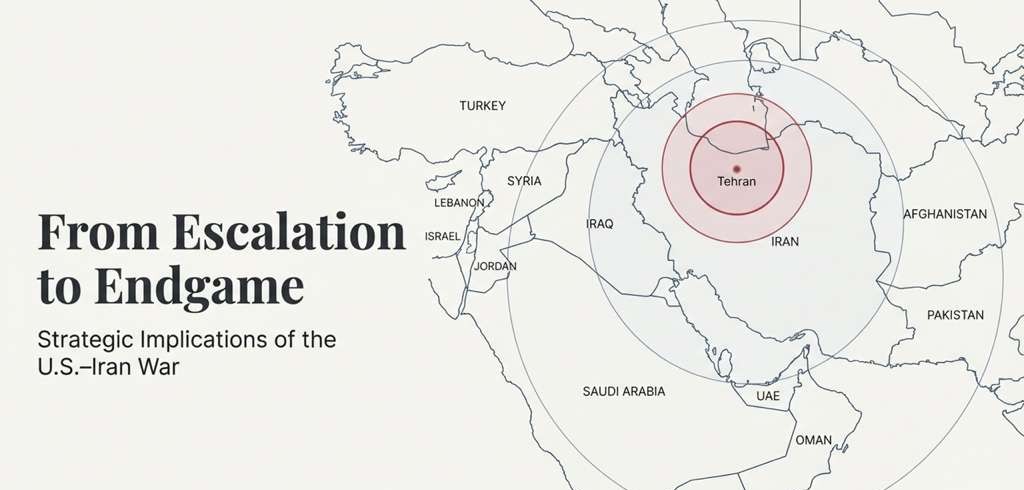
The eruption of open war between the United States and Iran represents a turning point, not just a tactical move. It signals a deep shift in American strategy, moving from attempts at forceful negotiation to a clear effort to disrupt Iran’s regime. While the immediate focus is naturally on military confrontations, the more telling question isn’t whether the situation has escalated, but rather what strategic thinking led to this point and what new geopolitical landscape might emerge from it.
This conflict didn’t just spring up overnight. It’s the outcome of a long and steady decay in the region’s stability, a series of calculated messages and warnings, and a gradual change in what each side was willing to tolerate. At the same time, the trajectory suggests more than reactive crisis management; it reflects strategic preparation unfolding over time.
Signaling Before the Strike
Looking back, the size and makeup of American naval forces in the area were one of the most obvious clues of what was to come. How you position your military can be a form of forceful diplomacy (aka Gunboat diplomacy), if it’s done as part of a bargaining strategy. But when you send in more forces than you’d need just for leverage in talks, it sends a different message: you’re getting ready for a real fight (Schelling, 1966).
The naval buildup near Iran pointed to a shift from just sending a warning to being fully prepared for action. In the world of deterrence, being credible isn’t just about what you have, but what your opponent thinks you’re willing to do (Jervis, 1976). If an enemy starts to believe that talking is just a way to buy time to bring in more troops, it damages your reputation far beyond the current situation. Any future talks, no matter where they are — Asia, Eastern Europe, or anywhere else — will be seen through the lens of this event.
So, this war sends a ripple of consequences through the entire international system.
Why Iran — and Why Now?
Anyone trying to understand this escalation needs to resist the temptation to treat it as something that came out of nowhere. What we’re looking at is the product of a regional sequence that unfolded gradually — one in which Iran’s network of forward deterrence was steadily worn down across several different theaters following October 2023. As the Gaza War expanded the operational arena, the pressure on Iran-aligned forces in Lebanon and Syria grew heavier, and what had been occasional deterrence signaling gave way to something more sustained: a campaign of attrition and disruption.
In Lebanon, Israel’s September 2024 campaign went well beyond airstrikes. It included a technologically sophisticated operation targeting Hezbollah’s communications network, which was widely reported as a mass “pager” attack that wounded operatives across the country and demonstrated a level of intelligence penetration and operational reach that few had anticipated (Associated Press, 2025; Lieber Institute at West Point, 2024). Around the same time, the killing of Hezbollah’s Secretary-General Hassan Nasrallah was widely assessed as a serious systemic shift — not just to the organization itself, but to Iran’s entire regional deterrence posture, which had long depended on Hezbollah as its most capable and reliable partner (Carnegie Endowment for International Peace, 2024; Chatham House, 2024).
At the same time, the situation in Syria — which had served for years as the critical logistical and strategic corridor connecting Tehran to Hezbollah — collapsed in a way nobody had fully anticipated. When Bashar al-Assad was forced to fled Damascus, Syria was thrown into a contested transition, and in January 2025 Ahmed al-Sharaa, with the full support of the US, was declared transitional president. That shift fundamentally changed the regional alignment landscape, cutting into Iran’s freedom of movement and making it far harder for Tehran to sustain the same depth of influence it had previously enjoyed across the region (UK House of Commons Library, 2026; Al Jazeera, 2025; The Guardian, 2025).
Taken together, these developments follow a recognizable pattern — something resembling a phased squeeze: first degrade Iran’s external arms, then fracture the corridors it relies on, then isolate its partners, and finally move against its core assets and leadership. That kind of step-by-step logic is well established in the literature on coercive escalation and campaign sequencing, where incremental pressure is used to shift the terms of any potential bargain and raise the cost of continued resistance to an unbearable level (Freedman, 2004; Pape, 1996). By early 2026, reporting on U.S.–Israeli operations made clear that the campaign had moved from squeezing Iran’s peripheral networks to striking directly at regime leadership and military infrastructure — an escalation that, far from being impulsive, reflected years of deliberate strategic positioning (Reuters, 2026; The Guardian, 2026; Time, 2026).
The China Variable: Energy, Leverage, and Strategic Competition
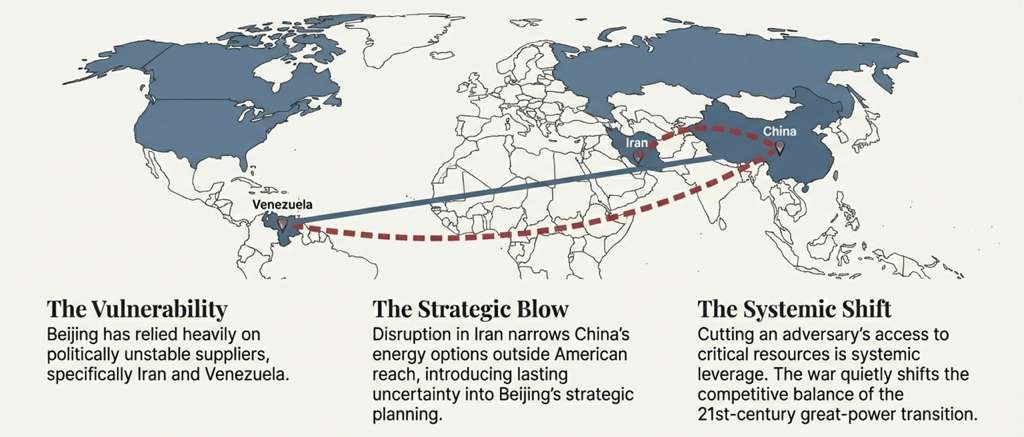
What this conflict means for China’s long-term energy security is hard to overstate. For years, Beijing has leaned heavily on politically unstable suppliers — Iran and Venezuela being two of the most significant. Prolonged chaos or a change of government in either country doesn’t just create a short-term headache; it introduces a lasting uncertainty into the foundations of China’s strategic planning.
In classic balance-of-power thinking, cutting off or complicating an adversary’s access to critical resources is itself a form of leverage over the entire system (Mearsheimer, 2001). Whether Washington intended this outcome or it simply emerged as a side effect, the war has narrowed the options Beijing has for securing energy from sources outside American reach — and increased China’s exposure to supply routes that the U.S. has significant influence over.
You don’t need to reach for any conspiracy theory to see the structural reality here. When two of the major oil producers that have historically been in China’s corner are weakened or pushed toward realignment, the energy math that has quietly powered China’s rise starts to look a lot less reliable. In that sense, this war is doing two things at once: it is reshaping the Middle East, and it is quietly shifting the competitive balance in the broader U.S.–China rivalry.
Intelligence Penetration and Regime Vulnerability
The precision of the early strikes tells its own story. Targeting leadership at the highest level doesn’t happen by accident — it requires sophisticated intelligence and surveillance architecture and a very detailed, high-confidence picture of what’s happening on the inside (Lowenthal, 2016).
But the technical achievement is almost secondary to the political message it sends. A regime’s ability to hold together depends on loyalty and trust within its inner circle and security services. When an outside power shows it can reach into leadership networks with that kind of accuracy, it usually means one of two things: there are cracks within the elite, or the regime’s counterintelligence has been seriously compromised (Walt, 1987).
The real significance of those strikes, then, isn’t just the damage they caused — it’s what they said about how penetrable the regime had become.
The Endgame Problem
History has shown, time and again, that taking down a regime is the easier part. The real test comes after — when the leadership is gone and someone has to figure out what comes next.
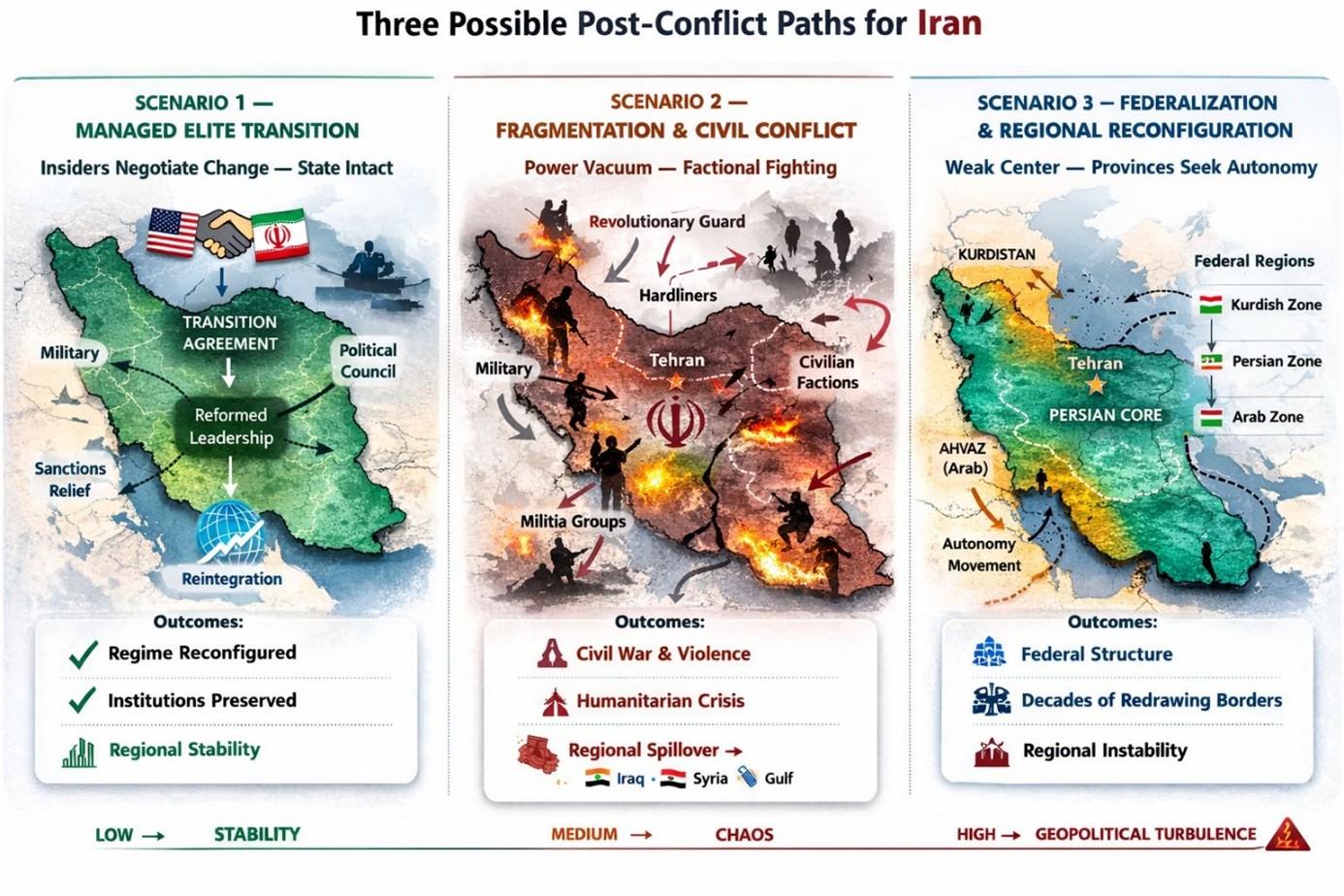
Scenario 1: Managed Elite Transition
The outcome that would cause the least regional damage is one where the transition is managed from the inside — where senior figures within Iran’s military or Revolutionary Guard, having quietly established back-channel contact with the United States or other outside actors before the escalation reached this point, step in to steer what comes next. This wouldn’t require any of them to suddenly share American values or foreign policy goals. It would simply require a cold-eyed calculation: that some version of the regime surviving in a modified form is a better deal than watching the whole system come apart.
There are historical precedents for this. Leadership change doesn’t always come through revolution or collapse — sometimes it happens through negotiated repositioning, where key insiders coordinate a handover and outside powers quietly signal what they’re willing to offer in return. In those cases, external actors have typically dangled things like security guarantees, sanctions relief, or a path back to international legitimacy, in exchange for cooperation on restructuring who’s actually in charge.
For this scenario to have a real chance of working, three things would probably need to already be in place. First, there would need to be enough agreement among key figures inside Iran that replacing the leadership is necessary — not just desirable but genuinely accepted as unavoidable. Second, there would need to be some form of quiet, credible communication between those figures and U.S. or allied interlocutors about what the post-conflict arrangements would actually look like. And third, the people running Iran’s military and security institutions would need some assurance that those institutions would survive the transition with their basic structure intact.
If all of that is already in motion, the result could be something closer to regime reconfiguration than regime collapse — the leadership changes, but the state itself doesn’t fall apart. That’s a very different and far more manageable outcome than the alternatives. If none of that groundwork was laid, though, the chances of a clean transition drop sharply, and fragmentation becomes a much more likely result.
Scenario 2: Fragmentation and Civil Conflict
If that kind of coordination doesn’t happen, the picture gets much darker. Rivalries between factions of the Revolutionary Guard, the conventional military, and various civilian political actors could easily spiral into drawn-out internal fighting. History is pretty clear on what happens when that kind of power vacuum occurs — armed groups move in, and the violence tends to spill across borders (Kilcullen, 2009).
Iraq is the obvious comparison. Removing the leadership without any real plan for what follows didn’t produce stability; it produced years of insurgency that the region is still dealing with.
Scenario 3: Federalization and Regional Reconfiguration
There’s a third possibility that gets less attention but could prove just as consequential in the long run. Iran is not a homogeneous country. Kurdish populations, Arab communities in Ahvaz, and Persian-majority regions all have distinct identities and, in some cases, longstanding grievances. A weakened central government could accelerate demands for greater autonomy or even some form of federalization. That would send shockwaves through the neighborhood — Türkiye, Iraq, and Syria are all already dealing with Kurdish political pressures that complicate their own stability.
This wouldn’t be an overnight collapse. It would be slow, grinding geopolitical reshaping that could take decades to fully play out.
Maritime and Energy Shock
The Strait of Hormuz doesn’t get the due attention in these discussions. A significant portion of the world’s oil (20%) passes through that narrow stretch of water, and any serious disruption there would hit global markets almost immediately. Europe, which has never fully recovered its energy confidence after recent years of supply disruptions, would be especially exposed — facing rapid price spikes and the kind of supply anxiety that tends to generate political instability.
When a conflict touches a chokepoint like this, it stops being a regional problem (Tangredi, 2002). At that point, what started in the Middle East becomes a crisis with a very real Atlantic dimension.
NATO’s Strategic Imperative
For NATO, the path forward is not particularly ambiguous. The Alliance needs to shield its southern flank from the fallout of this conflict before those shockwaves become unmanageable. The 2022 Strategic Concept already flagged instability in the Middle East and North Africa as a direct threat to Allied security and called for a full 360-degree approach to defense (NATO, 2022).
Turning that commitment into action means moving on three fronts at once. The first is intelligence — NATO needs tighter fusion of surveillance and early-warning systems to protect both deployed forces and critical infrastructure. The second is maritime: the Alliance has to sharpen its situational awareness and naval coordination around key chokepoints, especially the Strait of Hormuz, where any serious disruption would send immediate shockwaves through the global economy (U.S. Energy Information Administration, 2025). The third is energy resilience — NATO needs to work closely with the European Union to get ahead of the economic destabilization risks before they become political ones.
At the same time, NATO needs to manage this crisis with discipline. Alliance cohesion requires unified messaging and constant political consultation among members. Keeping the Alliance from fracturing internally is just as important as preventing the conflict from spreading. Supporting diplomatic de-escalation through multilateral channels is essential to breaking the cycle of strikes and retaliations that has been playing out across the region (Reuters, 2026a, 2026b). Taken together — force protection, maritime and energy stabilization, and cohesion-driven diplomacy — this approach best squares NATO’s deterrence posture with what the situation actually demands (NATO, 2022; CSIS, 2024).
Alliance Cohesion and European Response
So far, European governments have largely responded with calls for restraint and preparations for humanitarian assistance. That’s understandable, but it also highlights how limited Europe’s ability to project military influence in the Middle East has become — and it’s adding fresh fuel to the long-running debate about who carries how much of the burden within the Alliance.
Cohesion here isn’t just an Article 5 issue. It’s a test of whether Alliance members are even working from the same strategic script (Brooks & Wohlforth, 2005). If allies start interpreting this war in fundamentally different ways — some see it as counterproliferation, others as regime change, others as part of a broader systemic competition — those differences will create real fractures if they’re not addressed head-on.
Conclusion: From Regional War to Systemic Inflection Point
What we’re watching is a shift from carefully managed pressure to something more structural and direct. But removing leadership is where the operational phase ends, not where the strategic challenge is resolved.
What gets built in the aftermath — whether that’s an orderly transition, a fragmented breakdown, or some form of federal restructuring — will define the regional order for the next decade or more. And the systemic dimension is just as important as the regional one.
By degrading Iran’s capacity and injecting uncertainty into the energy supply chains that China has depended on, this conflict cuts right into the heart of the U.S.–China competition as it’s currently evolving. If Iran ends up realigning toward a U.S.-friendly order, Beijing would be looking at the long-term loss of two significant energy nodes — Iran and Venezuela — from its strategic supply network. That wouldn’t just redraw the map of the Middle East. It would shift the underlying balance of power that the twenty-first century’s great-power transition is being built on.
For NATO, this is not noise at the edges of the Alliance’s concerns. It is a structural inflection point. The credibility of NATO’s 360-degree defense posture now depends on its ability to contain spillovers, keep maritime arteries open, hold the Alliance together, and think clearly about what great-power rivalry means in practice.
The opening phase of this war is kinetic. Its decisive phase — for the Middle East, for NATO, and for the international order — will be structural.
References:
Al Jazeera. (2025, January 29). Syria’s Ahmed al-Sharaa named president for transitional period.
Associated Press. (2025, August 6). Survivors of Israel’s pager attack on Hezbollah last year struggle to recover.
Brooks, S. G., & Wohlforth, W. C. (2005). Hard times for soft balancing. International Security, 30(1), 72–108.
Carnegie Endowment for International Peace. (2024, September 29). Israel has assassinated the secretary general of Hezbollah Hassan Nasrallah.
Chatham House. (2024, October 1). Hezbollah faces an uncertain future after the assassination of Hassan Nasrallah.
Droin, M., Encina, C. G., Hudson, C., & Uysal, S. (2024, May 17). NATO and its south: Redefining the terms. Center for Strategic and International Studies. https://www.csis.org/analysis/nato-and-its-south-redefining-terms
Freedman, L. (2004). Deterrence. Polity Press.
Jervis, R. (1976). Perception and misperception in international politics. Princeton University Press.
Kilcullen, D. (2009). The accidental guerrilla. Oxford University Press.
Lieber Institute at West Point. (2024, October 11). “Well, it depends”: The explosive pagers attack revisited.
Lowenthal, M. M. (2016). Intelligence: From secrets to policy (7th ed.). CQ Press.
Mearsheimer, J. J. (2001). The tragedy of great power politics. W. W. Norton.
North Atlantic Treaty Organization. (2022, June 29). NATO 2022 strategic concept. https://www.nato.int/en/about-us/official-texts-and-resources/strategic-concepts/nato-2022-strategic-concept
Pape, R. A. (1996). Bombing to win: Air power and coercion in war. Cornell University Press.
Reuters. (2026a, February 28). Iranian leader Khamenei killed in air strikes as U.S., Israel launch attacks. https://www.reuters.com/business/aerospace-defense/israel-us-launch-strikes-iran-2026-02-28/
Reuters. (2026b, March 1). Israel says its warplanes hit Tehran again after killing Khamenei. https://www.reuters.com/world/middle-east/more-strikes-aimed-iran-after-us-israeli-assault-kills-supreme-leader-2026-03-01/
Reuters. (2026, February 28). Exclusive: Ahead of strikes, Trump was told Iran attack was high risk, high reward.
Schelling, T. C. (1966). Arms and influence. Yale University Press.
Tangredi, S. J. (Ed.). (2002). Globalization and maritime power. NDU Press.
The Guardian. (2025, January 29). Rebel leader Ahmad al-Sharaa made transitional president of Syria.
The Guardian. (2026, February 28). US and Israel strike Iran as Netanyahu says “many signs” Khamenei “no longer alive”.
Time. (2026, February 28). Iran’s Supreme Leader killed in U.S.-Israeli attacks.
U.K. House of Commons Library. (2026, January 22). Syria one year after Assad: Forming an interim government.
U.S. Energy Information Administration. (2025, June 16). Amid regional conflict, the Strait of Hormuz remains critical oil chokepoint. https://www.eia.gov/todayinenergy/detail.php?id=65504
Walt, S. M. (1987). The origins of alliances. Cornell University Press.

Dr. Rula Jabbour is a Postdoctoral Fellow at the Nebraska Deterrence Lab, Department of Political Science, University of Nebraska. She holds a Ph.D. in Political Science from the University of Nebraska-Lincoln, specializing in International Relations, Strategic Studies, and Middle Eastern Politics. Her research focuses on authoritarian governance, civil-military relations, counterterrorism, and post-conflict reconstruction in the Middle East.
Dr. Jabbour’s work has been published in Dynamics of Asymmetric Conflict, the Syrian Studies Journal,The MENA Journal on Violence and Extremism and is featured in forthcoming volumes with Springer Nature on regional security and innovation in the Eastern Mediterranean. She has presented her research at leading international conferences including ISA, APSA, and IPSA.
Dr. Jabbour has taught in many American universities during her career. She has taught a broad array of courses in international relations, Middle Eastern studies, and U.S. foreign policy, with a reputation for inclusive pedagogy and student engagement. Originally from Syria and a recipient of a prestigious U.S. State Department Scholarship, Dr. Jabbour brings a unique intersection of field-based insight and scholarly rigor to the study of regional security and conflict transformation.
- Dr. Rula Jabbour - Research Fellow