
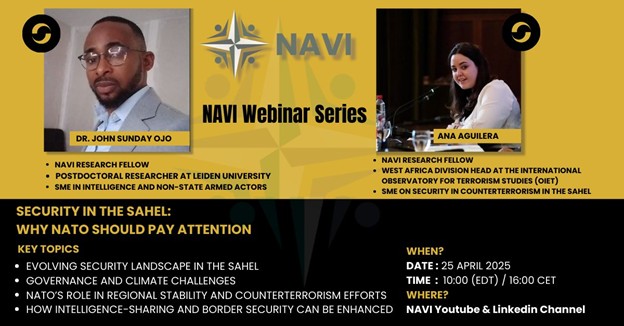
NAVI experts Dr. John Sunday Ojo and Ms. Ana Aguilera shared their insights in the latest episode of the NAVI Webinar Series, moderated by NAVI Research Fellow Angelia Keever, on Friday, April 25, 2025. The event was live-streamed on LinkedIn and YouTube.
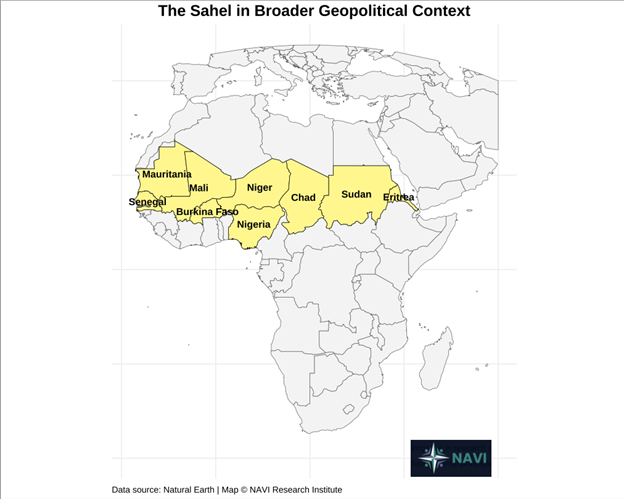
This in-house episode of the NAVI Webinar Series focused on the security implications of the recent developments in the Sahel Region. Expert speakers highlighted that the Sahel faced significant challenges, including a recent epidemic of coups/military junta regimes, growing influence by China and Russia, rising instability/extremism, and challenges to democratic governance. This security environment led to challenges for NATO due to its detrimental impacts on regional democracy, governance, and human rights. Both NAVI experts, Dr. Ojo, and Ms. Aguilera, urged NATO to pay closer attention to the development in the Sahel, emphasizing the potential spillover effects into Europe while calling for diplomatic approaches and security assistance to locally-led initiatives rather than military intervention.
Security Landscape in the Sahel
Key security developments in the Sahel include the recent wave of military coups and resulting military/military-led regimes, the growing Influence of China and Russia, challenges to democracy and governance, and the escalation of violent extremism.
Impact of Recent Coups and Military Regimes
The wave of military coups in the Sahel has created a “non-cooperative security system” and a regional security breakdown, which hampered counterterrorism efforts and led to the emergence of transborder terrorist group activities. The epidemic-level concentration of coups also created a vacuum where Sahelian states and neighboring countries struggled to cooperate due to growing tensions, trust, and governance issues. The current military regimes are seen as a viable alternative by the Sahelian people, who are disillusioned with the failures of the previous democratic regimes, but their survival depends on delivering basic public goods such as security, economic growth, and basic services.
Growing Influence of China and Russia in the Sahel
China and Russia have recently been ramping up their existing influence on security and governance dynamics in the region and Africa at large, leading to important implications for NATO. China primarily focused on economic investment, infrastructure development projects (including ports), and security cooperation, while Russia’s involvement is more recent and opportunistic. China is a major trading partner and supports the African Union’s (AU) peace and security architecture. Both NAVI experts raised concerns about the implications of Chinese-built infrastructure (such as ports and telecom systems) and China’s partnerships with authoritarian regimes in the region. On the other hand, Russia’s involvement centers on military cooperation, arms sales, and deploying military support to states experiencing conflict (e.g., Mali, CAR, Sudan). Russia’s foreign policy in the Sahel revolves around “regime protection.”
Challenges to Democracy and Governance
Chinese and Russian partnerships often come “without these conditions related to political reforms or the protection of human rights,” allowing African leaders to “resist Western pressures for democratization processes.” This support enables regimes to “consolidate power and to maintain stability on their own terms,” making it harder for NATO and Western countries to “influence government outcomes.” The current political trends suggest that “civilian-led governance in the Sahel is becoming more difficult to restore.”
Escalation of Instability and Violent Extremism
Violent activity has not only increased but also expanded geographically, with the Sahel becoming the “epicenter of global extremist activity.” Groups now “control vast territories,” and their influence is “spreading to our coastal states like Benin, Togo, and Ghana.” Political challenges and the fragmented security agenda due to military coups “animate the uncoordinated regional counterterrorism operations,” making it challenging to achieve “regional collective security.” The expansion of extremist control “threatens regional international security,” with direct implications for Europe in terms of “increased terrorism humanitarian crisis and control migration factors.”
Why Should NATO Pay Attention to the Sahel?
NAVI’s experts recommended the following approach for NATO and other external actors (e.g., IGOs and NGOs):
- Priority should be on diplomatic efforts and working with African agencies, especially on issues like climate change (a major driver of terrorism).
- NATO can “penetrate through these states, especially via diplomatic effort” rather than direct military intervention, which may “create a chaos that may not be contained.”
- Support “locally-led initiatives” while “respecting the independence of regional alliances.”
- Focus on “economic development, humanitarian aid, and capacity building rather than changing political conditions.”
- Support should be aimed at “good governance rather than imposing an outsider style of democracy.”
Conclusion
The latest episode of the NAVI Webinar Series featured Dr. John Sunday Ojo and Ms. Ana Aguilera, two of NAVI’s own experts, who shared their insights on the recent developments in the Sahel Region in Africa and the resulting security implications for NATO and the international community at large. Both experts pointed out that the clustering of military regimes, the impacts of climate change, growing Chinese and Russian influence in the region, and the rising extremism posed challenges to democracy and governance. Experts urged NATO to pay closer attention to the recent developments in the Sahel. They recommended that NATO and the broader international community should focus on diplomatic efforts and partnerships with local institutions (e.g., the African Union). They also maintained that efforts to assist good governance should focus on economic, humanitarian aid, and capacity building rather than military intervention or imposing an externally construed form of democracy.
Link to the webinar video: https://www.youtube.com/watch?v=iQx0ngxiPjw

The NAVI Research Institute is the research division of NATO Veterans Initiative - NAVI that provides a unique perspective to transatlantic leaders and societies on peace and security through the lens of NATO's founding principles of rule of law, democracy, human rights, and individual liberties. The NAVI Research Institute was officially established by the NAVI Board on July 16th, 2023.
- NAVI Research Institute

- NAVI Research Institute
- NAVI Research Institute

- NAVI Research Institute

- NAVI Research Institute
- NAVI Research Institute
- NAVI Research Institute
- NAVI Research Institute
- NAVI Research Institute
- NAVI Research Institute
- NAVI Research Institute
- NAVI Research Institute
- NAVI Research Institute
- NAVI Research Institute
- NAVI Research Institute
- NAVI Research Institute
- NAVI Research Institute

- NAVI Research Institute
- NAVI Research Institute

- NAVI Research Institute
- NAVI Research Institute
- NAVI Research Institute
- NAVI Research Institute
- NAVI Research Institute
- NAVI Research Institute
- NAVI Research Institute

- NAVI Research Institute
- NAVI Research Institute
- NAVI Research Institute
- NAVI Research Institute
- NAVI Research Institute
- NAVI Research Institute
- NAVI Research Institute
- NAVI Research Institute
- NAVI Research Institute
- NAVI Research Institute
- NAVI Research Institute

- NAVI Research Institute
- NAVI Research Institute
- NAVI Research Institute

- NAVI Research Institute
- NAVI Research Institute
- NAVI Research Institute
- NAVI Research Institute
- NAVI Research Institute
- NAVI Research Institute
- NAVI Research Institute

- NAVI Research Institute
- NAVI Research Institute
- NAVI Research Institute
- NAVI Research Institute
- NAVI Research Institute
- NAVI Research Institute
- NAVI Research Institute
- NAVI Research Institute
- NAVI Research Institute
- NAVI Research Institute

- NAVI Research Institute
- NAVI Research Institute
- NAVI Research Institute

- NAVI Research Institute
- NAVI Research Institute
- NAVI Research Institute
- NAVI Research Institute
- NAVI Research Institute
- NAVI Research Institute

- NAVI Research Institute

- NAVI Research Institute

- NAVI Research Institute