Abstract
In northwest Syria, the rise of Hay’at Tahrir al-Sham (HTS) as the governing authority has created a quiet but significant shift that the international community—particularly NATO—has yet to fully confront. While global attention has moved elsewhere, HTS has solidified its position as a quasi-state actor, managing courts, police forces, tax systems, and ideological education for nearly two million people. What is unfolding is no longer a simple insurgency, but an enduring model of extremist governance, one that merges rigid ideology with bureaucratic control. Because this entity sits directly on NATO’s southern doorstep, its growing institutional depth and influence carry long-term security consequences for Turkey, the Eastern Mediterranean, and the Alliance’s broader 360-degree security posture.
This analysis argues that the primary threat emerging from Syria today is structural extremist governance—not terrorism in its traditional, attack-based form. HTS’s economic networks—spanning taxation, cross-border trade, and illicit finance—create corridors for weapons flows, foreign fighters, and regional destabilization. If this trajectory continues unaddressed, the group’s proto-state could harden into a permanent enclave that erodes NATO’s crisis-management capacity and regional stability efforts. To counter this, NATO should integrate northwest Syria into its Southern Flank planning, support credible local governance alternatives, deepen coordination with Turkey, and align its diplomatic and reconstruction tools with clear governance benchmarks. Without early action, the Alliance may face a more deeply rooted and far more costly challenge at its own borders.
Keywords
NATO; Extremist governance; Hay’at Tahrir al-Sham (HTS); Northwest Syria; Idlib; Southern Flank Strategy; Counterterrorism; Regional stability; Türkiye–NATO cooperation; Illicit finance networks; Governance by extremism; Eastern Mediterranean security.
A quiet but profound transformation
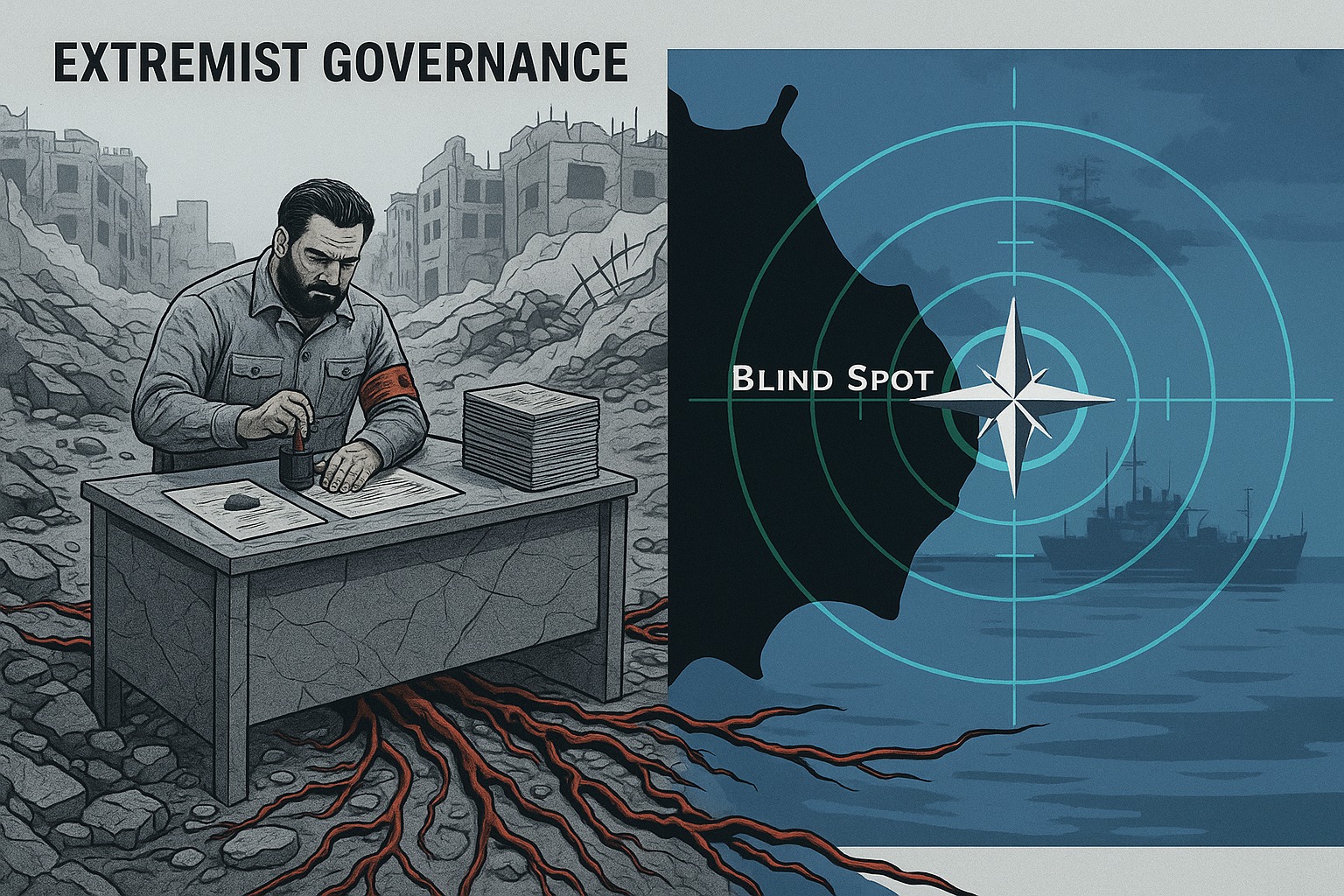
While the world’s attention has drifted from the devastation of the Syrian civil war, a subtler yet equally consequential transformation is taking place in the country’s northwest: the entrenchment of extremist governance under Hay’at Tahrir al-Sham (HTS). Once dismissed as a transient rebel coalition, HTS has evolved into a quasi-state actor. It now administers justice, collects taxes, regulates markets, and exerts authority over a population of approximately two million people, roughly half of whom are internally displaced Syrians (CSIS, 2023; UN OCHA, 2024). Its governance apparatus includes Sharia-based courts, internal security units, police forces, and administrative bodies that oversee or regulate essential services. For NATO, this development is not a distant irregularity but a strategic blind spot. Allowing an entrenched extremist governance model to consolidate so close to the Alliance’s borders risks institutionalizing instability and undermining NATO’s 360-degree security posture.
Recent empirical findings underline the depth of this transformation. Between 2023 and 2024, HTS continued to expand its administrative apparatus. Its Sharia and penal courts issued numerous rulings, consolidating the group’s control over civil dispute resolution, criminal adjudication, and social regulation (Drevon & Haenni, 2021; Haenni & Drevon, 2025). The group has also formalized taxation, utility billing, market regulation, and cross-border commercial oversight at the Bab al-Hawa crossing, embedding itself in nearly every economic transaction in Idlib. Analysts estimate that HTS generates tens of millions of dollars annually through these activities, including customs fees, fuel and utility monopolies, real-estate rents, and commercial licensing—revenues robust enough to sustain a sizeable bureaucracy and internal security apparatus (Middle East Institute, 2021). This institutionalization is not hypothetical; it is measurable, entrenched in daily governance, and expanding.
A strategic threat hiding in plain sight: Why it matters?
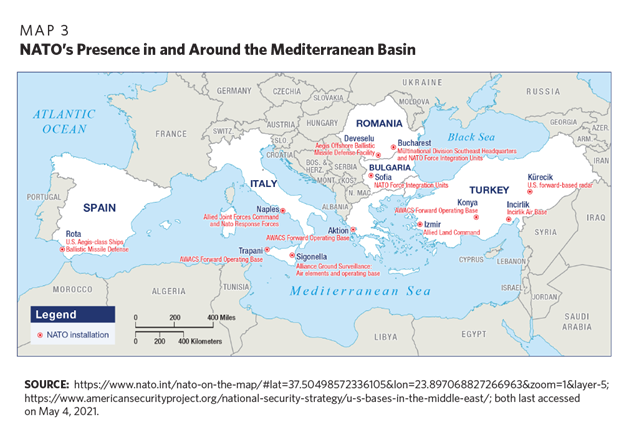
Syria occupies a critical position on NATO’s southern axis, adjacent to Turkiye and within reach of the Eastern Mediterranean and Levant. A durable extremist governance zone inside Syria therefore directly influences the Alliance’s security calculus, especially as NATO redefines its Southern Flank strategy to address hybrid and non-traditional threats. Viewing the region solely through a counter-terrorism lens risks overlooking the more complex and enduring challenge of extremist governance—where radical ideology becomes embedded within administrative institutions that function with surprising coherence (Zelin, 2022).
Hay’at Tahrir al-Sham, which originated as al-Qaeda’s Syrian affiliate Jabhat al-Nusra, has gradually evolved from a battlefield insurgency into an administrative authority with wide-reaching control. It now operates Sharia-based courts, internal security bodies, taxation systems, and educational institutions, effectively replacing state functions across key areas of northwest Syria (Lister, 2016; Drevon & Haenni, 2021). This evolution has produced a distinctive model of “extremist governance,” in which ideological rigidity blends with bureaucratic functionality to create a durable form of non-state rule (Haenni & Drevon, 2025). Rather than relying solely on violence, HTS sustains authority through institutions, social control, and selective service provision—especially in displaced communities that lack viable alternatives.
This evolution presents NATO with a strategic dilemma. The threat today is not limited to acts of direct terrorist violence but includes the normalization of a radical political order across generations and the entrenchment of extremist governance systems within the Alliance’s near neighborhood. HTS’s rule in Idlib is financially sustained by taxation, smuggling, and cross-border commerce, maintaining channels that facilitate not only basic subsistence but also arms flows, foreign fighter movements, and illicit financial transactions that reach far beyond Syria’s borders (Zelin, 2022). This institutional resilience directly impacts Turkey’s border security, increases migration pressure toward Europe, and threatens to undermine NATO’s broader southern perimeter.
Persistent instability also hampers United Nations humanitarian operations and political mediation efforts tied to the Geneva and Astana processes. As HTS tightens its control over civil space and movement in internally displaced camps, international access and influence shrink, making negotiated outcomes even more difficult (Droin, Encina, Hudson, & Uysal, 2024). Governance by extremism in Idlib is not a temporary insurgent phase but an evolving proto-state project that NATO cannot afford to ignore.
Some observers might argue that HTS’s consolidation of governance reflects pragmatic stabilization rather than a strategic threat, pointing to the group’s distancing from al-Qaeda and its suppression of Islamic State cells. This view, however, confuses tactical adaptation with substantive transformation. While HTS has softened its rhetoric and professionalized parts of its administration—as documented by Haenni and Drevon’s fieldwork—its core governance model remains exclusionary, authoritarian, and ideologically rigid (Haenni & Drevon, 2025). The European Union Agency for Asylum’s 2024 guidance documents ongoing restrictions on civil liberties, arbitrary detention, and systematic constraints on independent civil society (EUAA, 2024). For NATO, the relevant question is not whether HTS is “better” than the Islamic State, but whether the Alliance should accept the institutionalization of any extremist governance model on its southern periphery. Whatever stability HTS provides is fragile, coercive, and fundamentally incompatible with the norms that underpin Euro-Atlantic security.
HTS’s consolidation also indirectly benefits Russia and Iran, whose strategic posture in Syria relies on a fragmented, weakened, and internationally isolated northwest. A durable HTS-controlled enclave limits the reach of internationally supported governance alternatives, undermines Turkish security, and diminishes Western leverage in Syrian negotiations. This dynamic reinforces a regional balance that accrues to the benefit of Moscow and Tehran at NATO’s expense.
The structural threat NATO isn’t preparing for: What should NATO do?
What NATO faces today in northwest Syria is not a temporary insurgency but the steady entrenchment of a proto-state combining coercion, ideology, and administrative capacity. The longer HTS remains unchallenged, the deeper its institutional, economic, and social roots will grow, embedding extremist norms into local structures and normalizing an alternative governing order that rivals state authority (Drevon & Haenni, 2021). Governance by extremism represents a long-term hybrid threat precisely because it blurs the boundary between militant activity and state-like authority. This complicates counterterrorism planning, stabilization frameworks, and any future political settlement, while creating a governance structure that is resilient, adaptive, and difficult to dislodge (Haenni & Drevon, 2025).
Empirical conflict data confirm that HTS is consolidating, not weakening. ACLE-derived reporting shows that Idlib remains one of Syria’s most volatile regions, with more than 1,800 security incidents recorded between August 2022 and July 2023. Many of these incidents involved HTS or its affiliated security structures, underscoring the group’s sustained operational tempo and territorial entrenchment (EUAA, 2024, summarizing ACLED). At the same time, multiple security assessments—including the EUAA’s 2024 Syria analysis and U.S. Department of State reporting—identify northwest Syria as a persistent hub for jihadist facilitation networks, foreign fighter remnants, and cross-border logistical chains linking Syria, Türkiye, and parts of Europe. This ecosystem does not represent an isolated militant pocket but a durable extremist governance zone with regional reach, influencing migration flows, clandestine financial circuits, and broader regional stability. The danger is not territorial expansion but the deepening of governance capacity to the point where reversing HTS control becomes economically, socially, and politically prohibitive.
Three interconnected mechanisms help explain how this governance consolidation translates into regional threats. First, institutional capacity enables dual-use infrastructure: the same administrative systems HTS uses to collect taxes, regulate markets, and issue identity documents can facilitate weapons smuggling, foreign fighter transit, and illicit financial flows. As the Middle East Institute’s 2021 analysis shows, HTS’s control of the Bab al-Hawa crossing and its formalized revenue streams generate tens of millions of dollars annually while creating logistical corridors that extend well beyond Idlib (MEI, 2021). Second, economic integration creates regional dependencies and leverage points. HTS’s governance intersects with Turkish border trade, diaspora remittances, and informal hawala networks that the Financial Action Task Force identifies as potential conduits for terrorism financing (FATF, 2025). These linkages give HTS influence far beyond its territory, shaping migration patterns, commercial ties, and financial circuits across the Eastern Mediterranean. Third, generational normalization embeds extremist frameworks. Prolonged exposure to HTS governance socializes communities—particularly internally displaced groups and youth—into alternative political norms, creating long-term ideological resilience. International Crisis Group analyses document how HTS has systematically marginalized moderate governance alternatives and consolidated ideological control over educational and religious institutions (Haenni & Drevon, 2025; Drevon & Haenni, 2021).
Ignoring this evolution risks allowing an extremist governance system to solidify just beyond NATO’s borders. Comparable cases—Hezbollah in Lebanon, Hamas in Gaza, and the Taliban in Afghanistan—illustrate how militant organizations that develop coherent governance structures become durable political actors, often unaffected by battlefield defeats (Lob, 2018; Hazbun, 2016; Brown, 2012; Morisco, 2023). Although Syria differs in its geographic proximity to NATO territory and its intersection with multiple regional conflicts, the underlying dynamic is the same: governance consolidation creates path dependencies that constrain future policy options. What distinguishes the HTS case is that NATO still has a window—albeit narrow—to apply lessons from these precedents before extremist governance becomes firmly entrenched on its immediate southern flank.
How NATO can close this strategic gap
The regional spillover effects of HTS’s entrenchment are already visible. International Crisis Group analyses and CrisisWatch updates document regular cross-border security incidents, drone strikes, artillery exchanges, and infiltration attempts along the Turkish-Syrian frontier—highlighting the persistent risk of spillover into Türkiye’s southern provinces (ICG, 2013; CrisisWatch 2023–2024). At the same time, multiple economic studies indicate that Idlib has become a critical node in informal financial circuits. Hawala networks in Afrin and Idlib experienced significant inflows of remittances after the 2023 earthquakes. HTS-affiliated financial channels—including the evolution of the al-Waseet hawala system into Sham Bank—facilitate commercial transactions and cross-border fund flows, while FATF and CTC reporting identifies Idlib-based virtual asset platforms and NGOs suspected of involvement in illicit or extremist-linked financial activity (MEI, 2021; FATF, 2025; CTC, 2020). These patterns show that HTS governance is directly entangled with NATO’s southern security environment, shaping migration pressures, armed activity, and criminal economies that reach far beyond Syria.
Although NATO has clear security interests in Syria, its ability to influence developments remains limited. The Alliance lacks a mandate to operate inside Syria, and the entrenched presence of Russia and Iran significantly restricts NATO’s room to maneuver (GMF, 2022). Member states have also struggled to reach a unified position on Syria, particularly following the U.S. draw-down and shifts in Turkish border strategy (CEPA, 2022). These political and operational constraints mean that NATO must rely on tools short of direct intervention—intelligence coordination, border security support to Türkiye, counterterrorism cooperation, and diplomacy grounded in humanitarian principles. Recognizing these limits strengthens rather than weakens the argument for proactive engagement.
NATO should take several steps
Integrate northwest Syria into NATO’s Southern Flank Strategy
NATO should embed Syria’s northwest into its Southern Neighbourhood and Strategic Direction South frameworks, consistent with the Alliance’s 2024 independent expert group recommendations emphasizing the centrality of Middle Eastern hybrid threats.
Strengthen local resilience and alternative governance
Partnering with vetted civil society groups and moderate governance structures can provide essential services outside HTS’s control, reducing community reliance on extremist institutions (Drevon & Haenni, 2021). This approach weakens HTS’s social legitimacy and promotes locally-driven stability.
Deepen intelligence and counterterrorism cooperation with Turkey.
Given its proximity to Idlib, Türkiye is indispensable to managing the region’s security landscape. Enhanced NATO–Türkiye coordination—including joint surveillance, border security, and counter-finance initiatives—would help contain militant activity and reduce spillover risks (CEPA, 2022).
To move past the current deadlock, NATO could help set up a practical coordination mechanism, something like a small, standing council focused on keeping communication open between Türkiye, the SDF, and the relevant Syrian authorities. The point is not to negotiate a political settlement, but to create a space where each side can raise concern, clarify intentions, and prevent misunderstandings that often lead to escalation along the border. This kind of structured dialogue would also give Türkiye the assurance that the SDF is not drifting toward becoming a long-term threat. At the same time, NATO and Türkiye could work together to strengthen monitoring and early warning system along the Syrian Turkish border, especially in the area where the SDF is active. That would send a clear signal that Türkiye security concerns are treated seriously. And throughout this process, NATO should keep its message steady and unified. The goal is a stable Syria, no safe havens for extremist groups and full respect for Türkiye’s legitimate security worries. Reaching that point requires progress on three fronts- security corporation, rebuilding local governance, and ultimately reintegrating local forces into a future Syrian state.
Leverage diplomatic and reconstruction tools.
NATO and its member states should work with the EU and the UN to ensure that reconstruction assistance and diplomatic engagement are tied to governance benchmarks. These benchmarks should include:
(1) verifiable reductions in arbitrary detention and torture;
(2) expanded space for independent civil society;
(3) transparent revenue collection and third-party taxation audits;
(4) judicial review mechanisms operating independently of HTS’s security apparatus; and
(5) inclusive governance structures that incorporate religious minorities, women, and non-HTS-affiliated community leaders.
These measures align with EUAA monitoring criteria and reflect best practices for post-conflict governance transitions (EUAA, 2024). Crucially, they are meant not to impose external models but to create conditions that allow local populations to exercise meaningful political agency.
Reframe strategic communication and awareness.
NATO must articulate a clear narrative that extremist governance—even within limited territory—is a systemic threat to Euro-Atlantic security. Sustained policy attention depends on recognizing and communicating this danger.
The cost of inaction for NATO
If NATO hesitates, the price will rise sharply—and the burden will fall squarely on its own members. Allowing HTS to deepen its grip in northwest Syria means watching an extremist governance system harden into something far more durable and costly to reverse. Their financial and commercial networks already facilitate the movement of weapons, foreign fighters, and illicit funds across the Turkish border (Middle East Institute, 2021; FATF, 2025). Every year that this system expands, the harder it becomes to disrupt it without major political or economic investment. For Turkey, continued instability translates into recurring border incidents, heightened security deployments, and increased pressure on already stretched provincial administrations (ICG, 2013). For Europe, it fuels irregular migration flows and undermines humanitarian operations that are already struggling to reach nearly two million civilians in the region (UN OCHA, 2024). In strategic terms, delaying action opens more space for Russia and Iran to anchor themselves in Syria, allowing them to shape local dynamics in ways that weaken NATO’s influence across the Eastern Mediterranean (German Marshall Fund, 2022). The longer the Alliance waits, the narrower its options become—and the higher the political, financial, and security costs will be when action is finally unavoidable.
Final words
The future of northwest Syria will not be decided by front-line maps or cease-fire arrangements but by which governance model endures. If NATO remains passive, it risks confronting a resilient, ideologically rigid enclave whose institutions, economic networks, and security apparatus are already self-sustaining. Preventing that outcome does not require direct military involvement. Instead, it demands coordinated political, intelligence, and stabilization measures that align NATO’s southern commitments with the realities of a region where extremist governance—not traditional insurgency—now defines the strategic landscape.
The question is not whether NATO should act, but how soon the Alliance can recognize that governance by extremism, if allowed to harden, will shape regional order for years ahead. Northwest Syria is not a peripheral theater; it is a real test of NATO’s ability to anticipate threats, adapt its posture, and act before extremist governance becomes an irreversible feature of its southern neighborhood.
References
Brown, N. J., & Shaikh, S. (2010). Hamas: The politics of governance. The Brookings Institution.
Center for European Policy Analysis. (2022). Turkey’s shifting Syria policy and NATO’s southern strategy. https://www.cepainstitute.org
Center for Strategic and International Studies. (2023). Examining extremism: Hay’at Tahrir al-Sham. https://www.csis.org
Combating Terrorism Center at West Point. (2020). Crypto and jihadist financial networks in Syria. https://ctc.westpoint.edu
Haenni, P., & Drevon, J. (2025). Transformed by the people: Hayat Tahrir al-Sham’s road to power in Syria. Hurst Publishers.
Hazbun, W. (2016). Assembling security in a ‘weak state’: The contentious politics of plural governance in Lebanon since 2005. Third World Quarterly, 37(6), 1053–1070. https://doi.org/10.1080/01436597.2015.1137024
Drevon, J., & Haenni, P. (2021). How jihadists govern: A study of governance in Idlib. Chatham House. https://www.chathamhouse.org
Droin, C., Encina, C., Hudson, L., & Uysal, A. (2024). Humanitarian access and governance dynamics in northwest Syria. Stiftung Wissenschaft und Politik (SWP).
European Asylum Agency. (2024). Country guidance: Syria – Idlib governorate. European Union Agency for Asylum.
Financial Action Task Force. (2025). Comprehensive update on terrorist financing risks. https://www.fatf-gafi.org
German Marshall Fund. (2022). NATO, Syria, and the limits of Western influence. https://www.gmfus.org
International Crisis Group. (2013). Blurring the borders: Syrian spillover risks for Turkey (Middle East Report No. 225). https://www.crisisgroup.org
International Crisis Group. (2023–2024). CrisisWatch: Syria. https://www.crisisgroup.org/crisiswatch
International Viewpoint. (2023). The socio-economic impact of the 2023 earthquakes on opposition-held Syria. https://internationalviewpoint.org
Lister, C. (2016). The Syrian jihad: Al-Qaeda, the Islamic State and the evolution of an insurgency. Oxford University Press.
Lob, E. (2018). Construction Jihad: State-building and development in Iran and Lebanon’s Shi‘i territories. Third World Quarterly, 39(11), 2103–2125. https://doi.org/10.1080/01436597.2018.1460197
Middle East Institute. (2021). The economics of Hay’at Tahrir al-Sham. Middle East Institute. https://www.mei.edu
Morisco, V. (2023). From rebel governance to institutionalization? Prospects for the Taliban and Afghanistan (OIIP Working Paper No. 116). Austrian Institute for International Affairs. https://www.ssoar.info/ssoar/handle/document/90184
NATO. (2024). Independent expert group report on NATO’s southern neighbourhood. NATO Public Diplomacy Division.
NATO Strategic Direction South Hub. (2024). Threats, instability, and hybrid challenges in the Southern Neighbourhood. https://thesouthernhub.org
Organization for the Coordination of Humanitarian Affairs. (2024). Syrian Arab Republic: Humanitarian needs overview 2024. United Nations Office for the Coordination of Humanitarian Affairs.
United States Department of State. (2022). Country reports on terrorism 2022: Syria. https://www.state.gov
Zelin, A. Y. (2022). The state of jihadist governance: Structures, strategies, and durability. The Washington Institute for Near East Policy.

Dr. Rula Jabbour is a Postdoctoral Fellow at the Nebraska Deterrence Lab, Department of Political Science, University of Nebraska. She holds a Ph.D. in Political Science from the University of Nebraska-Lincoln, specializing in International Relations, Strategic Studies, and Middle Eastern Politics. Her research focuses on authoritarian governance, civil-military relations, counterterrorism, and post-conflict reconstruction in the Middle East.
Dr. Jabbour’s work has been published in Dynamics of Asymmetric Conflict, the Syrian Studies Journal,The MENA Journal on Violence and Extremism and is featured in forthcoming volumes with Springer Nature on regional security and innovation in the Eastern Mediterranean. She has presented her research at leading international conferences including ISA, APSA, and IPSA.
Dr. Jabbour has taught in many American universities during her career. She has taught a broad array of courses in international relations, Middle Eastern studies, and U.S. foreign policy, with a reputation for inclusive pedagogy and student engagement. Originally from Syria and a recipient of a prestigious U.S. State Department Scholarship, Dr. Jabbour brings a unique intersection of field-based insight and scholarly rigor to the study of regional security and conflict transformation.
- Dr. Rula Jabbour - Research Fellow