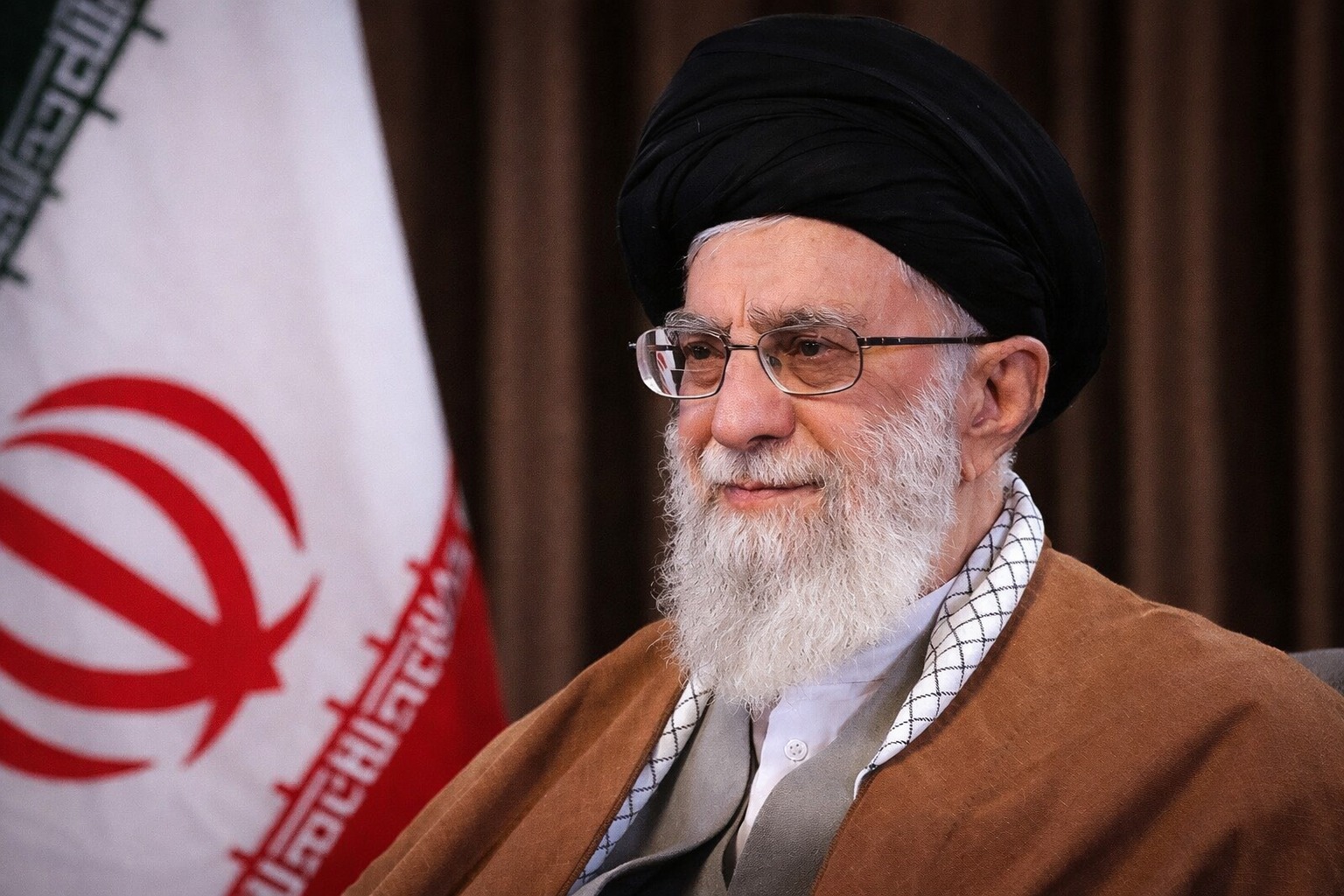
Ayatollah Ali Khamenei served as Iran’s Supreme Leader from 1989 until his reported death in February 2026.
Source: Khamenei.ir / Wikimedia Commons
In late February 2026, coordinated strikes by the United States and Israel targeted multiple sites in Iran’s capital, Tehran. Within hours, Iranian state media confirmed that Supreme Leader Ayatollah Ali Khamenei had been killed in the attack, ending his nearly 37-year tenure as the Islamic Republic’s supreme leader.
Iran responded with waves of ballistic missiles and armed drones aimed at Israeli territory and facilities hosting American and allied forces across Gulf states, Levant corridors, and the broader Middle East. Sirens sounded and interceptors engaged in Bahrain, Kuwait, Qatar, Iraq, and elsewhere as air defenses nationwide triggered high alert conditions.
This is not a typical confrontation in a long cycle of shadow conflicts. The targeted killing of a sitting head of state, the highest authority in Iran’s constitutional order, has abruptly reshaped deterrence dynamics, nuclear calculations, and alliance cohesion across the international system.
This commentary provides a strategic narrative built on open-source reporting, institutional context, and policy insight to help decisionmakers and informed citizens navigate this historic turning point.
1. Strategic Intent: What Were the Strikes Designed to Achieve?
Understanding intent is the first step in assessing strategic effects.
Leadership decapitation is not a limited kinetic choice; it carries broad political signals. Analysts at Just Security have raised deep questions about the legal basis for high-profile leadership strikes, arguing that expanding the circumstances for lethal force beyond active armed conflict challenges foundational principles of the jus ad bellum and international humanitarian law. Lawfare contributors have similarly warned that the broad exercise of presidential authority to target individuals without clear statutory or judicial grounding represents a profound shift in legal norms and executive incentives.
Was the objective to upend Iran’s command-and-control? To impose deterrence by demonstrating escalation dominance? To preempt an act perceived as imminent? Or to trigger a systemic realignment within Iran’s power structure? These are not mutually exclusive goals, and each carries distinct risks.
The strikes may have been intended to constrain Tehran’s nuclear calculus and disrupt its strategic proxies. Yet the removal of Khamenei also removes a central actor in Iran’s regime architecture, making any prediction about Tehran’s next moves contingent on institutional structures rather than individual actors.
2. Transition of Power: Who Now Governs?
Following confirmation of Khamenei’s death, Iran has moved constitutionally to manage the power transition. A three-member interim leadership council was established under Article 111 of the Iranian Constitution to exercise the duties of the Supreme Leader until a permanent successor is selected by the Assembly of Experts, an 88-member clerical body responsible for choosing the next supreme leader, as reported by Reuters.
The transitional council currently includes:
- Ayatollah Alireza Arafi, a senior cleric serving as the jurist member of the interim council who now assumes interim leadership authority.
- Masoud Pezeshkian, President of Iran and a reformist politician, representing the executive branch in the interim body.
- Gholam-Hossein Mohseni-Ejei, Chief Justice of Iran’s judiciary, aligning judicial authority with the interim leadership framework.
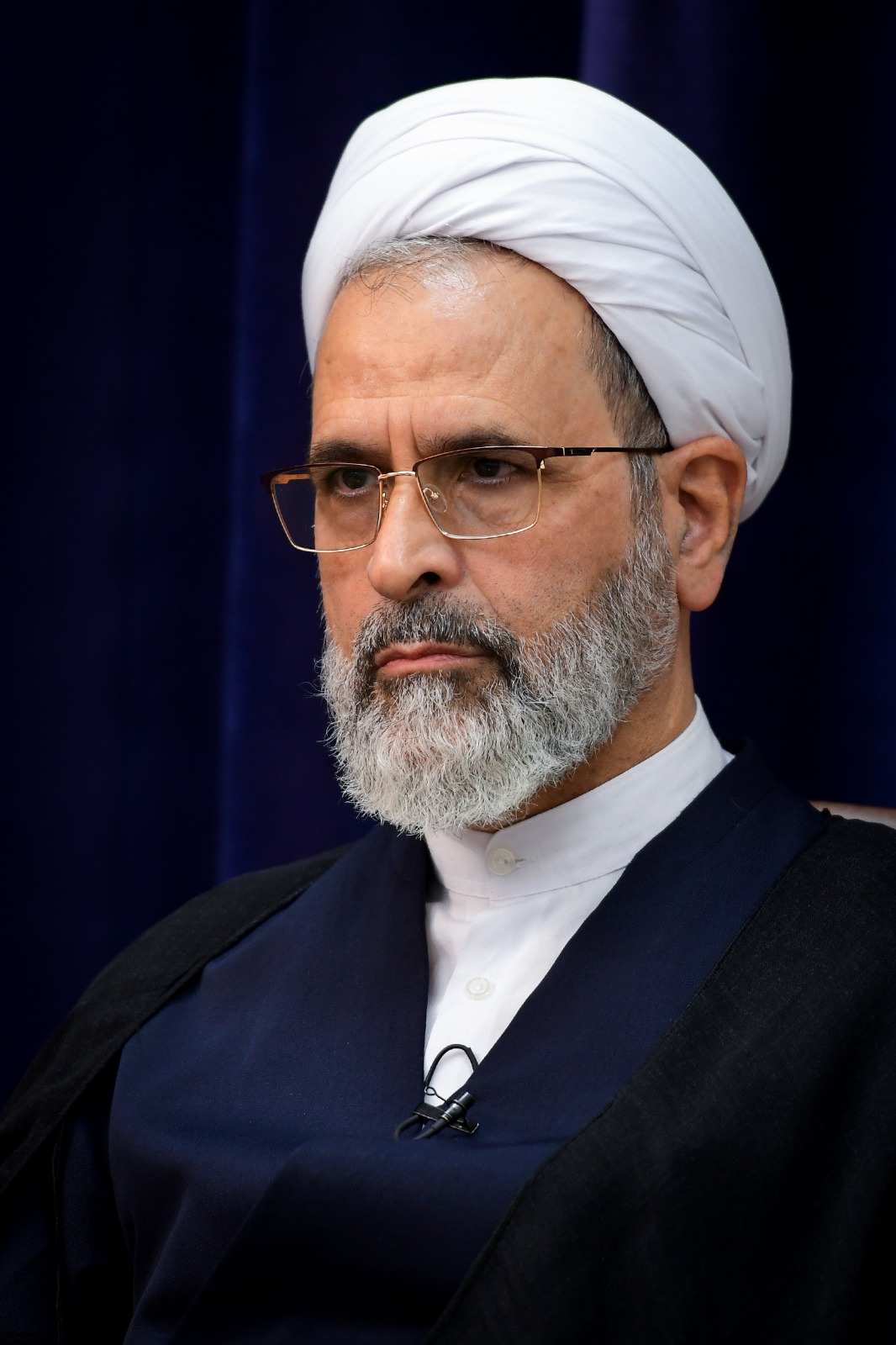
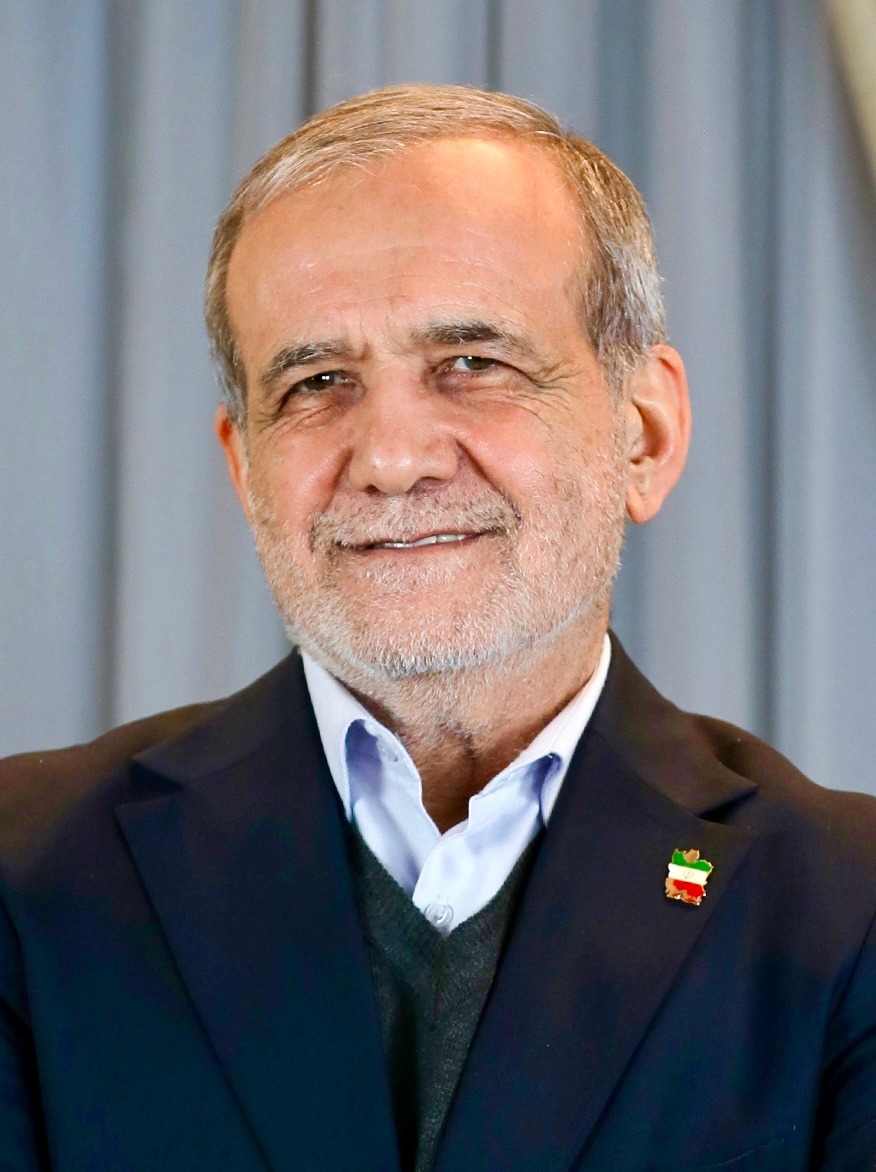
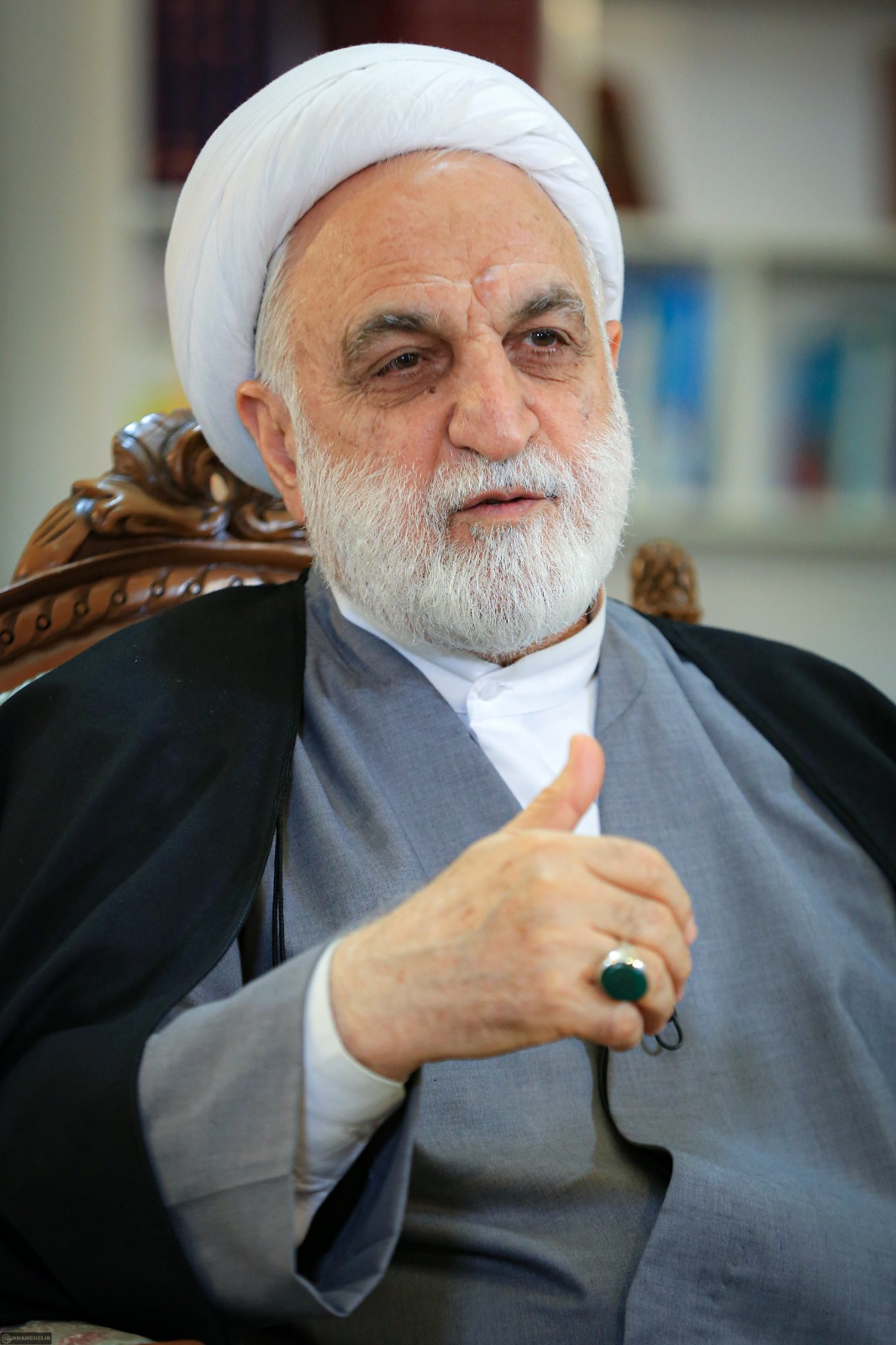
Composite image showing portraits of Ayatollah Alireza Arafi, President Masoud Pezeshkian, and Chief Justice Gholam-Hossein Mohseni-Ejei.
Source: Wikimedia Commons (All source images are licensed under Creative Commons Attribution 4.0)
This composition bridges the executive, judicial, and clerical domains, reflecting constitutional design intended to ensure continuity. Analysts, however, caution that the real locus of decision-making may depend on broader power dynamics, particularly the evolving role of senior security figures such as Ali Larijani and the influence of the Islamic Revolutionary Guard Corps (IRGC) as Iran’s succession process unfolds amid uncertainty. Reporting from Reuters and The Washington Post highlights how Iran’s succession arrangement has been complicated by the deaths of senior commanders, underscoring that informal power networks within the security apparatus may shape policy more than formal constitutional mechanisms.
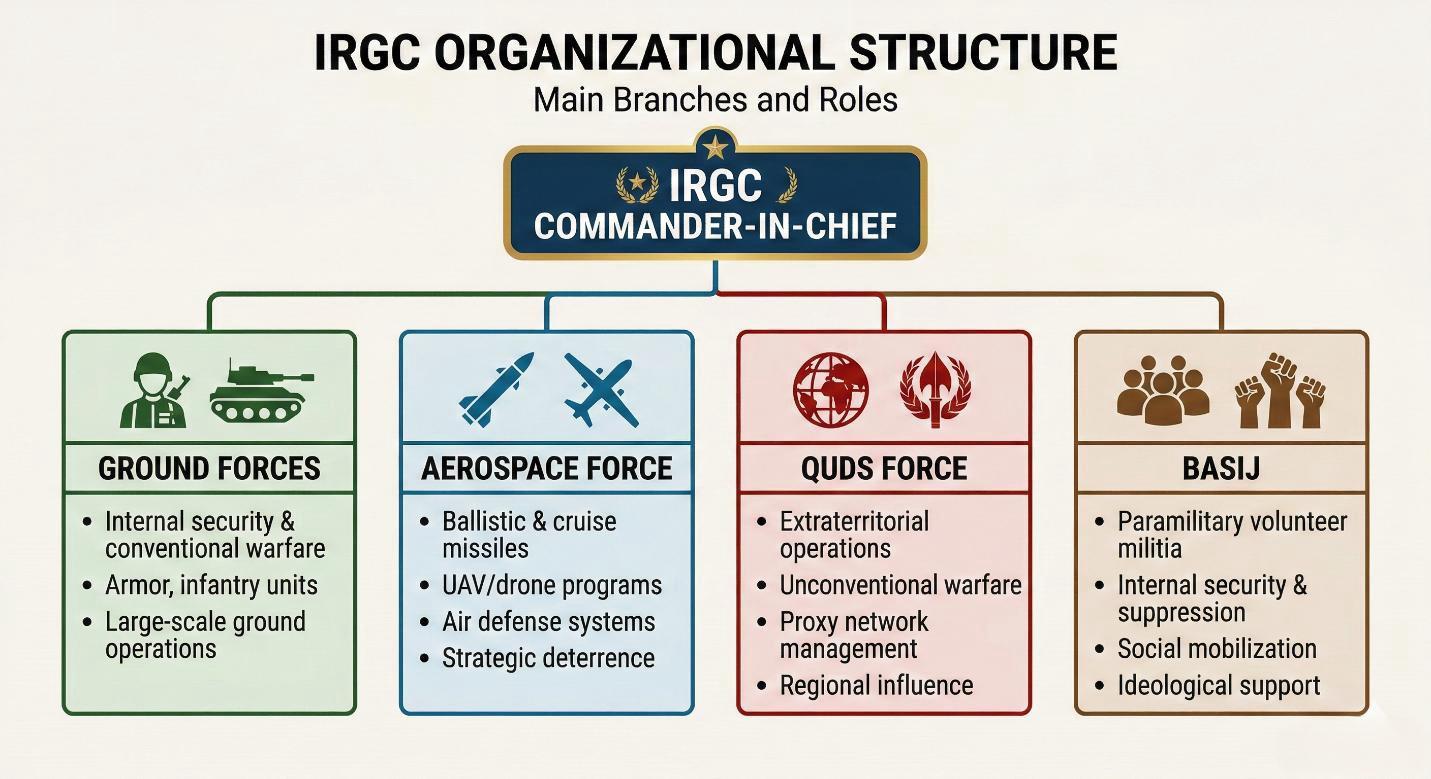
The Islamic Revolutionary Guard Corps (IRGC) plays a central role in Iran’s strategic decision-making and regional operations.
Sources: Graphic compiled using open-source institutional reporting (IISS and CSIS).
3. Nuclear Incentives in a Post-Khamenei Iran
One of the most consequential strategic implications of this crisis lies in nuclear signaling and incentive structures.
Iran’s nuclear enterprise, monitored by the International Atomic Energy Agency (IAEA) and the subject of sustained international reporting, has advanced steadily amidst restricted access and evolving enrichment activity following the collapse of the 2015 nuclear deal framework. Associated Press reporting notes that the IAEA cannot currently verify whether uranium enrichment has been suspended and highlights ongoing activity at key sites such as Natanz, Fordow, and Isfahan. Reuters summaries emphasize the urgency of inspection access and Iran’s stockpiling of enriched material under conditions of limited monitoring.
Leadership decapitation alters the logic of nuclear latency. Under Khamenei, nuclear advance was constrained by political calculus: weaponization carried enormous risk but not irrevocable isolation. In a post-Khamenei context, factions within Tehran may recalibrate around survival imperatives. The fear that nuclear latency failed to deter decapitation could incentivize movement toward explicit weapon capability, a profound strategic shift that would reverberate far beyond the region.
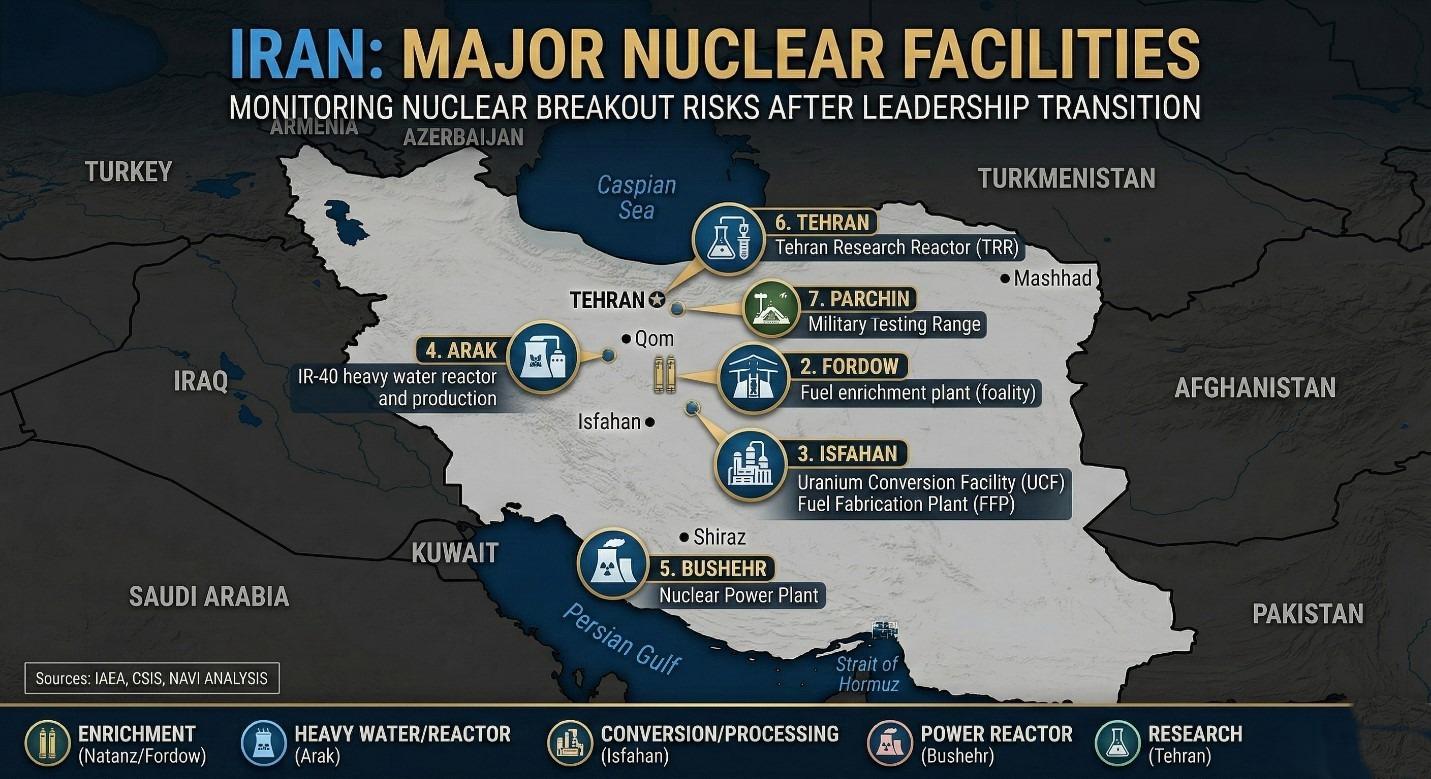
Major Iranian nuclear facilities monitored by the International Atomic Energy Agency (IAEA).
Sources: Graphic compiled using open-source institutional reporting (International Atomic Energy Agency (IAEA), CSIS Missile Defense Project, Institute for Science and International Security).
4. Sectarian Geometry and Regional Alignments
Iran’s self-described “Axis of Resistance,” encompassing networks such as Hezbollah in Lebanon, Houthi forces in Yemen, and various Iraqi and Syrian militias have been central elements of Tehran’s regional leverage. Yet the broader Middle Eastern landscape remains predominantly Sunni, with states like Saudi Arabia, the United Arab Emirates, Qatar, and Türkiye holding deep security ties with the United States and Western partners.
Clerical messages from cities like Najaf and Qom could shape whether this moment is framed as an existential confrontation or one requiring disciplined restraint. Sunni governments, meanwhile, must contend with their own internal dynamics and security exposures.
The 2019 Abqaiq and Khurais attacks on Saudi facilities, widely attributed to Iranian-aligned actors, demonstrated the vulnerability of Gulf energy systems and underscored that strategic geography cannot be ignored.
5. Missile Geography and Military Exposure
Iran’s ballistic and cruise missile inventory, detailed by CSIS and illustrated in publicly available range maps, places numerous allied bases and population centers within reach. Installations under CENTCOM, Israeli defense networks, and Gulf defense systems were actively tested in recent missile exchanges.
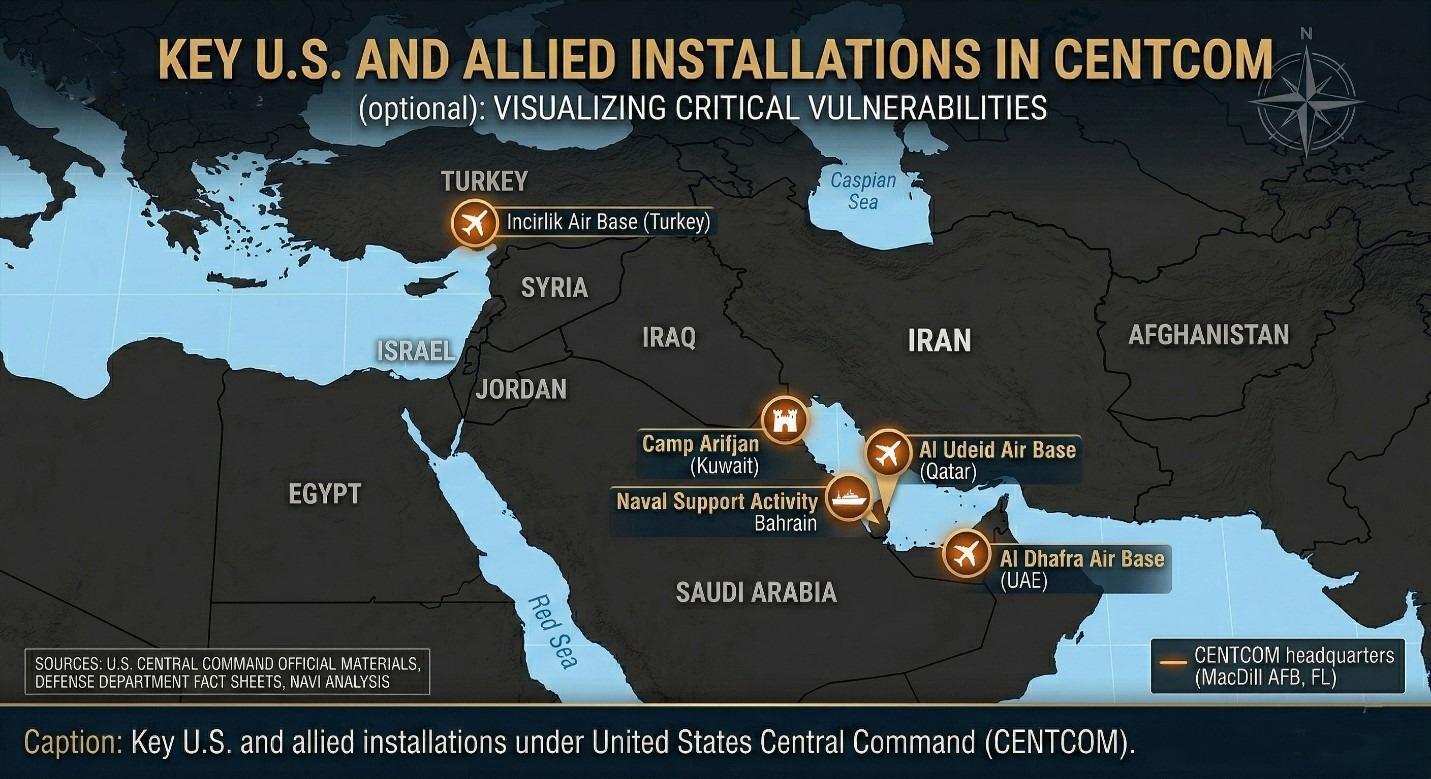
Key U.S. and allied installations under United States Central Command (CENTCOM).
Sources: Compiled using U.S. Central Command official materials, Defense Department fact sheets.
Threat rings emanating from Iranian territory cover strategic hubs such as the UAE, Qatar, Kuwait, and Bahrain, as well as Israel and southern Türkiye. Saturation attack doctrines, launching less accurate systems alongside advanced guided munitions, remain a doctrinal risk that could strain regional air defenses.
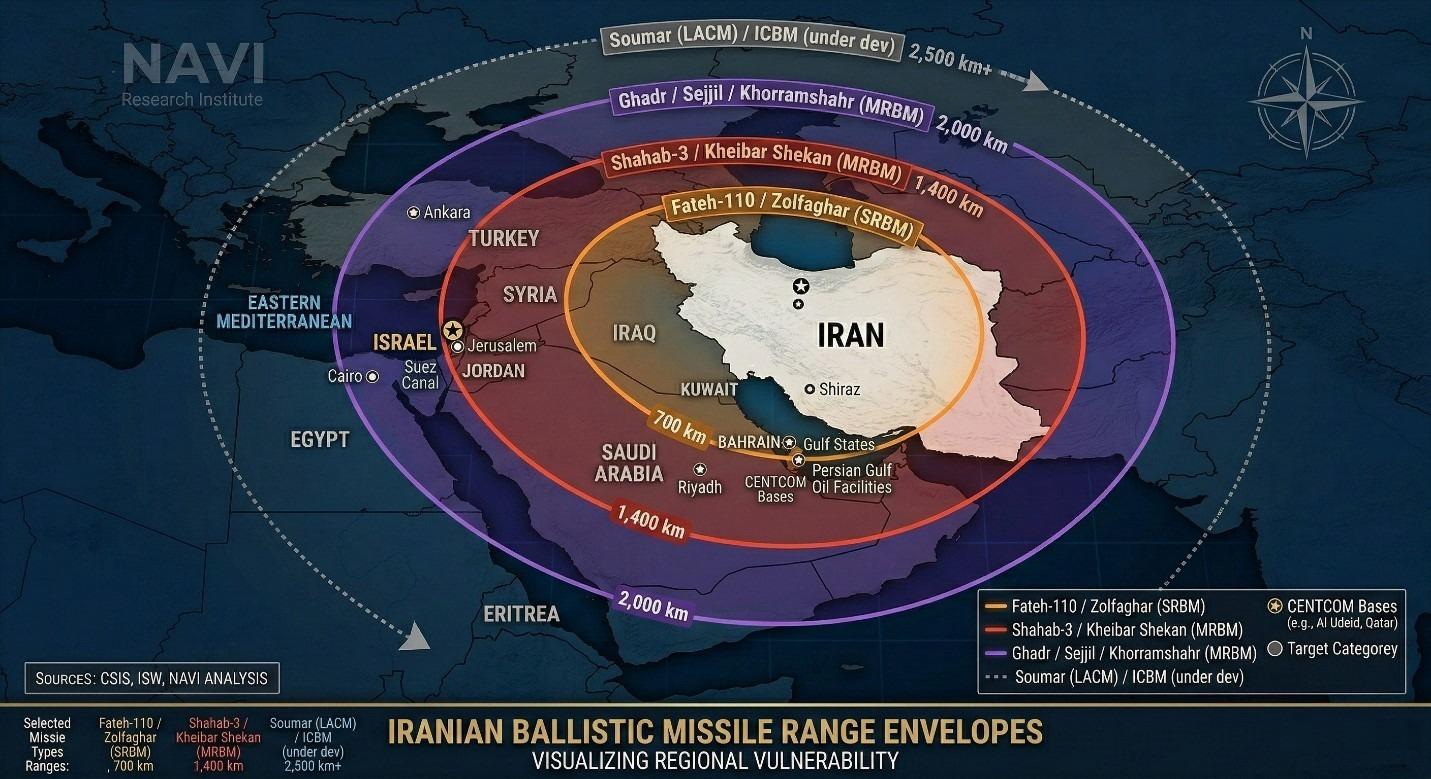
Iranian ballistic missile range envelopes place key military and energy infrastructure within reach.
Source: Compiled using open-source resources of CSIS Missile Defense Project, Institute for the Study of War.
6. Proxies and Distributed Battlefields
Iran’s partnerships with non-state and quasi-state actors create multiple indirect escalation channels that defy simple geographic containment. Groups within Lebanon, Iraq, Syria, and Yemen can strike maritime lanes, energy infrastructure, and soft targets. The autonomy of these proxies introduces unpredictability; Tehran’s capacity to restrain or direct them remains unclear and will be a central variable in the direction of escalation.
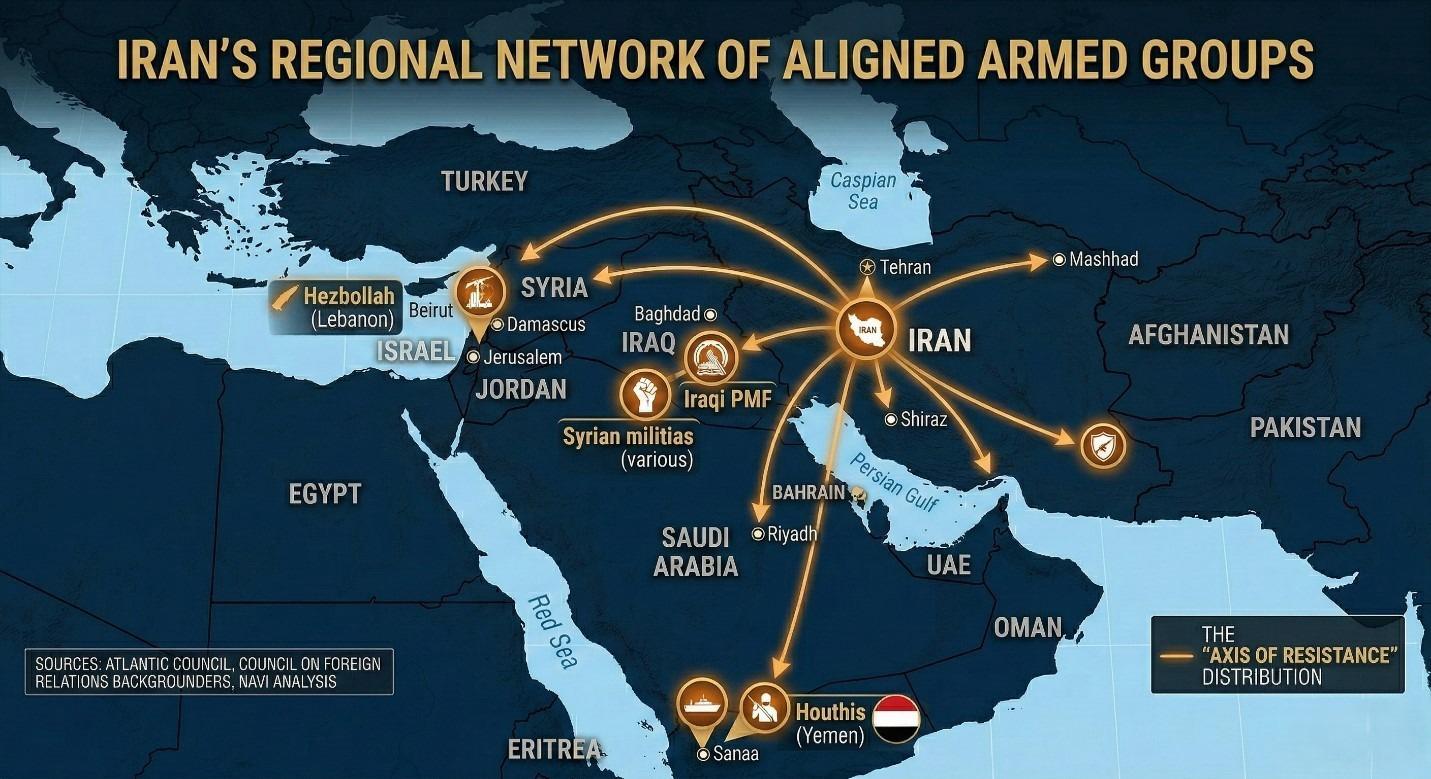
Iran’s regional network of aligned armed groups across Lebanon, Iraq, Syria, and Yemen.
Sources: Compiled using open-source institutional reporting Atlantic Council, Council on Foreign Relations backgrounders.
7. Energy, Global Markets, and Economic Spillover
The Strait of Hormuz remains one of the world’s most critical maritime chokepoints for energy trade. Significant portions of internationally traded crude oil and liquefied natural gas transit these waters. Disruption, even localized, can trigger disproportionate market reactions, insurance cost surges, and supply chain stress.
Europe, already seeking diversified sources after the upheavals of the 2020s, is economically exposed. Escalation that extends to maritime interdiction or Gulf infrastructure targeting would not be limited to military calculus; it would affect global energy security and political receptivity in NATO capitals.
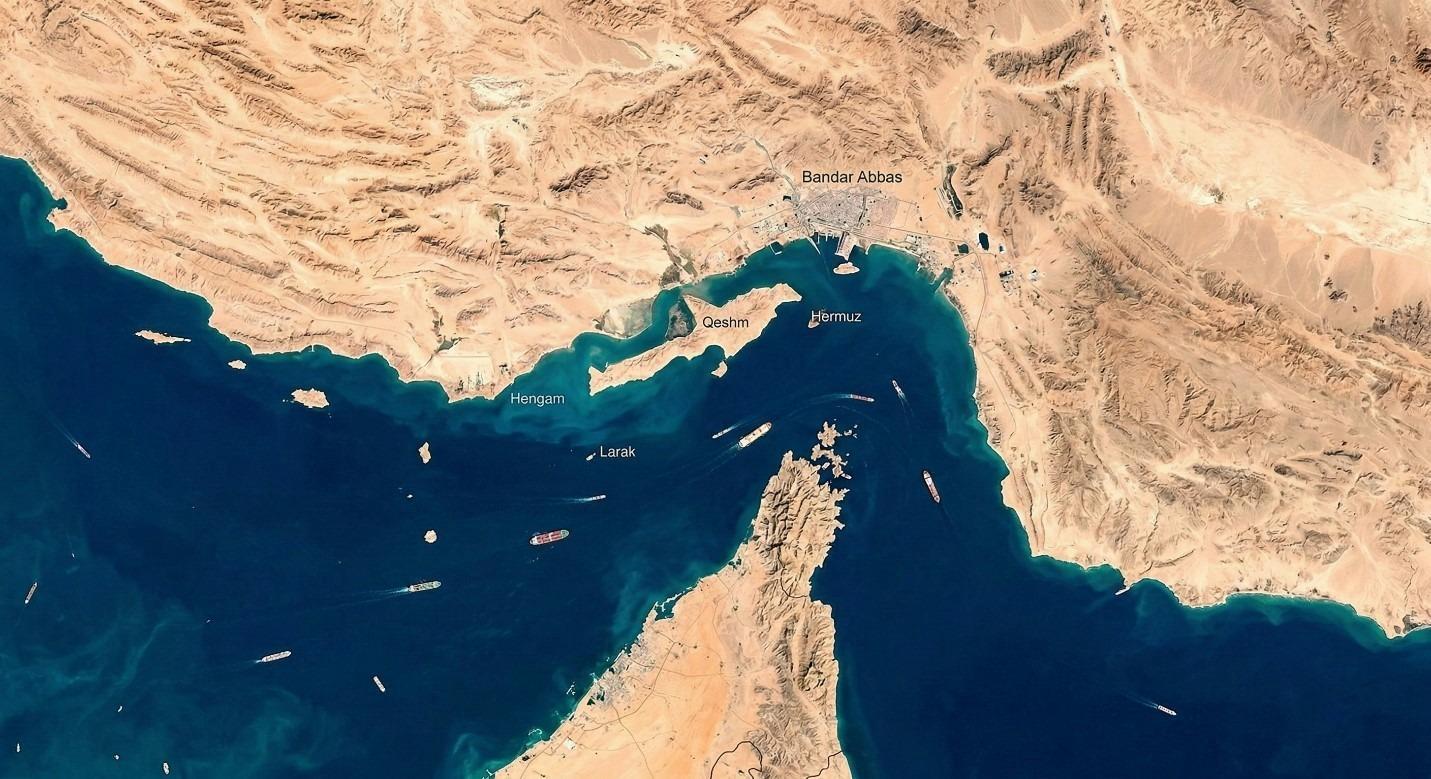
The Strait of Hormuz remains one of the world’s most critical maritime energy chokepoints.
Sources: Compiled using open-source resources of NASA Earth Observatory and U.S. Energy Information Administration (EIA).
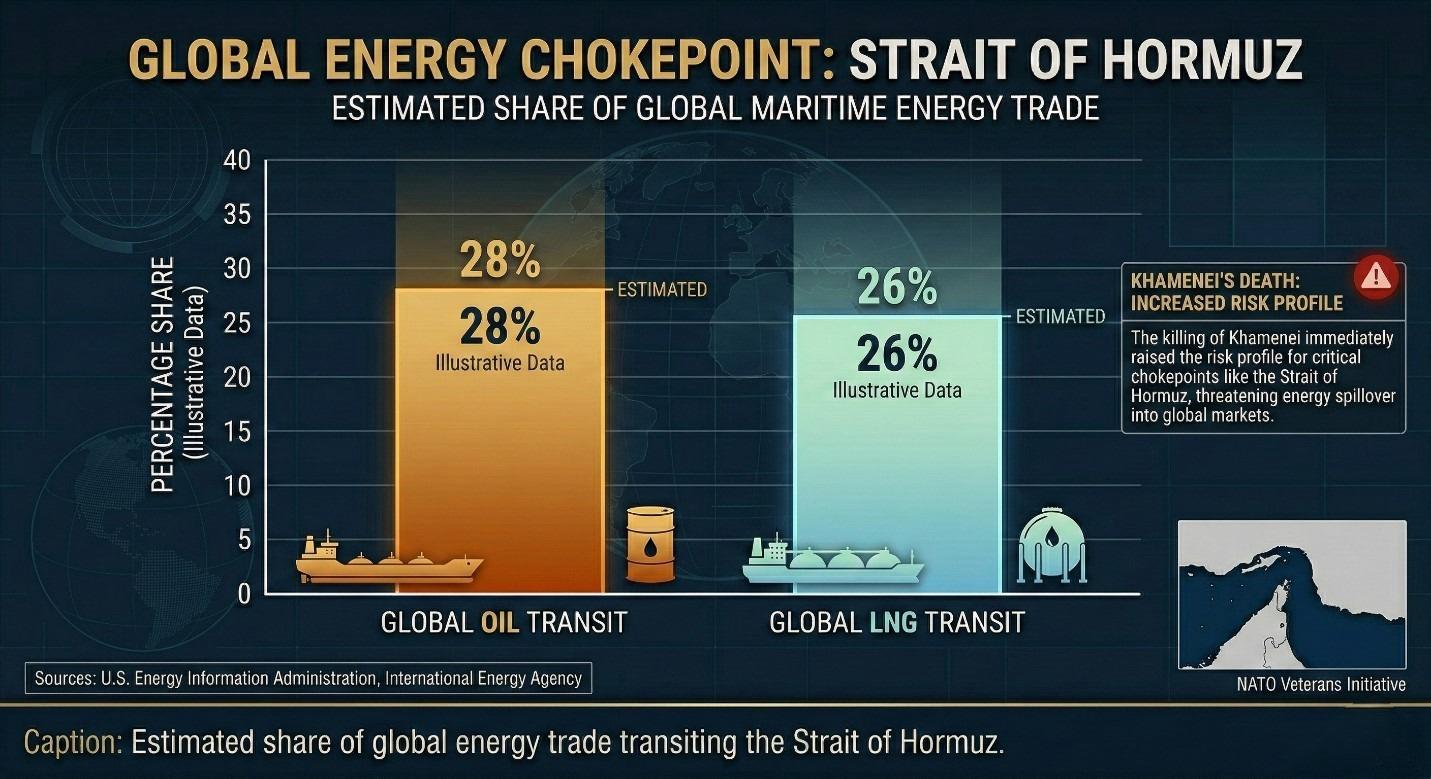
Estimated share of global energy trade transiting the Strait of Hormuz.
Sources: Graphic compiled using open-source institutional reporting from the U.S. Energy Information Administration and International Energy Agency.
8. Great Power Positioning: Russia and China
No regional crisis unfolds independent of global power competition.
Russia may portray the strikes as evidence of Western destabilization while seeking diplomatic leverage. China, heavily dependent on Gulf energy imports, has vital economic interests at stake. Both powers will observe NATO’s internal coherence, communication discipline, and alliance signaling. Fragmentation benefits geopolitical competitors; unity reinforces strategic deterrence beyond the Middle East.
9. Cyber Escalation: An Emerging Domain
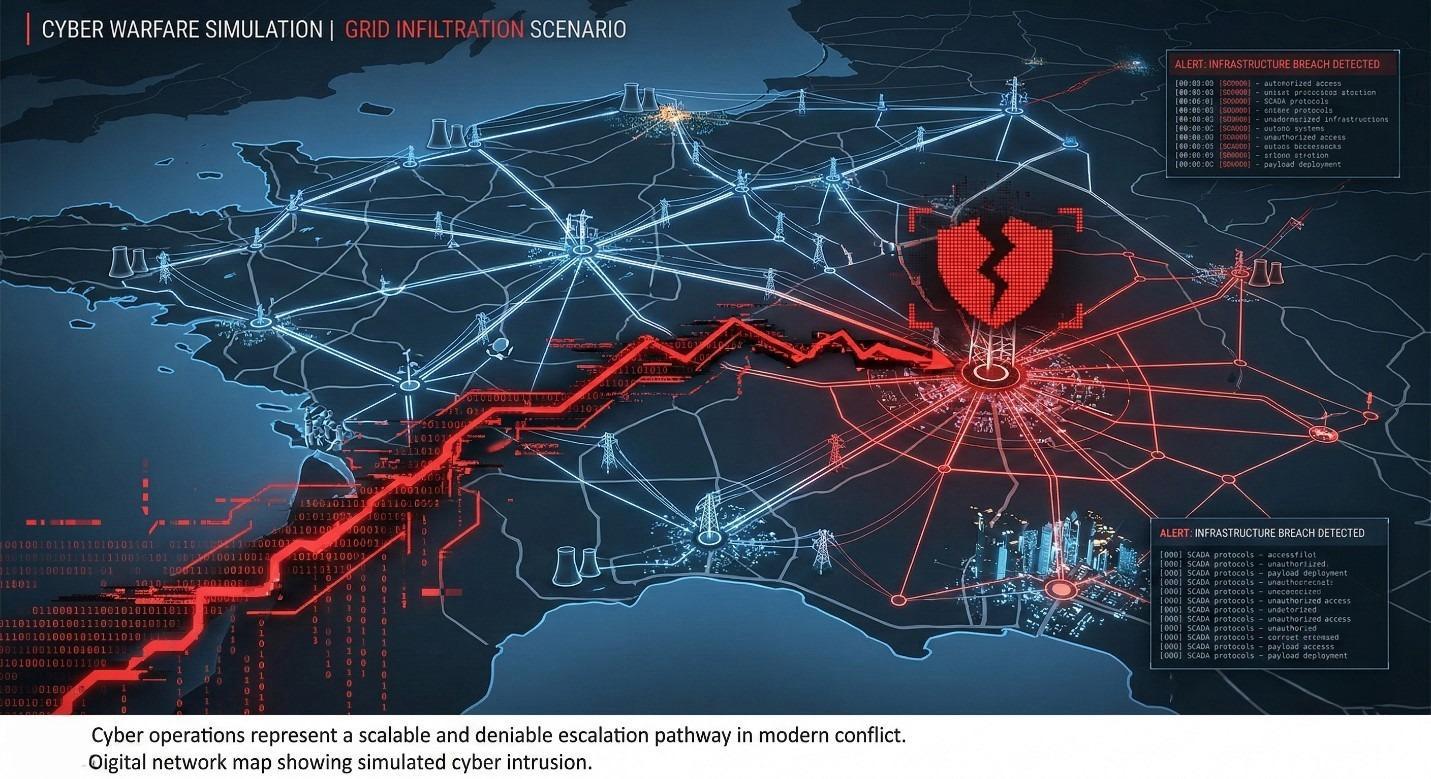
Iran has developed cyber capabilities that have previously targeted financial services and infrastructure sectors. In a crisis where kinetic risk is high, cyber retaliation can offer deniability and flexibility. Attacks against critical infrastructure logistics, energy grids, or supply chains could introduce an additional domain of escalation without crossing traditional red lines.
10. Iran’s Resilience and Slow‑Burn Transformation
The regime faces intense internal and external pressure. Still, its multilayered power structure, the cohesion of the security apparatus, and the economic-military dominance of the IRGC gives it significant short-term resilience. Public protests have eroded ideological legitimacy yet lack unified leadership or organizational capacity, limiting their ability to topple the system. Economic crisis fuels discontent but does not, by itself, trigger collapse as long as oil revenues and external lifelines from China and Russia continue.
External actors, including the U.S., Israel, and Gulf states, prefer a weakened but stable Iran over a chaotic collapse, and foreign pressure alone cannot produce regime change without an internal alternative.
As a result, Iran is more likely to undergo a prolonged phase of stress, adaptation, and partial transformation, marked by a stronger security apparatus, possible limited reforms, continued economic strain, and a recalibration of its regional networks, rather than an abrupt fall, with meaningful change emerging only gradually from within.
11. Alliance Cohesion: NATO, Türkiye, and Collective Response
Türkiye’s geographic proximity, hosting of key facilities like Incirlik Air Base, and intricate political positioning make its framing central to alliance unity. NATO consultation mechanisms, including Article 4 diplomatic engagement, are already active. Cohesion in messaging and shared thresholds for escalation will determine whether this crisis tests the alliance’s structural resilience or catalyzes fragmentation.
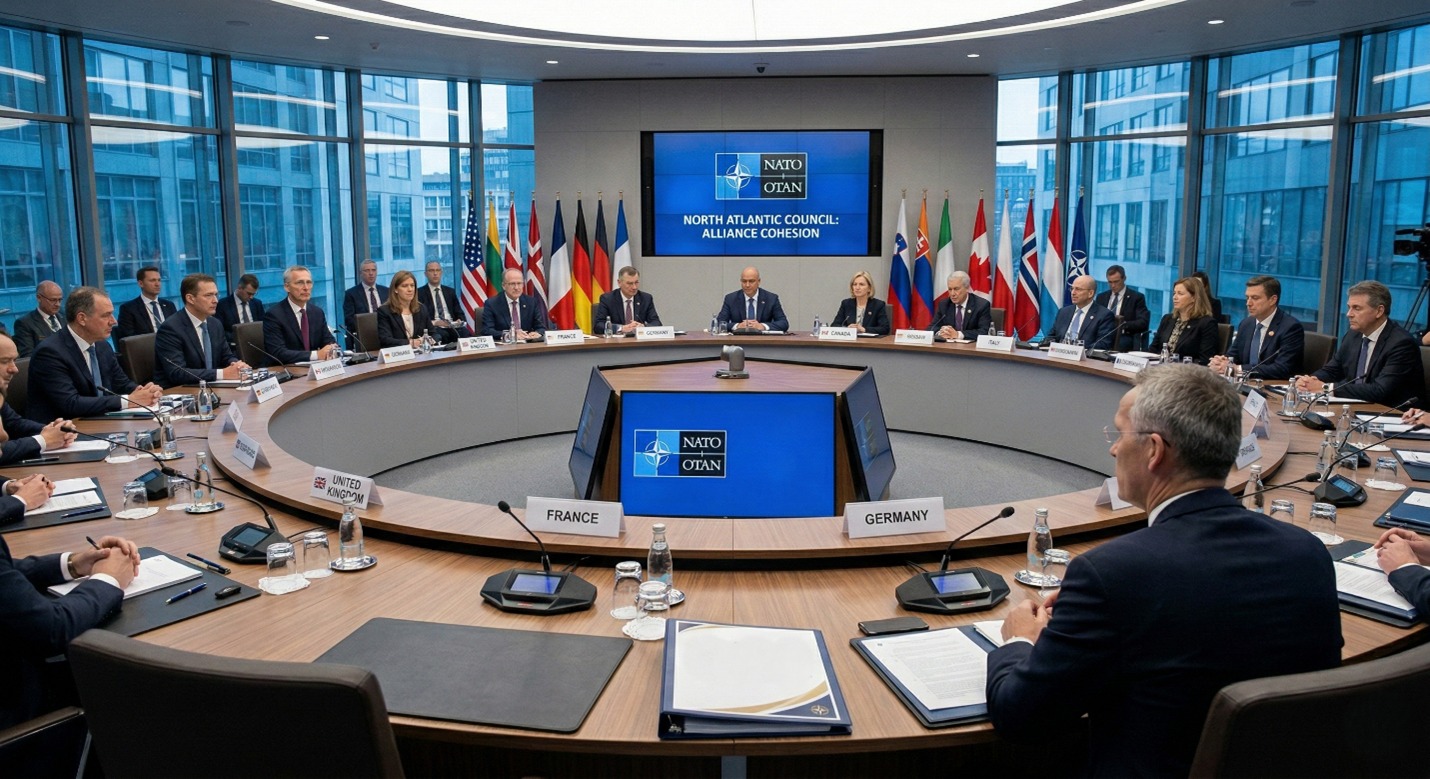
Illustrative Photo – NATO foreign ministers meeting amid rising regional tensions. Generative AI.
12. Law, Norms, and Precedent
The targeted killing of a sitting head of state raises profound legal questions under the UN Charter. Debates in Just Security and Lawfare underscore competing interpretations of self-defense, proportionality, and sovereign equality. The precedent set here will not remain confined to a single case; it will echo in future leadership targeting debates globally.
13. The Potential Escalation Steps
Escalation may follow identifiable pathways:
- Symbolic retaliation
- Maritime interdiction
- Critical infrastructure strikes
- Proxy saturation campaigns
- Mass-casualty engagements
- Multi-front regional war
The current phase appears to sit between infrastructure targeting and expanded saturation risk. Institutional control, calibrated signaling, and diplomatic interventions will determine upward or downward mobility along this ladder.
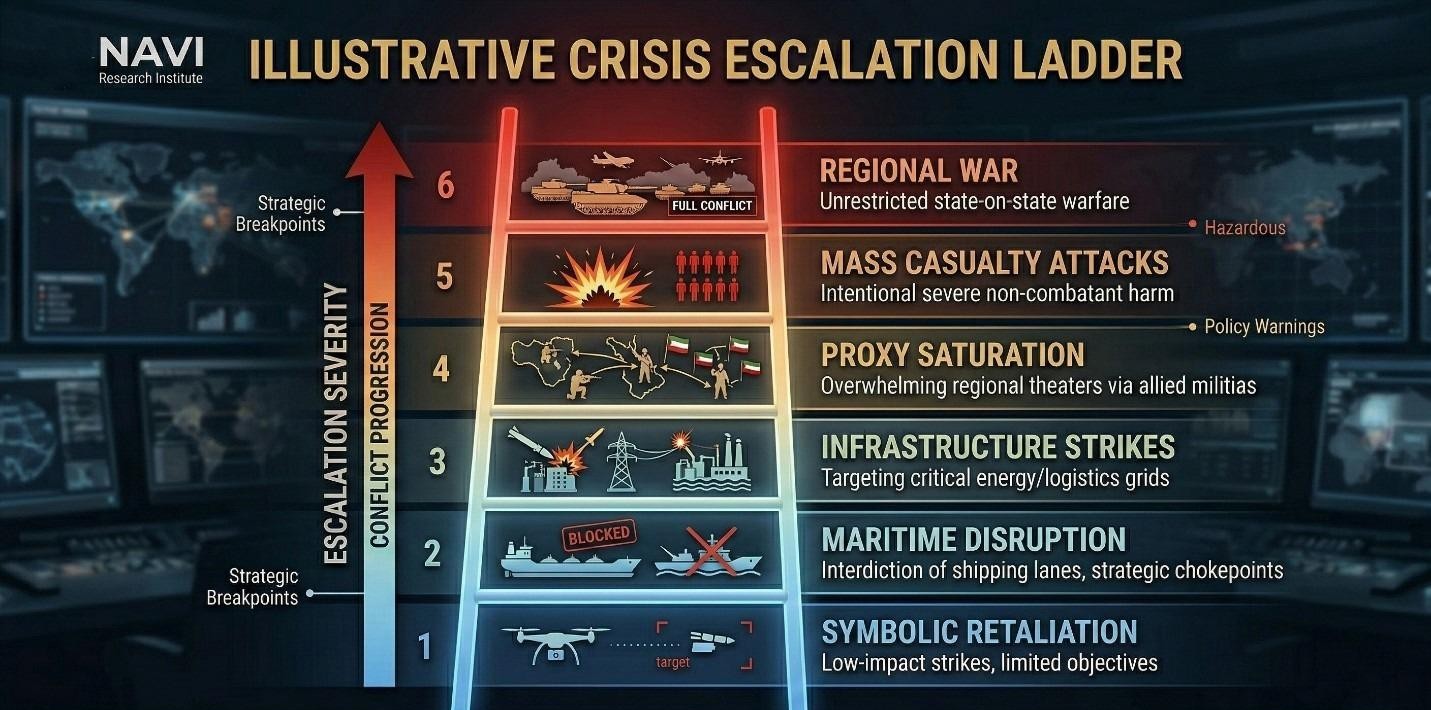
Building on classical escalation-ladder theory (Kahn, 1965), this model outlines plausible pathways for crisis intensification in the Iran theater.
14. Policy Considerations
NATO governments and partners should prioritize:
- Integrated air and missile defense coordination.
- Clear escalation thresholds and transparent public communication.
- Early engagement with regional mediators.
- Strengthened allied cyber defense postures.
- Humanitarian contingency planning.
- Structured alliance consultation to reinforce cohesion.
Preparedness with discipline, not provocation, must guide policy choices today.
Conclusion
Escalation is not inevitable. Yet restraint is not automatic.
The killing of Supreme Leader Ali Khamenei has altered deterrence logic, nuclear incentives, and alliance stress points simultaneously. The choices made in the coming weeks will shape not only Middle Eastern security but also energy markets, global norms, and the broader international order.
The strength of the Transatlantic Alliance rests not only on military capability but on a shared commitment to democratic governance, the rule of law, human rights, and collective defense. In periods of strategic uncertainty, alliance cohesion and disciplined coordination become decisive variables. Whether the current crisis escalates or stabilizes will depend less on rhetoric than on institutional clarity, calibrated deterrence, and sustained political resolve.
Further Reading
General Reporting on the Strikes and Immediate Escalation
- Reuters – Middle East coverage and breaking reporting on U.S.–Israel strikes and Iranian retaliation
https://www.reuters.com/world/middle-east/ - BBC News – Explainer coverage on Iran leadership and regional escalation
https://www.bbc.com/news/world-middle-east - Associated Press – Reporting on missile salvos, regional air defenses, and Gulf alerts
https://apnews.com/hub/middle-east - Institute for the Study of War (ISW): Iran Updates Detailed daily tactical maps, strike mapping, and escalation assessments covering the IRGC and regional militias.
Iranian Leadership Structure & IRGC Role
- Assembly of Experts – Constitutional role in selecting the Supreme Leader
(Background summary)
https://www.britannica.com/topic/Assembly-of-Experts - International Institute for Strategic Studies – Analysis of IRGC structure and strategic influence
https://www.iiss.org/ - Center for Strategic and International Studies – Iran military power and IRGC assessments
https://www.csis.org/programs/missile-defense-project
Missile Capabilities & Regional Base Exposure
- Center for Strategic and International Studies – Missile Defense Project (Iran missile ranges and systems)
https://missilethreat.csis.org/country/iran/ - Institute for the Study of War – Regional strike mapping and escalation assessments
https://www.understandingwar.org/ - United States Central Command – Official posture and force presence updates
https://www.centcom.mil/
Iran’s Proxy Network
- Atlantic Council – Iran’s regional network and “Axis of Resistance” analysis
https://www.atlanticcouncil.org/ - Council on Foreign Relations – Backgrounders on Hezbollah and Iran-backed groups
https://www.cfr.org/
Gulf Infrastructure & Precedent Attacks
- Reuters Special Report – 2019 Abqaiq/Khurais attacks
https://www.reuters.com/investigates/special-report/saudi-aramco-attacks/
Türkiye& NATO Context
- NATO – Official alliance doctrine and member responsibilities
https://www.nato.int/ - Incirlik Air Base – Background and U.S. operational role
https://www.af.mil/About-Us/Fact-Sheets/Display/Article/104546/incirlik-air-base/
Legal Debate on Leadership Strikes
- Just Security – Legal analysis on targeted killings and international law
https://www.justsecurity.org/ - Lawfare – Commentary on decapitation strikes and precedent
https://www.lawfaremedia.org/
Civilian & Humanitarian Risk
- United Nations Office for the Coordination of Humanitarian Affairs – Regional humanitarian situation reports
https://www.unocha.org/

Dr. Cihan Aydiner is an Assistant Professor and program director of Homeland Security at Embry-Riddle Aeronautical University Worldwide (ERAU-W). He has had prior academic and professional roles at Louisiana State University, Hybridcore (an AI-Powered Decision-Making Company), and Army. He has doctoral and master’s degrees in Sociology from Louisiana State University and a master’s degree in National and International Security Management from Army War College. He has many funded grant projects, publications, documentary films, and technical reports. Dr. Aydiner’s current research focuses on the complex interdependencies among policy, homeland security, and international migration.
- Cihan Aydıner - Research Fellow

- Cihan Aydıner - Research Fellow
- Cihan Aydıner - Research Fellow
- Cihan Aydıner - Research Fellow

- Cihan Aydıner - Research Fellow