
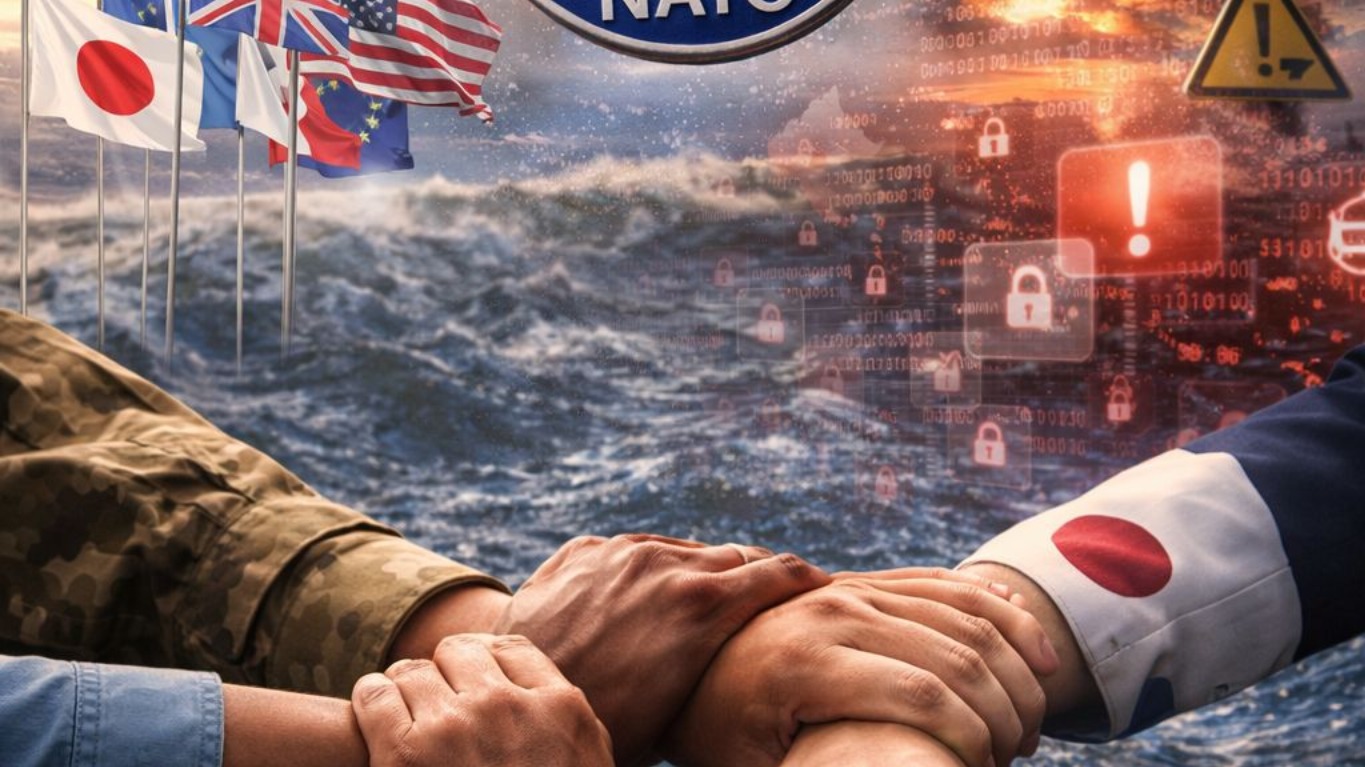
For more than three decades, European security planning has been shaped by the assumption that a major war on the continent was improbable. Defense spending decreased, industrial capacity decreased, and public expectations shifted towards a permanence of peace. This period was based on Cold War ideas about deterrence. Leaders believed that if other countries were unsure about the United States position, they would be less likely to escalate or start a conflict. In this context, President Donald Trump’s foreign policy has at times reflected elements of the “madman theory,” using unpredictability and rhetoric as a form of deterrence signaling.
Russia’s war of aggression in Ukraine has fundamentally altered Europe’s security landscape. European governments are now openly preparing their people for the possibility of conflict with Russia, a major shift from post–Cold War norms. Recent assessments cited by The Wall Street Journal state that NATO officials believe Russia could be capable of using military force against the alliance within five years, particularly if fighting in Ukraine subsides, and Russian forces are reconstructed.
For North Atlantic Treaty Organization (NATO), this is an inflection point, not a temporary crisis. In his press briefing, Secretary General of NATO Mark Rutte stated that there is a growing adversarial alliance among Russia, China, Iran, North Korea, and Belarus.
Deterrence Must Function Before a Ceasefire
NATO planning cannot assume that a ceasefire in Ukraine will create stability. If active combat decreases, Russia would likely regenerate, modernize, and put coercive pressure elsewhere. European intelligence services already assess that Russia is conducting an ongoing gray-zone campaign involving cyber operations, sabotage, disinformation, and airspace violations designed to try to make NATO cohesion weak without triggering Article 5.
Effective deterrence must therefore be strong and continuous. This requires forward defense on the eastern flank, operationally tested reinforcement plans, resilient logistics networks, and escalation-management options for sub-threshold attacks. Waiting to focus on deterrence until after diplomacy ends could leave a country vulnerable.
Ukraine as a Long-Term Capability and Deterrence Mission
Ukraine should be supported as a long-term effort to build strong defenses, not as a short-term crisis. NATO’s role should not be just a symbolic gesture, but a force to make sure Ukraine’s defense stays strong and impenetrable for any adversary. Standardized training pipelines, logistics integration, maintenance hubs, ammunition sustainment, and interoperable systems are more important than symbolic commitments. Layered defenses, unmanned systems, electronic warfare, coastal defense, and resilient command and control will decrease the risk of escalation by increasing the cost of renewed aggression.
Multi-Theater Stress and European Responsibility
The Greenland dispute shows how NATO can get pulled into more than one crisis at the same time, and sometimes the stress comes from inside the alliance, not just from Russia. After several tense months between U.S. leaders and Danish and Greenlandic officials, an agreement has finally been met. In January, the Trump administration held talks with NATO and European allies about Greenland and Arctic security. While President Trump previously said he wanted the United States to own Greenland, discussions of full ownership appear to have been a negotiation tactic. Instead, the talks focused on increasing NATO’s military presence in the Arctic, expanding U.S. access to military bases in Greenland, and blocking Russia and China from mining Greenland’s rare-earth minerals. Denmark and Greenland strongly oppose giving up any sovereignty, saying land ownership is not negotiable, even though they are open to security cooperation. European leaders welcomed the talks as a way of protecting the Arctic while respecting national sovereignty.
The Trump administration says Greenland matters for national security because it sits in a key spot in the Arctic and helps with early warning, space tracking, and watching Russian and Chinese activity. Trump also points to Greenland’s resources, especially rare earth minerals for technology, and he argues the U.S. should not let rivals gain influence there. At the same time, history reminds us that this is not a brand-new idea: the United States has tried, more than once, to buy Greenland, going back to the 1800s and again after World War II.
Many experts say the U.S. already has strong military access through existing agreements, so a full takeover was not necessary to protect U.S. interests. This deal boosts Arctic security without changing borders, it updates defense agreements, increases joint NATO planning and exercises, and gets more European forces and funding into Arctic defense so the U.S. can claim the region is more secure. In plain terms, what “satisfied” Trump as a visible win was this new and updated agreement, bigger allied contributions in the Arctic, and stronger security cooperation that he can point to as proof that his pressure worked.
On the other hand, China’s pressure on Taiwan and North Korea’s missile activity reinforce the likelihood of concurrent crises. NATO must therefore plan for European readiness even if U.S. forces are diverted elsewhere. This raises urgency for European capability development, especially in air and missile defense, munitions stockpiles, maritime security, logistics, and defense-industrial capacity. European allies must be able to carry a larger load of the conventional deterrence burden.
Global Distraction Is the New Normal
The war in Iran continues to threaten the Middle East and Europe. Venezuela’s instability signals renewed competition in the Western Hemisphere, affecting energy markets and diplomatic bandwidth. These events indicate a dangerous reality for NATO: deterrence in Europe cannot assume a permissive global environment. In the Secretary General’s Annual Report, Mark Rutte highlighted the main points of his Secretary General’s Annual Report 2025, as a “landmark year” for NATO. The message is that NATO is stronger, fairer, and more lethal than ever before, with a feeling of Unity for all allies and other key global partners.
His comments about the recent Iran crisis and NATO/ Europe’s steadfast support of the U.S. and other allies underscore this reality. The recent Iran threat to Diego Garcia, 4,000 from Iran, proves that Iran has Long-Range Weapons capabilities, which affects NATO (pg. 11-19). This is a major reason for NATO backing the U.S., as all allies wish to keep nuclear capabilities out of Iran.
For NATO, the takeaway is unmistakable and uncomfortable. Avoiding war, like the crises in Iran still consume attention and decrease strategic flexibility. Deterrence is weakened when allies assume the strategic environment will stay calm long enough to delay preparation. Europe cannot rely on perfect timing or uninterrupted U.S. focus. The world NATO operates in now is unstable and demanding. Distractions are constant. If deterrence in Europe is to remain credible, it must be built to hold even when the United States is focused elsewhere. That means readiness, resilience, and responsibility cannot wait for quieter times.
In Summary
This period is dangerous, but it also brings clarity. Strategic ambiguity has faded, and long-standing weaknesses are impossible to ignore. After a generation shaped by the “long peace”, Europe is forced to adjust to a security environment defined by competition, pressure, and constant uncertainty, while Russia, China, Iran, N. Korea, and Belarus are developing stronger ties. Russia’s war of aggression in Ukraine shows what happens when deterrence is tested and stretched thin, while crises like Iran show how quickly U.S. attention and military resources can be pulled away from Europe. At the same time, disputes like Greenland expose internal strain within the alliance.
Deterrence is successful when burdens are shared, allies are prepared, and resolve is credible even during global distractions. NATO’s mission is to create unity, capability, and commitment so that escalation is never the rational choice for an adversary. That requires support for Ukraine, stronger European responsibility, and deterrence that holds even when the world is unstable. In this moment, preparation is the price of preserving peace.

Angelia Keever is an experienced professional in the airline industry, with several years of service in roles ranging from in-flight operations as a flight attendant to management positions. She is currently pursuing a master’s degree in Security and Resilience at Embry-Riddle Aeronautical University, building on her bachelor’s degree in Homeland Security with minors in Security and Environmental Science.
Beyond her professional career, Angelia dedicates time to volunteer work, serving as Vice President of Ways and Means for her local PTA and as a CASA advocate for children. Her hobbies include traveling, surfing, hiking, Kayaking, scuba diving, and cooking. After visiting NATO in 2023, Angelia became inspired to contribute to their mission, viewing the NATO Veteran’s Initiative (NAVI) as an excellent starting point to apply her skills and passion for global security and resilience.