
Abstract
China’s presence in Djibouti has become an important part of its growing military and economic activity outside of East Asia. Located next to the Bab el-Mandeb Strait, Djibouti sits along one of the major maritime routes connecting Europe, the Middle East, Africa, and Asia. China established its first acknowledged overseas military base there in 2017, only a few miles from the United States’ Camp Lemonnier and next to infrastructure connected to major Chinese investments in the country. Since then, the base has supported Chinese naval deployments, military cooperation, and a more persistent Chinese military presence in the Red Sea and Gulf of Aden.
This report examines what China’s presence in Djibouti means specifically for NATO Allies and their maritime security interests. Using a qualitative case-study approach based on open-source research, the report compares Chinese military capabilities, documented activity, and regional relationships to assess the risks they could create for Allied operations. It argues that the greatest risks do not come from the existence of the Chinese base alone, or from assuming that China intends to use it directly against NATO. Instead, the main concern is the growing number of military and strategic options the base gives China. These include sustaining naval forces farther from Chinese territory, improving communications and potentially collecting intelligence on nearby military activity, expanding China’s influence around an important maritime chokepoint, and creating capabilities that could become more significant during a future crisis. At the same time, Djibouti is not simply a passive country caught between China and the West. Its government has used its strategic location to maintain relationships with several competing powers. Understanding China’s presence therefore requires looking at what the base can actually do, how China is currently using it, and where the evidence stops before assuming hostile intent.
Keywords: China, Djibouti, NATO, Red Sea, Gulf of Aden, maritime security
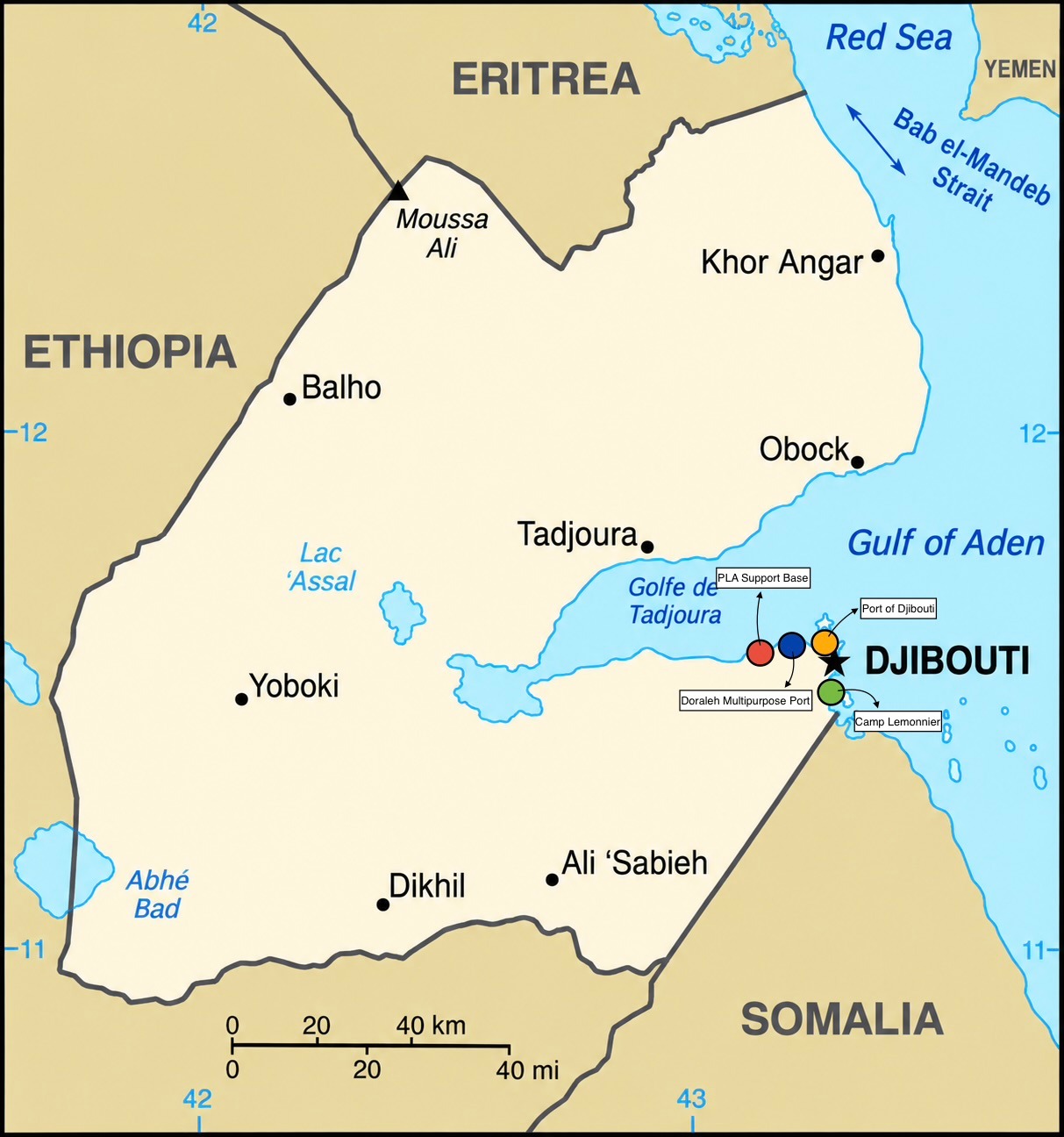
Source: Base map adapted from Central Intelligence Agency, The World Factbook, “Djibouti,” 2004, public domain, accessed via archived World Factbook page hosted by IIASA, https://user.iiasa.ac.at/~marek/fbook/04/print/dj.html. Additional locations plotted and cross-checked for this report using Lauren Ploch Blanchard, “China’s Engagement in Djibouti,” Congressional Research Service, updated June 6, 2025; Djibouti Ports and Free Zones Authority, “Doraleh Multipurpose Port”; U.S. Navy, “Camp Lemonnier, Djibouti”; and Port de Djibouti. Map adapted and annotated by Jordan J. A. Rezende De Lucia.
Why China’s Presence in Djibouti Matters
China’s presence in Djibouti shows how Beijing’s economic, diplomatic, and military interests can overlap outside East Asia. Djibouti’s position beside the Bab el-Mandeb gives it strategic importance. It sits next to the Bab el-Mandeb Strait, which connects the Red Sea to the Gulf of Aden and Western Indian Ocean. Ships moving between Europe and Asia through the Suez Canal generally have to pass through the strait, making it an important part of international trade and energy transportation. According to the U.S. Energy Information Administration (EIA), petroleum flows through the Bab el-Mandeb reached approximately 8.1 million barrels per day during the second quarter of 2026, compared with 5.6 million barrels per day during the previous quarter (EIA, 2026a).
The amount of traffic moving through the strait has changed significantly because of conflict in the region. That instability itself shows why access and security around the waterway matter. When the Red Sea becomes unsafe, ships can travel around the Cape of Good Hope instead, but doing so increases travel time, fuel use, and costs. The consequences therefore extend beyond whichever countries are directly involved in a conflict and can affect countries much farther away (EIA, 2026b).
Djibouti has also become unusual because several major militaries operate from such a small area. The United States, France, Italy, Japan, and China maintain military facilities there. China’s People’s Liberation Army (PLA) opened its support base in 2017, making it China’s first acknowledged overseas military base. The facility is located next to the Doraleh Multipurpose Port. A subsidiary of the Chinese state-owned China Merchants Group also holds a 23.5 percent stake in the Port of Djibouti, and the PLA facility sits only a few miles away from the U.S. military’s Camp Lemonnier (Blanchard, 2025). Figure 1 shows where these facilities and the major ports are located in relation to Djibouti City and the surrounding region.
Djibouti is not a NATO member, and NATO does not maintain the same permanent role in the Red Sea that it does in the North Atlantic or Europe. However, NATO Allies depend on maritime routes in and around the region for trade, energy, military movement, and access between Europe and the wider Indian Ocean. NATO’s 2025 Alliance Maritime Strategy specifically identifies maritime access, freedom of navigation, secure sea lines of communication, critical maritime infrastructure, and maritime situational awareness as important parts of Alliance security. The strategy also identifies China’s expanding naval capabilities and increasing global reach as having potential implications for NATO maritime power (North Atlantic Treaty Organization [NATO], 2025).
The most direct exposure examined in this report concerns individual NATO Allies with forces or maritime interests in the region rather than a standing NATO operation in the Red Sea. NATO’s connection is broader, through Alliance interests in freedom of navigation, secure sea lines of communication, maritime awareness, and the ability to move forces between regions (Council of the European Union, 2026; NATO, 2026).
This distinction is important because simply saying that China has a military base next to an important waterway does not automatically make the base a direct threat. Capability and intent are not the same thing. Aspen Bilal makes a similar distinction in the NAVI Research Institute paper “2027” when examining China’s military modernization. Increasing military capability can give China more options without proving that its leadership has already decided to use those capabilities in a particular conflict (Bilal, 2026). The same idea can be applied to Djibouti.
The research question guiding this report is therefore: What risks does China’s presence in Djibouti create for NATO Allies’ maritime security in the Red Sea and Gulf of Aden?
This report argues that China’s presence creates several long-term and conditional risks for NATO Allies rather than one immediate military threat. The most important are China’s ability to sustain naval forces farther from its own territory, the possibility of collecting intelligence on nearby military activity, its growing military and economic influence around a major maritime chokepoint, and the additional options this position could give China during a future crisis. These risks become more important when China’s military presence is looked at alongside its commercial investments and broader relationship with Djibouti.
Djibouti’s own interests also complicate the situation. Its government has repeatedly worked with competing outside powers and has its own political and economic reasons for doing so. Because of this, the risk to NATO Allies cannot be understood by treating every Chinese investment as a military project or every military activity as evidence that China is preparing for confrontation. The more important question is what capabilities China has developed, how those capabilities are currently being used, and how their importance could change if the security environment around the Red Sea becomes worse.
Literature Review
Earlier research helps explain why China established a permanent military presence in Djibouti. Downs et al. (2017) connect the development of the base to China’s counter-piracy operations, expanding overseas interests, and its growing economic relationship with Djibouti. Cabestan (2020) places the base within China’s broader effort to extend the PLA’s ability to operate outside East Asia, particularly as competition with the United States has increased. Both studies suggest that the facility developed from years of expanding military and economic activity rather than from one immediate security concern.
The relationship between commercial infrastructure and military operations is another important part of the research. Kardon and Leutert (2022) argue that China’s overseas port investments can support military logistics and intelligence collection during peacetime. However, they also identify limits on how useful commercial ports may be during a war, especially when China does not control the host country’s decisions. Vertin (2020) examines similar concerns in Djibouti and the Red Sea, while also cautioning against assuming that every Chinese commercial investment has a hidden military purpose. This is particularly relevant to the Doraleh area, where Chinese economic interests and military infrastructure exist close to one another.
Djibouti’s own interests also need to be considered. Woldearegay (2026) argues that the country has used its location and relationships with outside powers to maintain political and economic leverage. This complicates the idea that greater Chinese investment automatically gives Beijing control over Djibouti’s decisions. This report builds on those studies by examining the risks to NATO Allies operating in the region and the developments that could make those risks more serious.
Methodology and Sources
This report uses a qualitative case-study approach based primarily on open-source information. The research examines China’s military, economic, and diplomatic presence in Djibouti and how those areas connect to maritime security in the Red Sea, Gulf of Aden, and Western Indian Ocean.
The main sources include assessments and documents from NATO, the U.S. Department of Defense, the Congressional Research Service (CRS), the International Monetary Fund (IMF), European institutions, and Chinese government and military sources. Peer-reviewed research and reports from established research organizations are used to compare different explanations of China’s presence. Recent reporting is also included when developments occurred too recently to appear in academic research.
Using sources from different countries is important because no single government provides a completely neutral description of what China is doing. Chinese military sources, for example, can verify that a naval task force used the Djibouti base or that Chinese and Djiboutian forces conducted an exercise. However, China’s explanation of why an activity took place should still be compared with other evidence. The same is true for U.S. government assessments, which provide important information about Chinese capabilities but come from another country involved in strategic competition with China.
Because of this, the report does not attempt to determine China’s intentions from one source or one activity. Instead, the report compares documented activities, assessed capabilities, and possible effects on Allied operations. Where accounts disagree, such as the 2018 laser incidents, it presents both positions and identifies what remains uncertain. The assessment uses evidence available through September 2026. Open-source research cannot reveal every classified intelligence capability at the base, internal PLA contingency plans, or private agreements between China and Djibouti.
Strategic Context
The Bab el-Mandeb and Allied Logistics
Djibouti’s strategic importance begins with its geography. The Bab el-Mandeb is the southern entrance to the Red Sea and one of the main maritime connections between the Mediterranean, Middle East, and Indian Ocean. If that route becomes too dangerous, vessels can instead travel around the southern coast of Africa, but the alternative adds considerable time and cost.
Recent events have already shown how quickly this can happen. Attacks against commercial shipping beginning in late 2023 caused large numbers of vessels to avoid the Red Sea. The resulting changes in shipping patterns show how quickly regional instability can affect one of the world’s major maritime routes (EIA, 2026b).
Renewed fighting in Yemen in September 2026 raised concerns about security around the Bab el-Mandeb and forced thousands of people to flee, including some who crossed into Djibouti. On September 18, the International Organization for Migration reported that at least 112,000 people had been displaced inside Yemen and nearly 3,000 had crossed by sea into Djibouti (Le Poidevin, 2026). The conflict does not involve China’s base directly, but it increases the strategic importance of military forces positioned around the strait.
The importance of the Bab el-Mandeb goes beyond energy transportation. The Center for Strategic and International Studies (CSIS) describes the Bab el-Mandeb as a roughly 20-mile-wide chokepoint and cites an estimate that about 16 percent of global maritime trade passes through it (Funaiole et al., 2026). This means that disruption around the strait can affect commercial shipping on a global scale while also creating problems for military forces that depend on the same regional ports, airfields, and sea routes.
Djibouti also plays a direct logistical role for at least some NATO Allies. France maintains approximately 1,500 military personnel there, and its forces use Djibouti as a strategic support point between Africa and the Indo-Pacific (Ministère des Armées et des Anciens combattants, 2025). In July 2026, French forces also used an A400M to move cargo between Djibouti and Abu Dhabi in support of French forces operating in the Middle East (Ministère des Armées et des Anciens combattants, 2026). This gives a more concrete example of why access around Djibouti and the Bab el-Mandeb matters for Allied military logistics, not only for commercial shipping.
This matters to NATO Allies for more than commercial reasons. The Alliance Maritime Strategy specifically connects maritime security with the ability to move military forces, maintain sea lines of communication, protect infrastructure, and keep access to important maritime areas. NATO also identifies attacks against commercial shipping, piracy, and threats to critical maritime infrastructure as challenges that can undermine freedom of navigation (NATO, 2025).
Djibouti’s Strategic Leverage
Djibouti’s importance has led several outside countries to establish a military presence there, but this does not mean the country has simply chosen one side of growing competition between China and Western states. More recent research argues that Djibouti has been able to use its geographic position and relationships with outside powers as a source of leverage. Tewodros Woldearegay describes Djibouti as a small state operating inside a much larger U.S.-China rivalry while still trying to maintain its own interests (Woldearegay, 2026). By allowing several foreign militaries to operate there and maintaining economic relationships with different countries, Djibouti has gained revenue, infrastructure, diplomatic attention, and security cooperation.
This is important because discussions about China’s involvement in Djibouti are sometimes reduced to the idea of a Chinese “debt trap.” There are legitimate concerns surrounding Djibouti’s debt. The IMF assessed the country’s overall and external public debt as being in distress and unsustainable in 2025, and Djibouti has had to negotiate a debt-service moratorium with China’s Export-Import Bank. However, its debt is spread across multiple creditors, and the government continues to work with countries that compete directly with China (International Monetary Fund, 2025; Woldearegay, 2026). The economic relationship gives Beijing influence, but the available evidence does not show that Djibouti has simply surrendered control of its foreign policy to China.
China’s economic position in the country is still significant, however. Chinese financing has supported large infrastructure projects, and Chinese firms are involved in port, railway, telecommunications, and other sectors. Vertin (2020) emphasizes that Djibouti has its own interests and warns against overstating China’s control over the country. Still, China’s investments matter because its economic, military, and diplomatic relationships with Djibouti can support one another over time.
The Doraleh area is a good example. A Chinese state-owned company holds a stake in the country’s port system while the PLA base is located directly next to the Doraleh Multipurpose Port (Blanchard, 2025). The adjacent military and commercial facilities are part of China’s wider economic relationship with Djibouti, although proximity alone does not establish PLA control of commercial operations.
The Doraleh Container Terminal dispute also shows how Djibouti can make decisions that affect foreign commercial interests. In February 2018, the Djiboutian government terminated its agreement with Dubai-based DP World and took control of the Doraleh Container Terminal. The decision resulted in several legal disputes, with international arbitration rulings supporting DP World’s claims. However, Djiboutian officials have maintained that they do not intend to transfer control of the terminal to China. The Doraleh Container Terminal is separate from the Doraleh Multipurpose Port located beside the PLA base. This distinction matters because Djibouti’s ability to change commercial arrangements does not automatically mean those changes are made on China’s behalf (Blanchard, 2025; U.S. Department of State, 2024).
Djibouti maintains relationships with several competing powers, so understanding the risks to NATO Allies requires looking at how China actually uses its military base in the region.
China’s Presence in Djibouti
China’s military presence in Djibouti did not begin with the construction of the base itself. The People’s Liberation Army Navy (PLAN) began counter-piracy operations off Somalia in 2008. Chinese forces later participated in evacuations of Chinese citizens from Libya and Yemen, while China also increased its peacekeeping involvement and economic activity throughout Africa and the Middle East. These missions created a practical need for resupply and support much farther away from Chinese territory. China signed a defense agreement with Djibouti in 2014, construction of support facilities began in 2016, and Chinese military personnel first deployed to the base in 2017 (Blanchard, 2025).
Jean-Pierre Cabestan argues that the Djibouti facility has to be understood as part of China’s larger effort to expand the PLA’s ability to operate overseas. Rather than serving only one purpose, the base can support counter-piracy missions, protection of Chinese citizens and investments, military diplomacy, logistics, and other operations depending on what happens in the region (Cabestan, 2020). This flexibility is one of the reasons the base matters more than a simple refueling location.
The physical capabilities of the base have also expanded. CRS reports that the base includes barracks, hangars for unmanned aerial vehicles and helicopters, a tarmac, an underground facility, and a pier assessed as likely capable of accommodating major naval vessels. A PLAN Marine Corps element of approximately 400 personnel is also based there according to Department of Defense reporting (Blanchard, 2025; U.S. Department of Defense, 2025). These facilities give Chinese forces a permanent location from which they can support operations in the Red Sea, Gulf of Aden, and wider Indian Ocean.
Current Use and Military Activity
This does not mean China is already using Djibouti as the equivalent of a major wartime base. The Department of Defense’s 2025 China Military Power Report gives a more limited picture of how the facility has actually been used. As of 2024, the Pentagon assessed that the base had only minimal participation in protecting Chinese citizens and investments, had not supported the ongoing Red Sea crisis, and had instead primarily enabled a persistent regional presence through counter-piracy activity and increasing military diplomacy (U.S. Department of Defense, 2025).
There are several possible explanations for why China did not use the base more extensively during the Red Sea crisis. China may have decided that direct involvement was unnecessary, had other military priorities, or wanted to avoid becoming more involved in the conflict. It is also possible that the base still had operational limitations. However, the available evidence does not establish which explanation was most important. Its limited role during that period should therefore not be treated as proof that China could not use the facility differently during another crisis.
More recent activity demonstrates how the facility supports a persistent naval presence. On August 11, 2026, the PLAN hospital ship Auspicious Ark arrived at the base for a technical stop. China’s Ministry of National Defense stated that the ship would replenish supplies and provide medical services for personnel at the base and China’s 48th naval escort task force (Zhang et al., 2026).
Less than a month later, China’s 48th and 49th naval escort task forces conducted their mission handover at the Djibouti base. The 49th task force then assumed responsibility for escort operations in the Gulf of Aden and waters off Somalia, and the two forces also conducted joint escort and patrol operations (Ministry of National Defense of the People’s Republic of China, 2026). These are normal military activities rather than evidence of preparation for conflict with NATO. However, they directly show why the base is useful. China can rotate forces, replenish them, support personnel, and maintain naval operations thousands of miles away from Chinese territory without depending completely on commercial facilities.
China’s relationship with the Djiboutian military has also developed. In April 2025, Chinese and Djiboutian forces conducted four days of joint training. According to China’s Ministry of National Defense, the exercise included unmanned aerial vehicle reconnaissance, coordinated artillery fire, armored vehicle maintenance, counterterrorism scenarios, field operations, and battlefield medical support (Wang et al., 2025). Once again, this does not mean Djibouti has chosen China over the other countries maintaining military forces there. It does show that the relationship now includes direct military training and cooperation in addition to China’s use of the base itself.
The proximity of Chinese and American forces has also created friction in the past. In May 2018, the U.S. Department of Defense reported several incidents involving lasers directed toward American aircraft operating near Djibouti. Two U.S. Air Force personnel suffered minor injuries, and American officials stated that they believed Chinese nationals were responsible. The United States formally protested the incidents, but China’s Ministry of National Defense denied the accusations. Although responsibility remains disputed, the incident demonstrates that concerns about military activity near the bases are not entirely hypothetical (Garamone, 2018; Xinhua, 2018).
Communications and Intelligence
More recently, the base appears to have developed capabilities beyond basic naval logistics. On September 17, 2026, researchers at the Center for Strategic and International Studies (CSIS) published an analysis of commercial satellite imagery showing upgrades to communications infrastructure at the facility. According to the researchers, the PLA installed new equipment that can improve internal and long-distance military communications while also enabling potential signals intelligence collection (Funaiole et al., 2026).
This development is particularly important for NATO Allies because Djibouti hosts several foreign militaries and sits close to military and commercial activity moving through the Red Sea and Gulf of Aden. Better communications allow China to support forces operating farther away from the base, while intelligence capabilities could improve China’s awareness of activity throughout the region (Funaiole et al., 2026).
There are limits to what satellite imagery can show. The equipment is consistent with a possible intelligence role, but the imagery cannot confirm what China is collecting or whether Allied forces are being monitored (Funaiole et al., 2026).
These capabilities also create practical concerns for nearby Allied forces. Stronger communications discipline, communications security, operational security surrounding deployments, and greater awareness of what information can be collected electronically could reduce the amount of useful information available to a foreign intelligence service. These measures would not remove the risk, but they could make intelligence collection more difficult and reduce unnecessary exposure.
A facility initially explained largely around logistics, counter-piracy, and protection of overseas interests now supports a wider range of military activities. It can assist naval deployments, support personnel, host military cooperation with Djibouti, improve communications with Chinese forces operating farther away, and potentially contribute to intelligence collection. Together, these activities give Beijing more options during a crisis without establishing an intention to target NATO Allies.
NATO and Individual Allied Exposure
NATO has operated in this region before. From August 2009 to December 2016, Operation Ocean Shield contributed to international counter-piracy efforts in the Gulf of Aden and waters off the Horn of Africa. NATO forces helped protect shipping, deter piracy, and cooperate with other maritime security operations. Although the mission ended in 2016, it demonstrates that NATO’s interest in maritime security around Djibouti is not limited to commercial shipping or theoretical concerns about access (NATO, 2022).
Individual NATO Allies are already involved in regional maritime security. Italy, France, the United States, and other Allies maintain interests or forces in and around Djibouti (Blanchard, 2025). European countries also participate in maritime operations intended to protect commercial shipping through the European Union’s Operation ASPIDES (Council of the European Union, 2026). Italy’s defense minister, for example, called on September 18, 2026, for a larger naval presence in the Red Sea as renewed fighting in Yemen increased threats to navigation. Italy already contributes to the European Union’s Operation ASPIDES and is considering additional national action (Amante, 2026).
NATO does not currently have a standing naval operation in the Red Sea. Its maritime activities include Operation Sea Guardian in the Mediterranean, while the European Union conducts Operation ASPIDES and Operation Atalanta. These distinctions are important because the most direct exposure in Djibouti concerns individual NATO Allies with regional forces and interests. NATO’s broader role concerns maritime security, freedom of navigation, information sharing, and the ability of Allied forces to operate across regions (Council of the European Union, 2026; NATO, 2026).
The European Union’s maritime operations also provide opportunities for cooperation. In March 2026, the Council of the European Union updated the mandates of Operations ASPIDES and Atalanta. The changes included additional responsibilities involving maritime information sharing and critical submarine infrastructure, while ASPIDES was also given a role in training Djiboutian maritime forces. These developments create practical opportunities for NATO Allies to improve regional awareness and cooperation without assuming that the EU operations are commanded by NATO (Council of the European Union, 2026).
Rula Jabbour (2026) discusses how regional competition and instability affect NATO’s southern security interests in her article “Proxy Wars Without End.” China’s presence in Djibouti raises a related concern because it gives Beijing a permanent military position near maritime routes used by NATO Allies.
China’s permanent presence in Djibouti provides the infrastructure needed to support sustained naval operations in the region, particularly during periods of instability. However, the risks this creates for NATO Allies depend on how those capabilities are used. The following assessment looks at the evidence supporting each risk, how it could affect Allied operations, and what changes would be worth monitoring.
Risk Assessment
Not every risk connected to China’s base in Djibouti is supported by the same amount of evidence. Some activities, such as naval rotations and military training, are already documented. Other concerns, particularly restrictions on Allied access during a crisis, remain possibilities rather than confirmed developments. Table 1 separates what is currently known from the effects these risks could have on Allied operations.
Table 1 uses three categories to describe the current evidence: Observed, Potential, and Conditional. Observed means the activity is already documented. Potential means there is evidence supporting a possible capability or risk, but its actual use or effects remain uncertain. Conditional means the risk would depend on additional developments, such as changes in access agreements or a major regional crisis. The potential severity is assessed separately. Low means limited disruption, Moderate means additional security or logistical challenges, and High means substantial restrictions on Allied access or military operations. These are qualitative assessments based on available evidence, not predictions of hostile Chinese action.
Changes in Chinese activity also need to be compared with what has already been documented. This assessment uses escort-task-force rotations, replenishment stops, joint military training, and existing infrastructure reported through September 2026 as its starting point. However, the available sources do not provide a complete record of routine activities at the base. Because of this, a single additional ship visit or piece of communications equipment should not automatically be treated as evidence of a growing threat. More significant warning signs would include sustained changes in Chinese operations or developments that directly affect Allied access, operational security, or freedom of movement.
These four risks are separate, but they can also reinforce one another. Sustained naval operations and intelligence capabilities could provide China with additional military options, while political influence could affect how those options are used. The final risk, constraints on Allied freedom of action during a crisis, represents a possible consequence if several of these developments occurred together. This does not mean that one risk will automatically lead to the next.
Sustained Chinese naval presence is already documented, with the base supporting naval operations and personnel rotations. Its potential severity is assessed as Moderate because increased naval activity could require additional monitoring, operational security, and logistical planning from nearby Allied forces. There is currently no clear evidence that Chinese naval operations are directly disrupting Allied missions. Still, a sustained increase in deployments, larger combat vessels, or new operational missions could make this risk more serious, particularly during a regional crisis (Blanchard, 2025; Ministry of National Defense of the People’s Republic of China, 2026).
The communications infrastructure identified by CSIS could support signals intelligence collection, but the available evidence does not establish exactly what China is collecting or whether Allied forces are being targeted. The potential severity could increase during a crisis if intelligence collection gave Chinese forces a clearer understanding of Allied movements or communications. Additional equipment would be worth monitoring, but its installation alone would not prove hostile intelligence activity (Funaiole et al., 2026).
Restrictions on Allied access remain a conditional risk. China’s military and economic ties with Djibouti are significant, but they do not mean that Beijing controls Djibouti’s decisions. For this risk to become more serious, Djibouti would have to make decisions that limited Allied access or provided China with additional military privileges. Economic incentives, security concerns, and diplomatic pressure could influence those decisions, but Djibouti also has reasons to preserve its relationships with other countries operating there. The most important indicators would therefore be actual changes in access agreements or operating privileges rather than new Chinese investments alone (Blanchard, 2025; Woldearegay, 2026).
There is currently limited evidence of Chinese efforts to restrict Allied operations from Djibouti. This makes restrictions on Allied freedom of action a conditional crisis risk rather than an observed development. The potential impact could become High if worsening regional security and tensions between China and NATO Allies resulted in major restrictions on Allied access, movement, or military operations. Under those conditions, an increased Chinese military presence, intelligence activity, or changes in access arrangements could complicate Allied operations.
For near-term monitoring, sustained Chinese naval activity and potential intelligence collection deserve the most attention because there are already observable capabilities and activities to follow. Influence over access and crisis-time restrictions are more conditional, making them important for longer-term monitoring and contingency planning rather than evidence of an immediate confrontation.
Table 1. Risk Assessment of China’s Presence in Djibouti
| Risk | Current Evidence | Potential Severity | Indicators |
| Sustained Chinese Naval Presence | Observed | Moderate: possible security and logistical burdens | More frequent PLAN visits to Djibouti, larger or more capable ships using the base, expansion of logistics or aviation facilities, or a noticeable increase in Chinese military activity supported from Djibouti |
| Intelligence Collection and Operational Awareness | Potential | Moderate; potentially High if intelligence exposure significantly disrupts operations | New or expanded communications equipment, additional antenna systems, more infrastructure that could support intelligence collection, or credible evidence that the base is being used more directly to monitor foreign military activity |
| Influence and Access Around the Bab el-Mandeb | Conditional | Moderate if changes to access agreements affect Allied operations | Changes to foreign basing agreements, new limits on Allied access, arrangements that give Chinese forces greater access or privileges, or new infrastructure agreements that increase China’s military options in Djibouti |
| Crisis-Time Constraints on Allied Freedom of Action | Conditional | High if Allied access or military operations are substantially restricted | A rapid increase in Chinese deployments, unusual resupply or logistics activity, major changes in security around the base, or Chinese military activity that goes beyond normal escort and support missions |
Note. This assessment is based on available open-source evidence through September 2026. The evidence categories distinguish documented activities from potential and conditional risks. Indicators should be compared with China’s normal activity in Djibouti and evaluated based on their possible effects on Allied operations. An increase in military capability does not automatically indicate hostile intent. The assessment should be updated as new evidence becomes available.
Crisis Scenario
Consider a future crisis in which shipping through the Red Sea becomes more dangerous while relations between China and NATO Allies also deteriorate. This is a hypothetical scenario rather than a prediction, but it shows how several of the risks discussed above could become more serious at the same time. Renewed conflict around the Red Sea could cause another major increase in military and commercial activity around the Bab el-Mandeb. U.S. and French forces would already have infrastructure in Djibouti, while European naval forces could also be operating in the region to protect commercial shipping. China would have its own permanent base operating in the same environment.
China would not have to attack or directly interfere with Allied forces for its presence to matter. Improved communications and potential signals intelligence capabilities could provide the PLA with a better understanding of force movements and operating patterns around the strait. China’s ability to resupply and rotate its own forces would allow it to maintain a presence throughout the crisis. If relations between China and NATO Allies were also deteriorating, Allied planners could face less operational secrecy and greater uncertainty about Chinese activity.
Political relationships could also affect how different countries experience a regional maritime crisis. In March 2024, reporting indicated that Houthi representatives had given China and Russia assurances that their ships would not be targeted while passing through the Red Sea and Gulf of Aden. These assurances did not guarantee safe passage, as later attacks on ships carrying Russian commodities demonstrated (Longley et al., 2024). However, the episode shows how regional political relationships can create different security conditions for different countries using the same maritime routes. It does not establish that China’s military base in Djibouti influenced Houthi decisions (Dagher & Hatem, 2024; Longley et al., 2024).
This scenario is not a prediction that China will use its base against NATO Allies. It shows how capabilities that appear limited during normal conditions could become more important when regional instability and wider strategic competition occur at the same time.
Conclusion and Policy Implications
China’s presence in Djibouti has given the PLA a permanent position near one of the world’s important maritime routes. The most immediate findings concern China’s ability to maintain naval operations and the expansion of its communications infrastructure. Intelligence collection, political influence, and restrictions on Allied access remain more uncertain, but they could become more significant if regional instability and strategic competition worsened at the same time. The main concern is therefore not that China’s base presents one immediate threat to NATO Allies, but that its capabilities provide Beijing with additional options under changing conditions.
Several practical measures could help NATO Allies prepare for these risks without assuming that China intends to act against them.
Allies with forces in Djibouti, particularly the United States and France, should prioritize communications security, operational security, and alternative arrangements for military logistics. These measures would help reduce unnecessary exposure and dependence on any single facility during a crisis.
NATO Allies should monitor changes in Chinese naval activity around Djibouti, particularly increases in ship visits, new military infrastructure, or activities that differ from China’s normal operations. Sharing this information through existing Alliance channels could help Allied forces identify developments that might affect their operations.
NATO Allies should also work with the European Union’s Operations ASPIDES and Atalanta to improve maritime awareness in the region. Where existing arrangements allow, sharing information on shipping disruptions, changes in naval activity, and threats to maritime infrastructure could help both NATO Allies and EU forces respond to developments around the Red Sea and Gulf of Aden.
Allied governments maintaining relationships with Djibouti should continue diplomatic and security cooperation with the Djiboutian government. Preserving access and maintaining strong relationships with Djibouti may be more useful than assuming every Chinese investment represents a loss of Allied influence.
These findings show why NATO Allies should continue monitoring China’s activities in Djibouti without assuming that confrontation is inevitable. Maintaining strong communications security, reliable logistics, and cooperation with Djibouti will be important for protecting Allied operations as conditions in the region change.
References
Amante, A. (2026, September 18). Italy’s minister calls for more ships to protect Red Sea navigation. Reuters. https://www.reuters.com/world/middle-east/italys-minister-calls-more-ships-protect-red-sea-navigation-2026-09-18/
Bilal, A. (2026, March 14). 2027. NAVI Research Institute. https://nato-veterans.org/nato-2027/
Blanchard, L. P. (2025, June 6). China’s engagement in Djibouti (IF11304). Congressional Research Service. https://www.congress.gov/crs_external_products/IF/PDF/IF11304/IF11304.6.pdf
Cabestan, J.-P. (2020). China’s military base in Djibouti: A microcosm of China’s growing competition with the United States and new bipolarity. Journal of Contemporary China, 29(125), 731–747. https://doi.org/10.1080/10670564.2019.1704994
Central Intelligence Agency. (2004). Djibouti [Map]. The World Factbook. https://user.iiasa.ac.at/~marek/fbook/04/print/dj.html
Council of the European Union. (2026, March 30). Maritime security: Council updates mandates of EU naval operations ASPIDES and ATALANTA. https://www.consilium.europa.eu/en/press/press-releases/2026/03/30/maritime-security-council-updates-mandates-of-eu-naval-operations-aspides-and-atalanta/
Dagher, S., & Hatem, M. (2024, March 21). Yemen’s Houthis tell China, Russia their ships won’t be targeted. Bloomberg News. https://news.bloomberglaw.com/international-trade/yemens-houthis-tell-china-russia-their-ships-wont-be-targeted
Djibouti Ports and Free Zones Authority. (n.d.). Doraleh multipurpose port. https://dpfza.gov.dj/facilities/DMP
Downs, E., Becker, J., & deGategno, P. (2017). China’s military support facility in Djibouti: The economic and security dimensions of China’s first overseas base. CNA. https://www.cna.org/analyses/2017/china-military-support-facility-in-djibouti
Funaiole, M. P., Hart, B., Powers-Riggs, A., & Comstock, D. (2026, September 17). Extended range: China upgrades its military base in Djibouti. Center for Strategic and International Studies. https://features.csis.org/hiddenreach/china-djibouti-base-upgrade/
Garamone, J. (2018, May 3). U.S. protests Chinese interference with U.S. planes in Djibouti. U.S. Department of Defense. https://www.defense.gov/News/News-Stories/Article/Article/1511708/us-protests-chinese-interference-with-us-planes-in-djibouti/
International Monetary Fund. (2025). Djibouti: 2025 Article IV consultation (IMF Country Report No. 25/276). https://www.imf.org/en/publications/cr/issues/2025/09/22/djibouti-2025-article-iv-consultation-press-release-and-staff-report-570614
Jabbour, R. (2026, March 12). Proxy wars without end: How regional rivalries reshape NATO’s southern strategy. NAVI Research Institute. https://nato-veterans.org/proxy-wars-without-end-how-regional-rivalries-reshape-natos-southern-strategy/
Kardon, I. B., & Leutert, W. (2022). Pier competitor: China’s power position in global ports. International Security, 46(4), 9–47. https://doi.org/10.1162/isec_a_00433
Le Poidevin, O. (2026, September 18). Yemen conflict displaces 112,000 people inside country, thousands flee to Djibouti, UN migration agency says. Reuters. https://www.reuters.com/world/middle-east/yemen-conflict-displaces-112000-people-inside-country-thousands-flee-djibouti-un-2026-09-18/
Longley, A., Thornber, E., & Quinn, A. (2024, July 25). Russian commodities aren’t safe in Red Sea as Houthis attack. Bloomberg News. https://www.bloomberg.com/news/articles/2024-07-25/russian-commodities-aren-t-safe-in-red-sea-as-houthis-attack
Ministère des Armées et des Anciens combattants. (2025, April 22). Déploiement des armées françaises dans le monde. https://www.defense.gouv.fr/en/node/17781
Ministère des Armées et des Anciens combattants. (2026, July 23). Point de situation des opérations du jeudi 16 au jeudi 23 juillet 2026. https://www.defense.gouv.fr/en/node/24764/
Ministry of National Defense of the People’s Republic of China. (2026, September 7). 48th and 49th Chinese naval escort task forces conduct mission handover. https://eng.mod.gov.cn/2025xb/D/V/16484246.html
North Atlantic Treaty Organization. (2022, May 19). Counter-piracy operations (2008–2016). https://nato.int/en/what-we-do/operations-and-missions/counter-piracy-operations-2008-2016
North Atlantic Treaty Organization. (2025, October 29). Alliance maritime strategy. https://www.nato.int/en/about-us/official-texts-and-resources/official-texts/2025/10/29/alliance-maritime-strategy
North Atlantic Treaty Organization. (2026, May 20). NATO operations and missions. https://www.nato.int/en/what-we-do/operations-and-missions/nato-operations-and-missions
Port de Djibouti. (n.d.). Port de Djibouti: At the cross road of three continents. https://www.portdedjibouti.com/
U.S. Department of Defense. (2025). Military and security developments involving the People’s Republic of China 2025: Annual report to Congress. https://media.defense.gov/2025/Dec/23/2003849070/-1/-1/1/ANNUAL-REPORT-TO-CONGRESS-MILITARY-AND-SECURITY-DEVELOPMENTS-INVOLVING-THE-PEOPLES-REPUBLIC-OF-CHINA-2025.PDF
U.S. Department of State. (2024). 2024 investment climate statements: Djibouti. https://2021-2025.state.gov/reports/2024-investment-climate-statements/djibouti/
U.S. Energy Information Administration. (2026a, August 12). Global energy security data. Short-Term Energy Outlook. https://www.eia.gov/outlooks/steo/report/energysecurity/article.php
U.S. Energy Information Administration. (2026b, March 3). World oil transit chokepoints. https://www.eia.gov/international/content/analysis/special_topics/World_Oil_Transit_Chokepoints/
U.S. Navy. (n.d.). Camp Lemonnier, Djibouti. https://cnreurafcent.cnic.navy.mil/Installations/Camp-Lemonnier-Djibouti/
Vertin, Z. (2020, June). Great power rivalry in the Red Sea: China’s experiment in Djibouti and implications for the United States. Brookings Institution. https://www.brookings.edu/articles/great-power-rivalry-in-the-red-sea/
Wang, Z., Han, L., & Meng, X. (2025, May 5). PLA support base in Djibouti carries out joint training with Djiboutian military. Ministry of National Defense of the People’s Republic of China. https://eng.mod.gov.cn/xb/News_213114/TopStories/16384298.html
Woldearegay, T. (2026). Small state, big stakes: Djibouti’s strategic leverage in the post-Cold War in Sino-American rivalry. Comparative Strategy, 45(3), 399–422. https://doi.org/10.1080/01495933.2025.2603347
Xinhua. (2018, May 4). China refutes US allegation of laser use in Djibouti. https://www.xinhuanet.com/english/2018-05/04/c_137156345.htm
Zhang, Y., Zhang, G., Mi, P., Yu, K., Meng, X., Zhang, Y., & Zhou, J. (2026, August 12). Auspicious Ark makes technical stop at PLA support base in Djibouti. Ministry of National Defense of the People’s Republic of China. https://eng.mod.gov.cn/2025xb/D/V/16479039.html

Jordan Rezende De Lucia is an honors student at Embry-Riddle Aeronautical University pursuing a Bachelor of Science in Homeland Security and Intelligence, with minors in Global Conflict Studies and Military Science. He is an Intern with the NAVI Research Institute’s Regional Security Studies program, where he conducts international security research and contributes to NAVI Radar Weekly. His broader research interests include transatlantic security, civil-military relations, foreign military activity, and emerging security threats.